A Canadian homeowner scrolling through Instagram may not be looking for a mortgage broker today. However, six months later, when their mortgage renewal approaches, they might remember the professional who explained how renewal offers work. Similarly, a first-time buyer could discover a mortgage agent through a short video about down payments, follow their content for several weeks, and eventually contact them for financing guidance.
This is where social media marketing for mortgage brokers becomes valuable. It creates opportunities to build familiarity, demonstrate expertise, educate potential borrowers, and maintain relationships long before someone is ready to submit a mortgage application.
However, posting mortgage rate announcements, generic financial tips, and occasional property photographs is not enough to create a reliable marketing system. Canadian mortgage professionals need content that addresses genuine borrower concerns, a distribution strategy suited to their target audience, and a clear process for turning online interest into qualified enquiries.
In this guide, we’ll explore how mortgage brokers, agents, and lenders can use social media effectively, which platforms deserve attention, what content to publish, how to manage campaigns, and how to measure results while respecting Canadian mortgage advertising regulations.
Why Social Media Marketing Matters for Canadian Mortgage Professionals
Mortgage transactions are important financial decisions, and potential borrowers rarely choose a professional based on a single advertisement.
Before contacting a broker, someone may research qualification requirements, compare financing options, ask friends for recommendations, and look for professionals who can explain complicated subjects clearly.
Social media allows mortgage professionals to participate in that research process.
A mortgage broker in Toronto might publish an explanation of fixed and variable mortgage features. An agent serving Calgary could discuss common first-time buyer questions. A brokerage in Vancouver might create educational videos addressing refinancing costs or financing considerations for self-employed borrowers.
Each piece of content helps potential clients understand what the professional knows and how they communicate.
Unlike search advertising, where the consumer often expresses a specific need through a keyword, social media frequently reaches people before they actively begin searching for financing.
This changes how mortgage businesses should approach content.
Someone watching a video about mortgage renewals may not need assistance immediately. However, the information can establish familiarity that becomes useful when their mortgage term approaches expiration.
Social media also provides an opportunity to maintain visibility among existing clients and professional referral contacts.
The objective should therefore extend beyond immediate lead generation. Strong mortgage social media strategies support awareness, education, trust, enquiries, and client retention.
Choosing the Right Social Media Platforms for Mortgage Brokers
Not every platform deserves the same investment. Mortgage professionals should select channels based on the audience they serve, the type of information they can communicate effectively, and the resources available for content production.
A platform that generates substantial video views may not necessarily produce suitable mortgage enquiries. Similarly, a smaller professional audience can be valuable when the objective is to develop referral relationships.
Facebook: Local Communities and Homeowner Engagement
Facebook can be useful for reaching homeowners, participating appropriately in local communities, and distributing educational mortgage content.
Mortgage professionals can publish articles, explanatory videos, community event announcements, and answers to common borrowing questions.
For example, a broker serving Mississauga could publish a post explaining what homeowners should review before accepting a mortgage renewal offer.
The content could discuss changes in payment expectations, mortgage features, and the potential costs of switching lenders.
A relevant call to action might direct readers to a more detailed educational resource.
Facebook Groups can also provide community engagement opportunities, but brokers should respect group rules and avoid turning every discussion into a sales pitch.
Responding to legitimate questions with useful general information can be more effective than repeatedly posting advertisements.
Instagram: Educational Reels and Visual Explanations
Instagram is particularly suitable for communicating information through short videos, carousels, and accessible visual content.
Mortgage terminology can be intimidating, especially for consumers entering the housing market for the first time.
A short Reel explaining the difference between mortgage pre-approval and final approval may help clarify an important misconception.
Other useful topics include down payment considerations, common mortgage application mistakes, renewal preparation, and refinancing costs.
The creative approach matters.
Instead of opening with a generic introduction such as “Hello, I’m a mortgage broker,” begin with the question that concerns the audience.
For example:
“Your mortgage renewal offer has arrived. Should you sign it immediately?”
The remainder of the video can explain why homeowners should review the terms, compare appropriate options, and understand any relevant costs before making a decision.
A clear opening creates a reason to continue watching, while the explanation provides the substance that builds credibility.
LinkedIn: Professional Relationships and Referral Development
LinkedIn serves a different purpose from consumer-focused social media platforms.
Mortgage professionals can use it to establish professional credibility, share industry insights, and develop relationships with real estate agents, accountants, financial planners, and other relevant professionals.
The content should reflect the concerns of those audiences.
A post explaining how financing conditions affect a property transaction may interest real estate professionals. An article discussing mortgage documentation considerations for business owners may be relevant to accountants and their clients.
Rather than repeatedly requesting referrals, mortgage professionals can demonstrate their knowledge through useful explanations and thoughtful participation in industry discussions.
LinkedIn also offers advertising opportunities, although financial products and services are subject to platform-specific restrictions.
YouTube: Detailed Mortgage Education
Some mortgage subjects require more explanation than a short social media post can provide.
YouTube can accommodate detailed educational videos about mortgage qualification, refinancing, interest rate structures, and the financing process.
A video explaining how mortgage renewals work in Canada may remain relevant to borrowers well beyond its publication date, although time-sensitive information should be updated.
Video content can also support website articles. Embedding a relevant explanation within a mortgage service page provides readers with another way to understand the subject.
The priority should be accuracy and clarity rather than unnecessary production complexity.
A knowledgeable mortgage professional explaining a topic clearly can provide more value than an elaborate video that avoids answering the central question.
Social Media Marketing for Mortgage Agents: Building a Recognizable Professional Presence
Mortgage agents often work within larger brokerages while developing their own client relationships and professional reputations.
Their marketing needs can differ from those of a national lending institution.
An individual agent may benefit from emphasizing their professional knowledge, communication approach, service areas, and the mortgage situations they commonly assist with.
However, personal branding should not create confusion about the licensed brokerage responsible for the services.
In Ontario, the Financial Services Regulatory Authority of Ontario (FSRA) requires mortgage advertising to clearly identify the authorized brokerage and its licence number. When an individual broker or agent is named, the licensed name and approved title must also be used.
These requirements apply to public-facing promotional materials, including online content.
Develop Content Around Your Professional Strengths
An agent primarily helping first-time homebuyers should not automatically publish the same content as an experienced professional who works extensively with refinancing or complex borrowing circumstances.
The audience needs different information.
For example, an agent focusing on first-time buyers might explain how lenders evaluate income, why pre-approval does not guarantee final financing, and what expenses buyers should consider beyond the down payment.
An agent who frequently works with self-employed applicants could publish educational content about documenting income and preparing for a mortgage assessment.
The purpose is not to claim that one agent can guarantee better outcomes. It is to demonstrate an understanding of the questions their audience is likely to ask.
Show the Professional Behind the Business
Mortgage decisions involve personal financial information, so borrowers want confidence in the people helping them.
Professional introduction videos, educational discussions, and explanations of the consultation process can make an agent more approachable.
Authenticity is useful, but it should not come at the expense of professionalism.
Avoid sharing confidential application details, identifying clients without appropriate permission, or presenting hypothetical outcomes as actual completed transactions.
A genuine explanation of how a broker approaches mortgage questions is more credible than an invented success story.
12 Practical Social Media Content Ideas for Mortgage Brokers
Content planning becomes easier when topics are organized around actual borrower concerns rather than whatever is trending on a particular platform.
The following ideas can form the foundation of a useful monthly content calendar.
| Content idea | Recommended format | Reader benefit |
| Fixed vs. variable mortgages | Carousel or video | Understand mortgage features and risks |
| Preparing for mortgage renewal | Short video | Know what to review before renewing |
| First-time buyer down payments | Educational carousel | Understand common preparation requirements |
| Pre-approval vs. final approval | Reel | Avoid a common borrowing misconception |
| Refinancing costs | Explainer video | Recognize possible penalties and expenses |
| Self-employed mortgage documents | Checklist | Prepare for application discussions |
| Mortgage portability | Short article or video | Explore what may happen when moving |
| Common closing expenses | Carousel | Plan beyond the property down payment |
| Mortgage prepayment privileges | Educational post | Understand repayment flexibility |
| Bank of Canada rate announcements | Timely explainer | Understand possible mortgage implications |
| Questions to ask a mortgage broker | Checklist | Prepare for a productive consultation |
| Mortgage renewal mistakes | Video or carousel | Identify issues worth reviewing early |
These topics should be adapted to the professional’s actual services and the Canadian jurisdictions they serve.
For example, a post explaining a federal mortgage rule should distinguish national requirements from lender-specific policies or provincial considerations.
Similarly, content discussing interest rates should clearly identify when the information was accurate.
The goal is to make mortgage decisions easier to understand, not to oversimplify them.
How to Create a Mortgage Social Media Content Strategy That Generates Leads
Publishing relevant information is important, but content alone does not automatically produce qualified enquiries.
Mortgage professionals need a structure that connects what people learn on social media with the services they may eventually require.
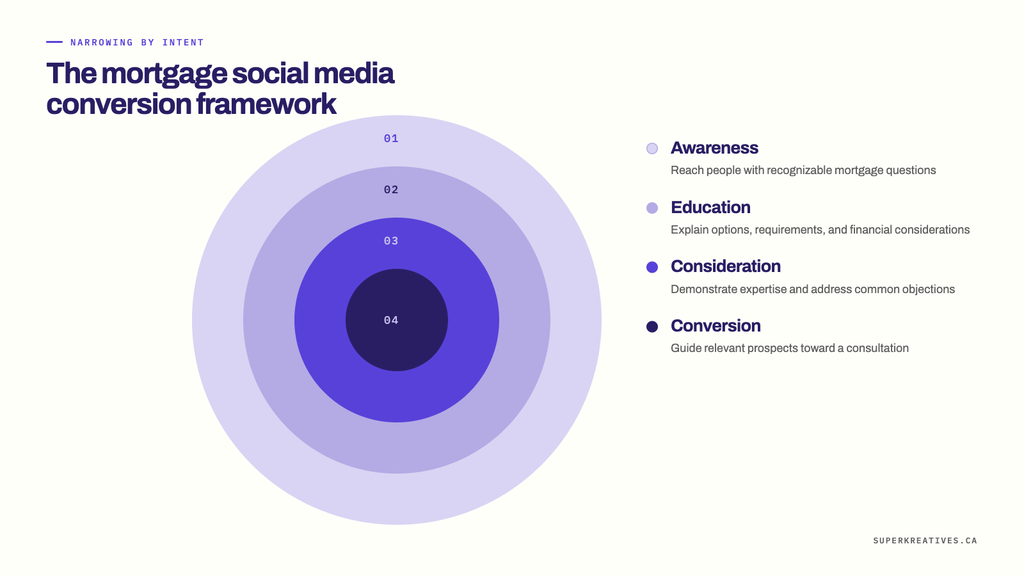
At SuperKreatives, we recommend organizing mortgage social media content around four stages: awareness, education, consideration, and conversion.
Awareness: Address Questions People Recognize
Awareness content introduces topics that resonate with prospective borrowers.
A video titled “Three Things to Check Before Renewing Your Mortgage” is likely to be more relevant to homeowners than a generic promotional post announcing that mortgage services are available.
The opening should explain why the subject matters. However, it should not create unnecessary anxiety or make unsupported financial claims.
Education: Explain the Subject Properly
Once the audience recognizes the problem, provide enough information to be useful.
If the content discusses refinancing, explain that borrowers may need to compare potential benefits against penalties, legal expenses, and other costs.
A post that merely states “Refinancing Could Save You Money” does not adequately explain the decision.
Educational quality is particularly important in financial services because incomplete information can lead consumers to misunderstand risks.
Consideration: Build Confidence Through Relevant Expertise
At this stage, potential borrowers may compare professionals, review licensing information, read educational resources, or explore the brokerage’s website.
Content should help them understand the professional’s approach, the services offered, and what to expect during a consultation.
An explanation of the application process may be useful. A short introduction to a licensed mortgage professional can also help establish familiarity.
Avoid treating follower counts or attractive branding as substitutes for professional credentials.
Conversion: Make the Next Step Clear
When someone needs individual guidance, the next action should be straightforward.
A post about mortgage renewal could direct readers to an appropriate landing page explaining the service and offering a consultation request.
The landing page should reflect the social media message rather than sending everyone to a generic homepage.
Initial enquiry forms should avoid collecting more sensitive financial information than necessary. Detailed documentation can be requested through appropriate secure processes later.
This creates a better connection between content, user expectations, and lead generation.
Social Media Marketing for Mortgage Lenders: How the Strategy Differs
A lender’s marketing priorities may differ significantly from those of an independent mortgage broker.
Brokers may emphasize personalized assistance, mortgage comparisons where appropriate, and guidance through different financing possibilities. Lenders generally promote their own products, lending criteria, customer experience, and distribution channels.
This difference should influence content planning.
A mortgage lender may publish educational information about its mortgage products, repayment features, application process, or borrower eligibility requirements.
A lender working with mortgage brokers may also develop professional content explaining documentation requirements, available programs, and how its application process operates.
Consumer-Focused Content for Mortgage Lenders
Consumer-facing posts should explain product characteristics clearly.
For example, a lender promoting a particular mortgage term should identify the relevant product features and explain that eligibility depends on applicable lending requirements.
Posts about interest rates need particular care. Rates may vary based on product type, borrower qualification, down payment, loan-to-value ratio, and other conditions.
An advertised rate should not be presented as universally available if material restrictions apply.
Broker-Focused Content for Mortgage Lenders
Business-to-business content serves a different audience.
Mortgage brokers may be interested in lender policy updates, documentation expectations, service processes, and product availability.
LinkedIn, professional webinars, and approved educational content can be useful for this type of communication.
The objective is to improve professional understanding rather than simply promote lender branding.
A lender might explain how a particular application category is assessed, what supporting information is commonly required, or how brokers should submit enquiries.
Such content should remain consistent with current lending policies and receive appropriate internal approval.
Marketing Strategies for Banks and Financial Mortgage Social Media
Banks and financial institutions generally operate with larger audiences, more established brands, and additional internal governance requirements.
A social media campaign for a bank may require coordination among marketing, product, legal, compliance, information security, and customer service teams.
This makes the approval process considerably different from that of an individual mortgage agent.
Balance Brand Awareness With Financial Education
Banks can use social channels to explain financial products, clarify common borrowing questions, and direct consumers toward official resources.
However, promotional content should not replace important product information.
For example, a campaign about mortgage affordability should not imply that every prospective borrower qualifies for the same financing amount.
Instead, the content can explain that affordability assessments depend on income, debts, property characteristics, and lender requirements.
Establish Clear Approval and Escalation Procedures
Financial institutions need defined responsibilities for reviewing content before publication.
A marketing team may produce the creative material, but relevant product specialists should verify lending information. Compliance reviewers should assess advertising claims and disclosures.
Customer service teams also need guidance for responding to public questions without disclosing personal information.
If someone comments publicly about their mortgage application, the response should not reveal their financial circumstances. Where necessary, the institution can direct them toward an authenticated support channel.
Adapt National Campaigns to Regional Requirements
Canada is not a single uniform regulatory market for every mortgage marketing activity.
Provincial differences in professional licensing, consumer protection, and mortgage services obligations may affect how certain advertisements must be presented.
For example, British Columbia’s BC Financial Services Authority published social media conduct guidance for mortgage services licensees on July 29, 2026. Its advertising guidance also addresses how brokerage identification should appear on social media profiles.
National campaigns should therefore be reviewed for the jurisdictions and business models involved rather than assuming one disclosure format is sufficient everywhere.
Social Media Marketing Management Platform for Mortgage Loan Officers: What to Look For
Managing several social accounts becomes difficult when content creation, publishing, enquiries, and approvals are handled manually.
A social media marketing management platform for mortgage loan officers can centralize some of these activities, but the required features depend on the size and structure of the organization.
A sole mortgage professional may only need scheduling, analytics, and an organized content calendar.
A larger brokerage or financial institution may require multiple user permissions, approval workflows, audit records, and integrations with other business systems.
Content Scheduling and Calendar Management
Scheduling features allow teams to prepare posts in advance and maintain a consistent publishing rhythm.
A calendar should distinguish educational content, promotional campaigns, announcements, and time-sensitive market updates.
Scheduled content must still be reviewed before publication. A mortgage rate announcement prepared weeks earlier may no longer be accurate when its publishing date arrives.
Approval Workflows and Access Controls
Brokerages employing several agents may require supervisory review of public-facing materials.
The software should allow authorized reviewers to check advertisements, verify required disclosures, and request changes before publishing.
Role-based access is also valuable because not every team member needs permission to modify account settings or approve regulated content.
Analytics and Enquiry Management
Useful reporting features include reach, engagement, link clicks, and campaign-specific traffic.
Some platforms also help consolidate social messages into a shared inbox.
However, mortgage professionals should be cautious about storing sensitive borrower details in ordinary social media inboxes or third-party marketing dashboards.
Private financial information should be handled through suitable authorized systems.
Content Archiving and Compliance Records
For organizations subject to applicable recordkeeping requirements, preserving approved content and relevant communications can be important.
The platform should support the organization’s actual record retention and supervisory obligations.
Do not assume that a basic posting history provides every record a mortgage brokerage or financial institution may need.
Comparing Social Media Marketing Management Software for Mortgage Loan Officers
There are several established platforms worth evaluating. However, a tool designed for general social media scheduling is not automatically a complete compliance solution for Canadian mortgage businesses.
| Platform | Relevant capabilities | Best suited for |
| Hootsuite | Scheduling, analytics, team workflows, and enterprise compliance options | Larger brokerages and financial organizations |
| Buffer | Content planning, publishing, and performance reporting | Individual agents and smaller teams |
| Sprout Social | Publishing, reporting, engagement management, and collaboration features | Growing marketing teams and multi-account operations |
| Meta Business Suite | Native Facebook and Instagram publishing, messaging, and insights | Businesses primarily active on Meta platforms |
Hootsuite
Hootsuite is worth evaluating when an organization manages multiple accounts and needs structured approvals.
Its financial services offering describes customizable approval workflows, archiving options, access controls, and compliance-related integrations. The availability of particular capabilities depends on the selected product and agreement.
For a larger mortgage brokerage, these features may help establish consistent publishing processes across multiple agents.
However, organizations should verify that the system and any compliance integrations actually support their applicable Canadian obligations.
Buffer
Buffer can be a practical option for smaller teams that primarily need to plan and schedule content.
It can help organize educational posts and maintain a manageable publishing calendar without requiring an extensive enterprise system.
Before choosing it, confirm that the available plan includes the required accounts, reporting functions, and collaboration features.
Organizations with complex supervisory obligations should separately evaluate whether the product’s approval and recordkeeping capabilities are sufficient.
Sprout Social
Sprout Social is another option for teams seeking centralized publishing, engagement management, and reporting.
It may be appropriate for mortgage organizations operating several social accounts or coordinating marketing activity across different professionals.
The key consideration is whether its team workflows, integrations, and available controls align with the brokerage’s responsibilities.
Meta Business Suite
Meta Business Suite can serve businesses focused primarily on Facebook and Instagram.
It provides native tools for managing eligible connected accounts, publishing content, reviewing performance information, and handling supported messages.
For an individual mortgage professional, this may be sufficient as an initial management solution.
However, it should not be mistaken for specialized mortgage compliance software or a system designed to manage confidential borrower applications.
The best social media marketing platform for mortgage loan officers is the one that fits the business’s publishing, security, approval, and reporting requirements. Evaluate workflows through a demonstration rather than selecting software purely because it has a long feature list.
How to Use Paid Social Media Advertising for Mortgage Lead Generation
Organic content and paid advertising serve related but different purposes.
Organic content can build familiarity and demonstrate knowledge over time. Paid campaigns allow businesses to distribute selected messages to eligible audiences within the targeting options permitted by the advertising platform.
Mortgage professionals can use paid campaigns to promote useful educational resources, relevant services, or consultation opportunities.
For example, a brokerage might develop a campaign explaining mortgage renewal considerations and direct interested homeowners to a dedicated landing page.
The campaign should make clear what the user can expect after submitting an enquiry.
Meta Advertising for Mortgage Professionals
Facebook and Instagram advertising can support awareness and lead generation, but mortgage-related campaigns must follow Meta’s applicable financial-product advertising policies.
Advertisers should verify the current special-category requirements, permitted audience controls, and any advertiser verification obligations in the target market before launching.
Do not assume that detailed demographic or behavioural targeting is available for every mortgage campaign.
Creative messaging should also avoid claims that guarantee approval or imply knowledge of an individual’s financial situation.
For example, an advertisement should not suggest that the advertiser knows a particular user is experiencing debt problems unless the claim and targeting are appropriate and compliant.
LinkedIn Advertising for Mortgage Businesses
LinkedIn may be more appropriate when the intended audience includes professional partners or industry contacts.
A mortgage brokerage could promote an educational webinar discussing financing considerations for real estate professionals.
However, advertising financial products and services is subject to LinkedIn’s policies, and discriminatory targeting related to housing or credit is prohibited.
Campaign targeting should reflect legitimate business objectives without improperly excluding protected groups.
Send Paid Traffic to Relevant Landing Pages
A person clicking an advertisement about refinancing should arrive at a page that explains refinancing considerations, not a generic page listing every mortgage service.
The landing page should provide accurate information, identify the licensed business, and make the next step clear.
For initial enquiries, request only the information reasonably necessary to arrange a consultation or provide the promised resource.
The landing page and advertising campaign should also be reviewed together. A compliant advertisement can still create problems if the linked page contains misleading claims or inadequate disclosures.
A 30-Day Social Media Content Calendar for Canadian Mortgage Brokers
Consistency matters, but mortgage professionals do not need to publish multiple times every day to establish a useful presence.
A practical starting schedule might include three primary posts each week, supplemented by relevant responses, occasional Stories, and additional timely information where appropriate.
The following calendar provides an example of how to balance educational content, professional credibility, and business development.
| Week | Content theme | Suggested execution |
| Week 1 | First-time homebuyers | Pre-approval Reel, down payment carousel, common buyer questions |
| Week 2 | Mortgage renewals | Renewal preparation video, fixed vs. variable explainer, consultation process post |
| Week 3 | Refinancing and home equity | Refinancing cost carousel, educational video, mortgage feature explainer |
| Week 4 | Professional trust and engagement | Broker introduction, borrower FAQ, educational checklist or webinar promotion |
During the remaining days, the team can respond to legitimate enquiries, participate in appropriate professional discussions, review performance, and prepare future content.
A sustainable schedule is better than an aggressive publishing plan that becomes difficult to maintain.
Repurpose Content Across Platforms
A single well-researched mortgage topic can support several formats.
For example, an article about mortgage renewals can become an Instagram carousel outlining key considerations, a short Facebook video answering one question, a LinkedIn post discussing professional implications, and a longer YouTube explanation.
However, content should be adapted to each platform.
A LinkedIn article written for real estate professionals may not work effectively as an Instagram caption for first-time buyers.
The factual foundation can remain consistent while the presentation changes according to the audience.
Measuring Social Media Marketing Performance Beyond Followers
A large follower count may create an impression of success, but it does not necessarily indicate that a mortgage business is attracting suitable clients.
Likewise, a video with thousands of views may contribute little commercial value if most viewers are outside the professional’s service area or have no interest in the services offered.
Performance measurement should connect marketing activity with meaningful actions.
| Metric | What it tells you |
| Reach and impressions | How widely content is being distributed |
| Saves and shares | Whether audiences find information useful enough to retain or circulate |
| Profile and website visits | Whether content generates further interest |
| Enquiry submissions | How many people request information or assistance |
| Qualified consultations | Whether enquiries match relevant mortgage services |
| Applications | Whether consultations progress into mortgage applications |
| Funded mortgages | Whether attributed opportunities become completed business |
Consider a hypothetical campaign with the following results.
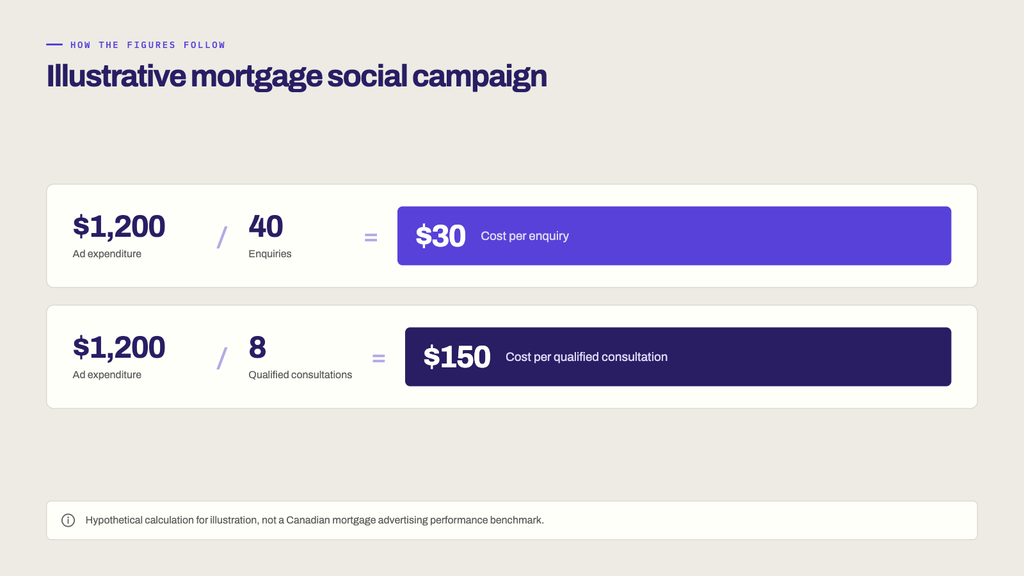
In this example, the cost per enquiry is $30, but the cost per qualified consultation is $150.
The second figure provides additional information because it accounts for the enquiries that did not progress to a suitable consultation.
A brokerage should continue tracking applications and funded mortgages where reliable attribution is available.
Some consumers may view content repeatedly before contacting the business through another channel, making precise attribution difficult. Combining website tracking, CRM records, and enquiry source information can provide a more useful picture than relying on platform reports alone.
Canadian Mortgage Social Media Advertising Compliance
Mortgage professionals operate in a regulated financial environment. Social media does not remove the obligations that apply to other forms of advertising.
Regulatory requirements vary by jurisdiction, professional licence, and business model.
Use Accurate Licensing and Brokerage Identification
Ontario’s FSRA requires regulated mortgage advertising materials to display the brokerage’s authorized name and licence number clearly and prominently.
If an individual broker or agent is identified, the licensed name and appropriate authorized title must also be used. False, misleading, or deceptive information is prohibited.
Similar questions about proper professional identification arise in other Canadian jurisdictions, although the precise requirements can differ.
A brokerage should establish approved profile formats, disclosures, and creative templates before delegating content production to individual agents.
Avoid Misleading Financial Claims
Mortgage advertising should not promise universal approval, guaranteed savings, or access to products without material qualification requirements.
Avoid phrases such as “Everyone Qualifies” or “Guaranteed Lowest Mortgage Rate” unless the claims can lawfully be substantiated and presented with all necessary qualifications.
Educational posts should also distinguish general information from an assessment of an individual’s financial circumstances.
Protect Client Confidentiality
Never publish identifiable borrower documents, mortgage application details, property information, or confidential communications without appropriate authorization.
Even an apparently anonymous case study can create privacy concerns if combined details make the borrower identifiable.
Use hypothetical examples when they are useful for education, and label them clearly.
Handle Promotional Direct Messages Carefully
Canada’s Anti-Spam Legislation (CASL) may apply to commercial messages sent through certain social media direct messaging systems.
The CRTC distinguishes general public social broadcasts from commercial messages sent directly to electronic addresses, which may include closed two-way social messaging accounts. Whether CASL applies depends on the platform and communication circumstances.
Mortgage professionals should avoid unsolicited mass promotional messaging and establish appropriate consent and compliance procedures before using automated outreach.
A 90-Day Social Media Growth Plan for Mortgage Professionals
The first three months should focus on establishing a reliable publishing and conversion process rather than attempting to dominate every social platform simultaneously.
| Timeline | Primary objective | Recommended activities |
| Days 1–30 | Build foundations | Audit social profiles, verify disclosures, define audiences, plan content themes, and establish tracking |
| Days 31–60 | Improve visibility | Publish educational content, test formats, strengthen engagement, and introduce carefully controlled advertising where appropriate |
| Days 61–90 | Improve lead quality | Review enquiries, optimize landing pages, improve follow-up, and invest more effort in the most relevant channels |
During the first month, determine which platforms the intended audience uses and what type of information they need.
An individual mortgage agent may begin with Instagram and Facebook. A brokerage focused on professional referrals may prioritize LinkedIn.
The second month should emphasize content consistency and audience engagement.
Analyze which topics encourage meaningful questions, profile visits, and website interactions. Where paid advertising is appropriate, begin with clearly defined campaigns rather than spreading the available budget across numerous unrelated objectives.
By the third month, focus on the relationship between social engagement and qualified enquiries.
If a campaign attracts attention but produces few consultations, review whether the audience, message, landing page, or follow-up process needs adjustment.
Ninety days can provide useful early insights, but it should not be treated as a guarantee of follower growth, leads, or funded mortgage volume.
Common Social Media Marketing Mistakes Mortgage Brokers Should Avoid
The first mistake is treating every post as an advertisement. Audiences have little reason to follow an account that repeatedly promotes services without explaining anything useful.
Another common mistake is copying generic mortgage content without adapting it to Canadian financing conditions. Advice developed for American borrowers may contain terminology, programmes, or qualification rules that do not apply in Canada.
Mortgage professionals should also avoid chasing engagement without considering audience relevance. A humorous video attracting thousands of views may contribute less business value than an educational post that reaches a smaller group of homeowners preparing for renewal.
Inconsistent communication is another concern. Posting frequently for two weeks and then disappearing for several months makes it harder to establish an ongoing professional presence.
Finally, businesses should not overlook the process that follows an enquiry. Social media cannot compensate for unresponsive communication, confusing appointment booking, or poor lead handling.
At SuperKreatives, we recommend evaluating the entire borrower journey, from the first impression through to the consultation and subsequent relationship, rather than treating social media as an isolated activity.
Final Thoughts: Build Trust Before Asking for the Mortgage Application
Successful social media marketing for mortgage brokers is not about posting more frequently than competitors or generating the highest number of video views.
It is about making relevant mortgage information accessible, demonstrating professional competence, and creating a reliable path for borrowers who need further guidance.
Canadian mortgage professionals can use Facebook and Instagram to explain common financing questions, LinkedIn to develop professional relationships, and YouTube to explore complex topics in greater detail.
A clear content strategy connects these platforms with relevant website resources, consultation opportunities, and client relationship management.
At SuperKreatives, our approach is to connect mortgage marketing activity with measurable business outcomes. A social media account should not exist merely to maintain an online presence. It should support a clearly defined audience, communicate useful information, and contribute to a broader client acquisition and retention process.
Start with the mortgage questions your audience genuinely needs answered. Choose the channels suited to those conversations, maintain accurate and compliant communication, and measure what happens after someone engages.
That is how social media can become a meaningful part of long-term mortgage business development.
Frequently Asked Questions
Is social media marketing for mortgage brokers effective in Canada?
It can help mortgage professionals establish visibility, educate borrowers, maintain client relationships, and generate enquiries. Effectiveness depends on the target audience, content relevance, consistency, advertising compliance, and conversion process. Results should be measured through qualified conversations and business outcomes rather than follower counts alone.
Which social media platform is best for mortgage brokers?
Facebook and Instagram are useful starting points for consumer education and local awareness. LinkedIn can support professional relationships and referral development, while YouTube is suitable for longer educational explanations. The best platform depends on the audience and the brokerage’s resources.
How often should mortgage agents post on social media?
Three thoughtful posts per week can provide a manageable starting schedule for many individual agents. The priority should be consistency, accuracy, and usefulness rather than achieving a particular publishing volume. Frequency can be adjusted based on audience response and available resources.
What is the best social media marketing management software for mortgage loan officers?
Options worth evaluating include Hootsuite, Buffer, Sprout Social, and Meta Business Suite. Smaller teams may prioritize scheduling and analytics, while larger organizations may need approval workflows, audit records, and stronger access controls. Software should be evaluated against actual business and regulatory requirements.
Can mortgage lenders generate leads through social media advertising?
Yes. Lenders can use eligible social advertising formats to reach relevant audiences and promote suitable financial products or educational resources. Campaigns must comply with platform advertising policies, applicable financial services regulations, and privacy requirements. Lead quality and completed business outcomes are more meaningful than click volume alone.
What type of social media content attracts mortgage clients?
Content addressing recognizable borrower concerns can generate useful engagement. Examples include mortgage renewal preparation, refinancing costs, first-time buyer guidance, pre-approval explanations, and common financing mistakes. The strongest topics are those that answer real questions and connect naturally with services offered.
Should mortgage brokers hire a social media agency?
An agency may be useful when a brokerage needs support with content strategy, production, paid advertising, reporting, or lead-generation systems. However, mortgage professionals should evaluate the agency’s understanding of Canadian mortgage advertising requirements and its ability to connect marketing activities with measurable business results.
How much should mortgage brokers spend on social media marketing?
There is no universal budget suitable for every brokerage. Expenditure depends on the service area, competition, business objectives, content production requirements, and available resources. Begin with a manageable test budget, account for both advertising and management costs, and evaluate qualified enquiries before increasing investment.