A mortgage broker receives an enquiry from a first-time homebuyer on Monday morning. The potential client completes an online form, but the broker is busy handling existing applications. By the time someone responds, the borrower may already have contacted another professional.
Meanwhile, three existing clients have mortgages approaching renewal, two applications require document follow-ups, and several previous borrowers haven’t heard from the brokerage since closing.
None of these problems necessarily indicates a lack of demand. They reveal gaps in communication, follow-up, and client relationship management.
This is where automated marketing for mortgage brokers can make a meaningful difference.
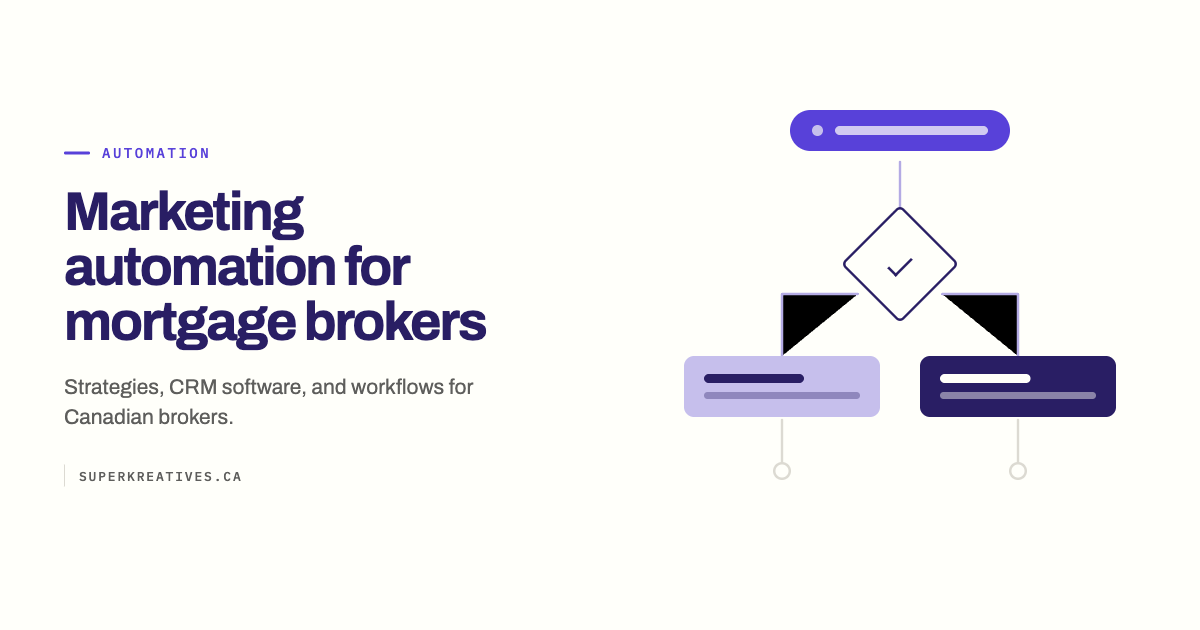
Marketing automation allows mortgage professionals to organize enquiries, deliver relevant communications, track important milestones, and maintain relationships without manually managing every interaction. When implemented correctly, it improves operational consistency while giving brokers more time for conversations that genuinely require professional judgment.
However, automation isn’t simply about sending more emails or purchasing sophisticated software. Canadian mortgage businesses must consider borrower privacy, accurate application information, marketing consent, provincial advertising rules, and the reliability of their data.
This guide explains how mortgage marketing automation works, which workflows deserve priority, how to compare CRM solutions, and how to build a practical system that supports qualified lead generation, mortgage renewals, and long-term business growth.
What Is Mortgage Marketing Automation?
Mortgage marketing automation refers to using connected software and predefined workflows to manage repetitive marketing and client communication activities.
Instead of remembering to contact every prospect manually, a broker can establish rules that trigger appropriate actions when a particular event occurs.
For example, when someone submits a consultation request, the system could create a contact record, notify the responsible broker, and send an acknowledgement explaining what happens next.
When an existing client’s mortgage approaches its recorded maturity date, the system could create a reminder for a renewal review.
Automation can also support educational newsletters, consultation scheduling, task assignments, and communication following verified mortgage application milestones.
The key distinction is that these processes respond to information or events recorded in the system.
How Mortgage Automation Differs From Traditional Marketing
Traditional mortgage marketing often depends on individual actions. Someone downloads an enquiry list, checks which clients need follow-ups, writes emails, and manually updates a spreadsheet.
This approach can work with a small number of clients, but maintaining consistency becomes more difficult as the business grows.
Automation reduces the need to repeat those administrative tasks.
Consider a hypothetical mortgage brokerage receiving 80 enquiries every month. If each enquiry requires several routine follow-ups, manually tracking every interaction can become difficult alongside application management and client consultations.
An organized system can ensure that enquiries enter the appropriate workflow, assigned team members receive notifications, and outstanding activities remain visible.
However, automation should not independently assess mortgage suitability, make lending decisions, or promise that an application will be approved.
Its appropriate role is to support the professionals responsible for those decisions.
Why Canadian Mortgage Brokers Need Marketing Automation
Mortgage businesses manage relationships over an unusually long period.
Some prospects contact a broker shortly before making an offer on a property. Others begin researching financing months before purchasing. Existing homeowners may not need another mortgage conversation until renewal or a significant financial change.
This creates a challenge: the business must maintain relevant communication without treating every contact as an immediate sales opportunity.
A properly configured automation system helps organize these different timelines.
Faster and More Consistent Enquiry Handling
Someone requesting information about mortgage pre-approval expects the brokerage to acknowledge their enquiry.
An automated response can confirm that the request was received and explain how to schedule a consultation.
The system can also notify the assigned mortgage professional.
This doesn’t replace the actual conversation. It reduces the chance that an enquiry remains unnoticed because a staff member is occupied with another task.
Better Application Communication
Borrowers frequently have questions about documents, lender reviews, conditions, and closing requirements.
CRM-connected workflows can support consistent communication when verified milestones occur.
For example, the system might notify a client when additional documentation has been requested.
Sensitive documents should still be exchanged through authorized, secure channels. An automated email should not expose confidential financial information unnecessarily.
More Organized Mortgage Renewal Management
Mortgage renewals create opportunities for brokers to maintain relationships with existing clients.
A reliable CRM can store relevant mortgage maturity dates and support reminders before those dates arrive.
Rather than relying on an employee to remember every renewal, the business can establish a structured review process.
The timing and content of promotional messages must still reflect valid consent and applicable Canadian requirements.
Improved Visibility Across the Brokerage
Automation also benefits managers who need to understand operational performance.
A centralized system can help show which enquiries are waiting for contact, which appointments are scheduled, and which client records require attention.
This information helps distinguish marketing problems from operational issues.
For instance, increasing advertising expenditure may be unnecessary if enquiries are already arriving but aren’t being followed up consistently.
Automated Mortgage Marketing Strategies Across the Client Lifecycle
Mortgage automation works best when it follows real borrower needs rather than a collection of disconnected promotional sequences.
At SuperKreatives, we recommend mapping the customer journey before selecting software.
A practical structure covers the period from initial enquiry through application, funding, ongoing relationships, and future financing conversations.
(Image)
1. New Lead Capture and Follow-Up Automation
The first workflow should address what happens when a potential borrower contacts the brokerage.
Leads may originate from Google Ads, organic search, social media campaigns, professional referrals, or website forms.
Where appropriate, these enquiries can enter a shared CRM with a recorded source and a responsible team member.
An initial acknowledgement should confirm receipt and explain what the prospect can expect next.
If a consultation has been scheduled, an appointment reminder may also be appropriate.
The system should distinguish an unanswered enquiry from someone who has already booked an appointment. Otherwise, the prospect may continue receiving irrelevant reminders after taking the requested action.
A well-designed workflow also creates an internal escalation when an enquiry has not received the required attention.
2. Educational Lead Nurturing
Not every borrower is ready for an immediate consultation.
Someone researching down payment requirements may still be saving for a property. Another prospect might be comparing refinancing considerations without having decided whether to proceed.
With appropriate marketing consent, educational sequences can support these audiences.
A first-time buyer sequence could explain the differences between pre-approval and final approval, common closing expenses, and questions to ask before applying.
A homeowner interested in refinancing could receive information about prepayment penalties, extending amortization, and evaluating total borrowing costs.
The goal is to help readers make informed decisions rather than repeatedly pressure them to book an appointment.
3. Mortgage Application Status Automation
Once an application begins, the focus should shift from promotion to accurate operational communication.
Messages can acknowledge the receipt of requested documents, identify outstanding information, or explain a verified next step.
However, application events must come from a reliable system or an authorized staff member.
A scheduled email should never announce final approval simply because a predetermined number of days has elapsed.
Different lenders, borrower circumstances, and mortgage products can involve different processes and timelines.
For this reason, transaction-based workflows need stronger safeguards than ordinary educational email sequences.
4. Post-Funding and Relationship Management
After a transaction closes, the system should stop application-related reminders.
A confirmed funding event can trigger appropriate internal record updates and post-closing communication.
The borrower may benefit from general information about mortgage payments, relevant contact channels, or important terms in their mortgage agreement.
Long-term promotional communication should remain separate and respect the client’s marketing preferences.
A client who declines newsletters should not be re-added to promotional campaigns simply because their mortgage has funded.
5. Mortgage Renewal Reminder Automation
Renewal reminders can be particularly useful when accurate maturity dates are available.
An illustrative workflow could create an internal review task approximately six months before the mortgage term expires.
The broker may then confirm the client’s circumstances and determine whether appropriate communication is warranted.
Further reminders can be scheduled closer to maturity, provided the information remains relevant and applicable communication permissions are in place.
If the client renews elsewhere, completes a new mortgage, or no longer wants promotional messages, the workflow should update accordingly.
This prevents a common automation failure: continuing to send messages about a financial decision the borrower has already completed.
Best Marketing Automation Software for the Mortgage Industry
The most suitable platform depends on whether a brokerage needs mortgage-specific operational integrations, general marketing automation, or both.
A mortgage CRM may manage borrower records, application stages, renewal dates, and client communication. A general marketing automation system may offer more flexibility for lead nurturing, campaigns, landing pages, and attribution.
These capabilities overlap, but they are not identical.
Before comparing products, determine which system will be responsible for maintaining accurate client and mortgage information.
Comparing Mortgage CRM and Marketing Automation Platforms
| Software | Primary strength | Best suited for |
| BluMortgage | Canadian mortgage workflows and deal-platform integrations | Brokerages using supported Canadian mortgage systems |
| HubSpot | CRM-connected marketing, segmentation, and campaign management | Businesses emphasizing digital lead generation and nurturing |
| Pipedrive | Pipeline management and rule-based sales automation | Smaller teams needing a customizable CRM |
| Zoho CRM | Configurable workflows, records, and third-party integrations | Teams prepared to configure their own processes |
These are examples of platforms worth evaluating, not a definitive ranking. Capabilities depend on subscription level, integrations, configuration, and the vendor’s current offering.
BluMortgage: Mortgage-Focused Automation
BluMortgage is designed for mortgage professionals and offers tools for deal management, lead follow-up, marketing communication, and renewals.
Its published documentation identifies integrations with Canadian mortgage platforms including Velocity, Filogix Expert, Finmo, and Scarlett DOS. It also describes customizable automated emails, tasks, and mortgage workflow templates.
This makes BluMortgage relevant for Canadian brokers whose existing application processes already depend on supported systems.
For example, rather than manually re-entering contact details from an origination platform into a marketing database, a supported integration can help synchronize relevant information.
However, the direction and timing of data synchronization vary by integration. Brokerages should confirm exactly which fields transfer and which events can trigger communications.
HubSpot: Digital Marketing and Lead Nurturing
HubSpot can be useful for mortgage businesses investing in website enquiries, downloadable resources, email campaigns, and digital advertising.
Its CRM and marketing products allow businesses to organize contact data and build workflows around relevant marketing interactions.
A brokerage could use it to distinguish new website enquiries from newsletter subscribers, segment educational content, and monitor consultation requests.
However, mortgage origination integrations should not be assumed.
If the brokerage needs application milestones or funding information inside HubSpot, it must verify whether the necessary integration exists and how information can be transferred securely.
Pipedrive: Sales Pipeline Management
Pipedrive focuses on organizing leads and managing sales activities.
Its automation capabilities support rule-based actions such as creating tasks, assigning responsibilities, and sending certain automated communications when CRM conditions are met. Feature availability depends on the subscription plan.
For a small mortgage team, this can provide a structured way to track enquiries and consultations.
However, a general sales pipeline does not automatically understand mortgage application stages, lender conditions, or financing workflows.
Those processes may need custom fields, integrations, and additional configuration.
Zoho CRM: Customizable Workflow Management
Zoho CRM provides workflow rules that can assign tasks, update fields, send notifications, and communicate with supported external applications.
Its flexibility can be useful for organizations with defined requirements and the technical resources to configure them.
A brokerage might build workflows for incoming enquiries, appointment scheduling, and internal follow-up tasks.
As with other general-purpose CRMs, mortgage-specific integrations, privacy controls, and operational suitability must be evaluated separately.
How to Choose the Best Mortgage Marketing CRM
Searching for the best mortgage marketing CRM can lead to long software comparisons, but feature counts rarely tell the whole story.
A brokerage should evaluate how the system handles its actual processes.
For example, if the team already uses Velocity for mortgage origination, direct integration may be more valuable than an extensive collection of generic email templates.
Conversely, a brokerage focused on digital acquisition may prioritize attribution, segmentation, and website integration.
A practical evaluation should cover five areas.
Data integration: Can the software connect with existing mortgage origination, website, and communication systems without excessive manual entry?
Workflow accuracy: Can it distinguish an enquiry from an application, a conditional approval from final approval, and a funded transaction from an active file?
Communication controls: Can staff manage marketing consent, unsubscribe preferences, message templates, and relevant approval processes?
Security and access: Does it provide appropriate permissions, audit capabilities, data safeguards, and reliable vendor documentation?
Operational value: Will the software reduce real administrative work, or will the team spend more time maintaining it than it saves?
A software demonstration should walk through an actual mortgage client journey. Ask the vendor to show what happens when a lead arrives, an appointment is booked, an application changes status, and a mortgage approaches renewal.
This provides more useful evidence than a feature checklist alone.
Mortgage CRM Comparison: POS, Marketing Automation, and Origination Systems
A common source of confusion is the difference between a CRM, a point-of-sale system, and a mortgage origination platform.
These systems may share information, but they serve different functions.
Here, POS refers to a mortgage point-of-sale system used to collect borrower information and support the initial application experience, not a retail payment terminal.
| System | Primary function | Example activity |
| Mortgage CRM | Manage contacts and relationships | Track enquiries, follow-ups, and renewals |
| Mortgage POS | Support borrower-facing intake | Collect application information and documentation |
| Mortgage origination system | Support application processing | Manage lender submissions and application progression |
| Marketing automation platform | Manage approved marketing communication | Send educational sequences and campaign follow-ups |
Some products combine several of these capabilities.
This matters when evaluating mortgage CRM comparison POS marketing automation requirements, because two vendors may advertise similar features while supporting very different workflows.
For instance, a CRM might store an application status entered manually. Another system may receive verified status updates from an origination platform.
Both can display the information, but their reliability and administrative requirements differ.
The most important question is which system holds the authoritative version of each record.
If information is duplicated across multiple tools, the brokerage needs clear rules for synchronization, ownership, and correcting conflicting records.
Mortgage Marketing Automation With Rate Data Integration
Rate data integration is a particularly sensitive area of mortgage automation.
Brokers may want to notify clients when relevant market conditions change or when a financing review could be worthwhile.
However, mortgage rates are not a single number that applies equally to every borrower.
Product type, term, borrower qualifications, property characteristics, and lender requirements can all influence the actual rate available.
The Bank of Canada explains that it influences mortgage rates but does not directly set them. Changes in its policy interest rate can affect variable-rate mortgages differently from fixed-rate mortgage pricing.
A system that simply copies the central bank’s policy rate into a promotional mortgage email risks giving consumers an inaccurate impression.
How Rate Data Automation Should Work
An appropriate system begins with a reliable and authorized source of rate information.
The data should identify what the rate represents, the effective date, the relevant product, and any material eligibility conditions.
The automation can then identify whether a relevant client segment should receive an educational update or whether a mortgage professional needs to review the opportunity.
For example, a change in rate information could create an internal task for a broker to review upcoming renewal cases.
This is safer than automatically sending every borrower a personalized savings promise.
Why Rate-Triggered Messages Need Safeguards
Rate information can become outdated or be interpreted incorrectly when important conditions are omitted.
A business should consider safeguards such as:
- Source verification: Confirm the data comes from an authorized provider, with appropriate terms for its use and redistribution.
- Product qualification: Identify relevant mortgage types, terms, and conditions rather than treating every borrower as eligible.
- Human approval: Require professional review before distributing messages that imply individual financial benefits.
- Data freshness: Prevent publication when a feed is unavailable, outdated, or inconsistent.
These controls are particularly important when automation connects directly with paid advertising, promotional emails, or public rate comparison pages.
A rate feed can support better-informed communication. It cannot independently determine whether refinancing, switching lenders, or choosing a particular mortgage is financially appropriate.
Understanding the Mortgage CRM Software Market in Canada
The mortgage CRM software market includes specialist mortgage platforms, general sales CRMs, marketing automation products, and connected origination tools.
This variety reflects the different needs of mortgage businesses.
An individual broker may primarily need contact records and renewal reminders. A growing brokerage may require automated lead assignment, multiple agent accounts, and shared operational visibility.
Larger organizations may prioritize integration architecture, compliance controls, access permissions, and reporting across multiple teams.
The market should therefore not be evaluated exclusively on subscription price.
A lower-cost product may require significant manual configuration. A more expensive mortgage-specific platform may reduce duplication if it connects directly with existing application software.
Equally, a brokerage with strong internal technical resources may find a configurable general CRM adequate for its requirements.
When comparing vendors, consider the full cost of implementation, migration, integration, training, ongoing administration, and support.
Avoid assuming that a provider’s advertised integration guarantees every required workflow is supported.
Canadian Compliance Requirements for Mortgage Marketing Automation
Automated communication can create compliance risks at scale.
A single poorly written email may mislead one borrower. An incorrectly configured workflow could send that same message to hundreds of recipients.
For Canadian mortgage businesses, compliance must therefore be incorporated into automation design before campaigns go live.
CASL: Consent and Promotional Communication
Canada’s Anti-Spam Legislation (CASL) generally requires businesses sending commercial electronic messages to have a valid basis for consent, provide appropriate sender identification, and include a functioning unsubscribe mechanism, subject to applicable exemptions.
The Canadian Radio-television and Telecommunications Commission (CRTC) explains that consent may be express or implied under specific circumstances. Implied consent can expire, and businesses relying on consent should maintain evidence supporting it. Unsubscribe requests generally must be honoured within 10 business days.
This has several implications for mortgage automation.
A person submitting a mortgage enquiry should not automatically enter an indefinite promotional sequence without an appropriate legal basis.
Operational communications about an existing transaction may receive different treatment under CASL, depending on the message’s content and the applicable exemption.
Brokerages should distinguish promotional messages from application-related communication and have the relevant workflows reviewed before launch.
Privacy and Borrower Information
Mortgage applications contain sensitive financial and personal information.
Canada’s federal privacy framework, including the Personal Information Protection and Electronic Documents Act (PIPEDA) where applicable, requires organizations to consider meaningful consent, appropriate purposes, and safeguards when handling personal information.
The Office of the Privacy Commissioner of Canada advises businesses to limit personal information collection to legitimate needs and to explain how information will be used or disclosed.
For automation, this means avoiding unnecessary transfers of borrower information between systems.
A marketing platform may need a client’s name, contact details, and relevant communication preferences. It generally does not need unrestricted access to tax returns, banking records, or identification documents merely to deliver a newsletter.
Also review provincial private-sector privacy laws where applicable, vendor access, data retention, and cross-border processing arrangements.
Mortgage Advertising and Professional Identification
In Ontario, the Financial Services Regulatory Authority of Ontario (FSRA) requires public-facing mortgage advertising to include the brokerage’s authorized name and licence number, along with required professional identification when an individual agent or broker is named.
The regulator also prohibits false, misleading, or deceptive information in mortgage-related public materials, including relevant email communications and websites.
Similar obligations may exist under other provincial regimes, although the details differ.
Automated templates should therefore be checked for appropriate identification, accurate claims, and the requirements of the jurisdictions being served.
Software does not make a message compliant merely because the sending process is automated.
How to Measure Mortgage Automation Performance
Marketing automation should make processes more reliable and improve meaningful business outcomes.
Tracking only the number of automated emails or messages sent provides little evidence of value.
A better approach is to measure how automation affects enquiry handling, consultation activity, application progression, and client retention.
| Performance metric | What to evaluate |
| Lead response time | How quickly new enquiries receive appropriate attention |
| Consultation booking rate | Whether enquiries progress to scheduled discussions |
| Qualified lead rate | Whether incoming prospects match offered services |
| Follow-up completion | Whether required actions occur consistently |
| Workflow error rate | Whether automations send incorrect, duplicate, or inappropriate messages |
| Renewal consultation rate | Whether eligible clients engage before maturity |
| Funded mortgage attribution | Whether tracked opportunities contribute to completed transactions |
Consider a hypothetical brokerage receiving 100 enquiries per month.
Before automation, only 60 receive timely follow-up, and 15 become suitable consultations.
After introducing a structured acknowledgement, assignment, and follow-up process, 95 enquiries receive timely attention and 23 become suitable consultations.
This example illustrates how better process consistency might improve opportunities. It does not establish that automation itself causes a particular conversion improvement.
Other factors, including lead quality, market conditions, staff capacity, and campaign targeting, can influence the result.
The brokerage should compare performance over appropriate periods and investigate whether the system is genuinely improving results.
A 90-Day Mortgage Marketing Automation Implementation Plan
Automation should be introduced gradually rather than attempting to redesign every brokerage process simultaneously.
A phased approach gives teams the opportunity to validate information, test communications, and identify technical problems before expanding the system.
| Timeline | Objective | Recommended actions |
| Days 1–30 | Prepare the foundation | Audit client data, map the lifecycle, verify permissions, select software, and establish workflow owners |
| Days 31–60 | Launch essential automation | Implement lead capture, assignment, acknowledgement, appointment reminders, and approved application notifications |
| Days 61–90 | Expand and optimize | Test renewal workflows, review campaign outcomes, audit data synchronization, and correct automation failures |
During the first month, prioritize data quality.
Duplicate contacts, outdated mortgage maturity dates, inconsistent application stages, and unclear communication permissions can undermine even sophisticated software.
The second month should focus on essential workflows with clear triggers and measurable outcomes.
Test what happens when an enquiry is duplicated, an appointment is cancelled, a client unsubscribes, or an application changes status unexpectedly.
By the third month, introduce more complex relationship management processes if the earlier workflows are reliable.
Each automation should have an owner, defined purpose, approved content, and a way to identify errors.
The aim is not to automate as much as possible within 90 days. It is to create a dependable system that can be expanded without compromising client experience.
Common Mortgage Marketing Automation Mistakes to Avoid
One frequent mistake is purchasing software before identifying the problem it must solve.
A brokerage struggling with missed enquiries may not need advanced artificial intelligence features. It may simply need dependable contact capture, assignment rules, and a consistent follow-up process.
Another mistake is confusing more communication with better communication.
An automated system that sends several reminders after a client has already responded may damage confidence rather than strengthen the relationship.
Poor data synchronization is equally problematic. If the CRM shows an application as pending after funding has been confirmed elsewhere, the wrong message could be sent.
Mortgage businesses should also avoid treating marketing consent as a permanent, universal permission. Communication preferences and applicable legal bases must be maintained as circumstances change.
Finally, automation should not replace professional judgment.
Mortgage suitability, financial advice, lending decisions, and sensitive borrower concerns require appropriate human involvement.
At SuperKreatives, our preferred approach is to automate the administrative steps surrounding the client relationship while protecting the decisions that require expertise, verification, and accountability.
Final Thoughts: Automate the Process, Not the Professional Relationship
Successful automated marketing for mortgage brokers is not about removing people from the mortgage journey. It is about reducing unnecessary administrative work so professionals can spend more time understanding borrower needs and providing appropriate guidance.
Canadian mortgage businesses can use automation to acknowledge enquiries, manage follow-ups, maintain application communication, organize renewal opportunities, and evaluate marketing performance.
However, these benefits depend on reliable information, sensible workflow design, suitable software, and consistent compliance oversight.
At SuperKreatives, we believe automation should begin with a practical question: where are prospective borrowers or existing clients experiencing avoidable gaps in communication?
Identify those gaps, determine which activities can safely be standardized, and connect the necessary systems.
Start with straightforward workflows, measure their reliability, and expand only when the foundations are working.
The right automation system should make mortgage marketing more responsive, more relevant, and easier to manage, without sacrificing the professional attention borrowers expect when making important financial decisions.
Frequently Asked Questions
What is automated marketing for mortgage brokers?
It involves using software to manage repetitive marketing and communication tasks based on predefined events or conditions. Examples include new enquiry acknowledgements, appointment reminders, educational email sequences, client follow-up tasks, and mortgage renewal notifications. Effective systems rely on accurate data and appropriate communication permissions.
What is the best marketing automation software for the mortgage industry?
There is no universally best platform. BluMortgage is worth considering for Canadian mortgage-specific integrations, while HubSpot, Pipedrive, and Zoho CRM provide general marketing or sales automation capabilities. The appropriate choice depends on existing software, required integrations, team size, security, and workflow complexity.
What features should a mortgage marketing CRM include?
A suitable CRM should support contact management, relevant mortgage lifecycle information, follow-up tasks, communication preferences, reporting, and appropriate integrations. Mortgage-specific systems may also provide renewal tracking and connections with origination platforms. Security and data accuracy should be central selection criteria.
Can mortgage brokers automate their renewal reminders?
Yes. When accurate maturity dates are available, a CRM can create tasks or send appropriately authorized communications before renewal. The workflow should update when the client renews, changes circumstances, or opts out of promotional communication. Automated reminders should support, not replace, individual mortgage reviews.
How does mortgage marketing automation with rate data integration work?
An authorized rate data source can feed current product information into a connected system. That information may support internal alerts or reviewed marketing communication. Because actual mortgage eligibility and pricing vary by borrower and product, rate-triggered campaigns should not automatically promise specific savings or approvals.
Is mortgage marketing automation legal in Canada?
Yes, provided the business complies with applicable laws and regulations. Relevant obligations may include CASL, federal or provincial privacy legislation, mortgage advertising rules, and requirements associated with particular communications. The legality of an automated message depends on its content, purpose, recipients, and circumstances.
What’s the difference between mortgage CRM software and marketing automation?
CRM software primarily organizes contacts, interactions, and relationship information. Marketing automation uses rules and triggers to deliver messages or perform repetitive campaign activities. Many modern platforms combine both functions, but their mortgage-specific operational capabilities can differ substantially.
Can a small mortgage brokerage benefit from automation?
Yes. Even a small team may benefit from reliable enquiry capture, appointment reminders, and renewal tracking. The key is to begin with a few high-value workflows rather than adopting complex software before the business has clear processes and accurate records.