A homeowner in Toronto searches Google for “mortgage renewal broker near me.” Within seconds, several mortgage businesses appear, offering consultations and information about renewal options.
Meanwhile, another homeowner in Calgary is scrolling through Instagram when a short video explains why accepting a mortgage renewal offer without reviewing its terms may not always be the right decision. The homeowner watches the video, saves it, and continues scrolling.
Both consumers have encountered mortgage advertising, but their intentions are different.
The first homeowner is actively looking for assistance. The second may not have considered contacting a mortgage professional until the advertisement introduced a relevant financial question.
This distinction is central to mortgage marketing advertising. Google Ads and Meta Ads can both help Canadian mortgage brokers reach prospective borrowers, but the platforms influence different parts of the decision-making journey.
Choosing between them should not come down to which platform generates cheaper clicks or the largest number of enquiries. The real question is which channel attracts borrowers who need the services your brokerage provides and can be converted into qualified consultations at a sustainable acquisition cost.
At SuperKreatives, we approach mortgage advertising by connecting platform decisions with borrower intent, campaign messaging, landing page performance, and downstream business outcomes.
This guide compares Google Ads and Meta Ads for Canadian mortgage professionals, explains when each platform makes sense, and provides a practical framework for evaluating advertising budgets, creative strategies, lead quality, and regulatory requirements.
Google Ads vs. Meta Ads: What’s the Actual Difference?
Google Search Ads primarily capture existing demand. Meta Ads, distributed across Facebook, Instagram, and other eligible placements, can introduce mortgage information to audiences before they actively search for a broker.
That distinction affects how borrowers interact with advertisements.
Someone searching Google for refinancing assistance has already expressed an interest through their search query. A person watching an Instagram video about refinancing costs may simply find the subject interesting.
Neither person should automatically be considered a qualified mortgage prospect.
The difference lies in the information available about their immediate intent.
| Comparison | Google Search Ads | Meta Ads |
| Discovery method | Search queries | Social feeds and eligible placements |
| Typical audience intent | Actively researching a subject or service | Browsing content, sometimes open to learning |
| Main creative formats | Search headlines, descriptions, assets | Videos, static images, carousels |
| Primary strength | Reaching existing demand | Building awareness and generating interest |
| Main challenge | Competitive queries and irrelevant clicks | Distinguishing curiosity from genuine financing needs |
| Suitable starting campaigns | Renewal, refinancing, mortgage broker enquiries | Educational campaigns, webinars, service awareness |
| Conversion approach | Relevant service landing page | Educational landing page, consultation or lead form |
These are general differences rather than fixed limitations. Meta can generate immediate enquiries, and Google offers campaign types extending beyond traditional Search Ads.
However, the comparison becomes more useful when campaigns are built around the same business objective.
For example, a brokerage wanting additional refinancing consultations could test Google Search campaigns against Meta advertisements focused on refinancing education.
Each channel may attract borrowers at a different stage of consideration, so performance should be compared using actual consultation quality rather than surface-level engagement alone.
Understanding Mortgage Advertising Opportunities in Canada in 2026
Canadian mortgage marketing needs to reflect the financial decisions borrowers are actually making.
A first-time buyer preparing a down payment requires different information from a homeowner approaching renewal. Someone considering refinancing may be concerned about debt restructuring, renovation expenses, or changes in monthly payments.
The Canada Mortgage and Housing Corporation (CMHC) 2026 Mortgage Consumer Survey gathered responses from more than 4,100 adults who had recently completed mortgage transactions.
Among respondents who searched online for mortgage information, 33% used interest rate comparison websites, 32% used mortgage broker websites, and 31% used lender websites. The survey also reported that 47% used social media for mortgage information, compared with 54% in 2025.
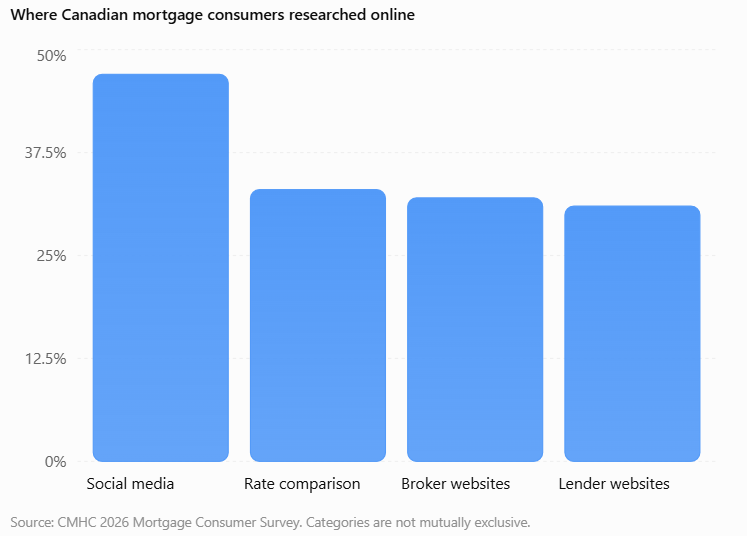
These figures do not establish whether Google Ads or Meta Ads delivers better advertising returns.
They do, however, demonstrate why mortgage businesses need more than a single acquisition channel. Borrowers may discover information through social content, compare available options online, and visit brokerage websites before contacting a professional.
Why Borrower Intent Matters More Than Platform Popularity
A mortgage broker serving homeowners in Edmonton may find that a renewal-focused Google campaign produces relevant consultation requests.
The same brokerage could use Instagram videos to explain mortgage renewal considerations and encourage homeowners to learn more.
Both activities can contribute to the same business objective, but their audiences may have different levels of readiness.
That should influence the language used in advertisements.
Search advertising can respond directly to an expressed service requirement. Social advertising may need to explain why the subject is relevant before presenting a consultation option.
Google Ads for Mortgage Brokers: When Search Advertising Works Best
Google Search advertising is especially useful when borrowers are already researching mortgage services.
Search queries can provide clues about the information or assistance someone wants.
A person searching “mortgage broker in Mississauga” may be looking for professional help. Someone searching “what is a mortgage prepayment penalty” is more likely seeking an explanation.
These searches should not automatically receive identical advertisements.
Structure Campaigns Around Mortgage Services
A practical Google Ads account can separate significant service categories such as mortgage renewals, refinancing, first-time buyer assistance, and self-employed borrower financing.
This makes it easier to develop relevant messages and evaluate how different audiences respond.
For instance, a renewal campaign could focus on homeowners interested in understanding their options before accepting a lender’s offer.
A refinancing campaign should instead address refinancing-related considerations, such as potential penalties, borrowing costs, and consultation services.
If the brokerage does not provide certain lending products, its campaign should not attract those enquiries through vague advertising.
Service-specific targeting also helps identify where the available budget is producing relevant conversations.
Create Landing Pages That Continue the Search Conversation
An advertisement is only the beginning of the conversion process.
Imagine someone searches for mortgage refinancing assistance, clicks an advertisement, and arrives on a homepage filled with unrelated information.
The visitor now has to find the refinancing section, evaluate the business, and determine how to request assistance.
A dedicated refinancing landing page removes some of those unnecessary steps.
It should explain the service, identify important financial considerations, display accurate professional credentials, and provide an accessible consultation request.
Avoid asking visitors for detailed financial documents before a suitable secure application process has been established.
Review Search Terms and Lead Quality
Mortgage-related keywords can attract visitors with different intentions.
For example, an advertisement may appear for searches involving mortgage calculators, careers, educational definitions, or services the brokerage doesn’t offer.
Search term reviews and suitable negative keywords can help reduce irrelevant expenditure.
However, keywords alone cannot establish whether a borrower is financially eligible.
The brokerage still needs a qualification process that distinguishes an initial enquiry from a suitable mortgage consultation.
Meta Ads for Mortgage Brokers: Creating Interest Before a Search Happens
Meta advertising requires the mortgage business to earn attention within a social environment.
Most users are not opening Instagram specifically to find mortgage financing.
They may be watching videos, communicating with friends, following local businesses, or browsing educational content.
A mortgage advertisement therefore needs to demonstrate relevance quickly.
Lead With Financial Questions Borrowers Recognize
An advertisement stating “We Offer Mortgage Services” provides little reason to stop scrolling.
A more useful opening would be:
“Your mortgage renewal offer has arrived. What should you review before signing?”
The advertisement could explain why mortgage terms, prepayment privileges, future payment expectations, and switching considerations deserve attention.
Another campaign might begin with:
“A lower monthly mortgage payment doesn’t necessarily mean lower borrowing costs.”
That message creates an opportunity to explain refinancing expenses, amortization, and penalties.
These approaches introduce financial considerations without guaranteeing a particular outcome.
Choose Creative Formats Based on the Explanation
Short videos can be effective when a broker needs to explain a single concept.
Carousels are useful for breaking down several related considerations, such as the steps involved in preparing for mortgage renewal.
Static images can communicate simple educational offers or invitations to relevant workshops.
The creative should be understandable without exaggerated claims.
A refinancing advertisement that promises substantial savings but omits important costs may attract attention while creating misleading expectations.
Use Lead Forms Carefully
Meta offers lead-generation formats that can allow users to submit information directly within supported platforms.
This may reduce the effort needed to make an enquiry, but it does not guarantee that the person is ready for a mortgage consultation.
An introductory form should clearly state which service is offered and what happens after submission.
The brokerage can then evaluate whether the enquiry is relevant.
Marketing teams should not collect unnecessary confidential financial information through ordinary lead forms.
The real measure of success is the progression from completed form to suitable professional conversation.
Mortgage Marketing Advertising Costs: Google Ads vs. Meta Ads
One of the most common questions from mortgage professionals is whether Meta Ads is cheaper than Google Ads.
The answer depends on what is being measured.
Meta may generate lower-cost form submissions in some campaigns, while Google Search may attract people with stronger immediate service intent.
But neither result is guaranteed.
Advertising costs differ across Toronto, Vancouver, Calgary, Edmonton, and other Canadian markets. Competition, campaign structure, auction conditions, landing page quality, and mortgage service specialization can all affect performance.
Why Cost per Lead Can Be Misleading
Consider two hypothetical campaigns with identical advertising budgets.
| Performance metric | Google Ads | Meta Ads |
| Advertising expenditure | CAD $2,000 | CAD $2,000 |
| Enquiries | 40 | 80 |
| Cost per enquiry | $50 | $25 |
| Qualified consultations | 12 | 10 |
| Cost per qualified consultation | $166.67 | $200 |
| Funded mortgages | 3 | 2 |
| Advertising cost per funded mortgage | $666.67 | $1,000 |
At first glance, Meta appears to perform better because it produces twice as many enquiries for the same expenditure.
However, Google produces more qualified consultations and funded mortgages in this example.
This illustrates the difference between optimizing for cheap contact information and optimizing for commercially relevant opportunities.
A brokerage needs to understand not only how many people submitted a form, but whether those people required the services offered and progressed through the mortgage process.
Evaluate Total Acquisition Costs
Advertising expenditure is not the only cost involved.
A campaign may also require creative production, landing page development, software, agency management, and internal staff time.
A brokerage paying $2,000 for advertising and $1,000 for campaign management has a different acquisition cost from one spending $2,000 in total.
The relevant calculation should account for the complete investment attributable to the campaign.
Cost per funded mortgage is particularly useful when the business has enough reliable outcome data, but it should still be compared against actual contribution margin rather than gross mortgage volume.
How to Decide Which Advertising Platform Your Brokerage Needs
The most appropriate channel depends on the brokerage’s existing marketing position.
A business with a strong website and clear service categories may be ready to test search campaigns.
A mortgage agent with valuable educational videos but limited search demand in a particular niche may find that social advertising provides an opportunity to introduce those services.
The decision should follow the business objective.
Start With Google Ads When Demand Is Already Visible
Google Search deserves consideration when prospective borrowers are actively searching for the services the brokerage provides.
This is especially relevant when the business has suitable landing pages, a clear geographic market, and the operational capacity to manage new enquiries.
For example, a brokerage serving Ottawa homeowners could develop a renewal consultation campaign built around relevant search terms.
The advertisement should explain the service accurately rather than promise universal access to lower mortgage rates.
Consider Meta Ads When Education Is Central to the Campaign
Meta can be useful when the business wants to introduce financial questions to relevant audiences.
An educational campaign explaining refinancing costs may attract homeowners who haven’t yet considered whether refinancing would be appropriate.
A first-time buyer webinar campaign can also introduce a mortgage professional to people seeking general information.
However, these campaigns may generate enquiries earlier in the decision-making journey.
The brokerage should establish expectations accordingly instead of evaluating every educational campaign as though it were a direct mortgage application campaign.
Use Both Platforms When There Is a Clear Reason
Running Google and Meta together can be worthwhile when the brokerage has enough resources to manage, measure, and improve both channels.
Search advertising can address immediate demand, while social advertising can support awareness and education.
However, don’t assume that a 50/50 budget allocation is appropriate.
At SuperKreatives, our preferred approach is to begin with the channel most closely aligned with the brokerage’s immediate objective, establish reliable conversion data, and expand based on actual performance.
What Scholarly Research on Mortgage Marketing Advertisements Teaches Us
Mortgage advertising has also been examined through academic research.
One relevant scholarly article on mortgage marketing advertisements is Advertising Expensive Mortgages by Umit G. Gurun, Gregor Matvos, and Amit Seru, published in The Journal of Finance in 2016.
The researchers studied advertising activity and mortgage originations involving subprime lenders in the United States. They found that lenders advertising more intensively within a region tended to originate more expensive mortgages after accounting for several borrower, contractual, and regional factors.
The research also found that introductory interest rates were often emphasized in advertisements while later reset rates received less prominence.
This is not evidence that Google Ads or Meta Ads produces higher-quality mortgage leads in Canada. The research examined a different market and period.
Its relevance lies in understanding how advertising can influence financial decisions and why prominent promotional claims deserve careful scrutiny.
What This Means for Canadian Mortgage Advertisers
Mortgage advertisements should not create the impression that one appealing interest rate represents the complete financial consequences of borrowing.
A campaign promoting refinancing should communicate the possibility of penalties and other relevant costs.
An advertisement discussing mortgage qualification should not imply that every applicant will be approved.
Similarly, a message about monthly payment reductions should avoid ignoring the potential effect of extending amortization.
Responsible advertising can still be commercially effective. Clear explanations help prospective borrowers understand the service and decide whether professional assistance may be appropriate.
The objective should be to attract informed enquiries, not generate leads through incomplete financial representations.
Canadian Mortgage Advertising Compliance on Google and Meta
Mortgage brokers must comply with platform policies and the advertising requirements of the Canadian jurisdictions in which they operate.
An advertisement approved by Google or Meta is not necessarily compliant with provincial mortgage rules.
Google Ads Financial Services Policies
Google requires advertisers promoting financial products and services to follow applicable local regulations and provide relevant disclosures.
Its policies address information such as the financial service provider’s physical address, associated fees, and supporting evidence for certain asserted third-party affiliations or endorsements.
Required disclosures must be accessible and clearly visible rather than hidden behind additional interactions.
Mortgage advertisers should also review Google’s applicable credit and financial advertising restrictions before selecting audiences or launching campaigns.
Meta Special Ad Categories
Mortgage advertisements on Meta can fall within special advertising categories, including financial products and services and housing.
These categories restrict certain audience selection options to reduce discriminatory advertising practices.
For Canadian-targeted mortgage campaigns, advertisers should verify the categories applicable to the actual promotion and review the targeting controls available in Ads Manager.
Depending on the campaign and applicable policies, restrictions may affect age, gender, geographic targeting, and certain audience features.
Avoid building a strategy around demographic exclusions or highly granular audience targeting before verifying that those settings are permitted.
Provincial Mortgage Advertising Rules
Ontario’s Financial Services Regulatory Authority of Ontario (FSRA) requires public mortgage advertising materials to clearly and prominently display the authorized brokerage name and licence number.
When an individual broker or agent is named, the licensed name and approved professional title must also be used.
False, misleading, or deceptive information is prohibited.
Mortgage professionals in Alberta, British Columbia, Québec, and other provinces must check their applicable regulatory requirements rather than assume Ontario’s rules apply unchanged.
Lead Forms and Privacy
Both advertising platforms can generate enquiries containing personal information.
A marketing lead form should collect only information reasonably necessary for the intended action, such as arranging an initial consultation.
Detailed income records, identification documents, and confidential mortgage application information should be handled through authorized secure processes.
If a campaign also enrols people in promotional email or text sequences, Canada’s Anti-Spam Legislation may apply. Commercial electronic messages generally require a valid consent basis, identification information, and an unsubscribe mechanism, subject to applicable exceptions.
The brokerage should ensure that advertisements, landing pages, consent mechanisms, and CRM workflows operate consistently.
Measuring Mortgage Advertising Beyond Clicks and Form Submissions
Google and Meta provide extensive campaign reporting, but these dashboards usually cannot independently establish whether a lead is suitable for mortgage financing.
A completed contact form is an enquiry. A qualified consultation requires additional evaluation.
The brokerage should therefore connect marketing reporting with the actual client acquisition process.
Track the Mortgage Acquisition Funnel
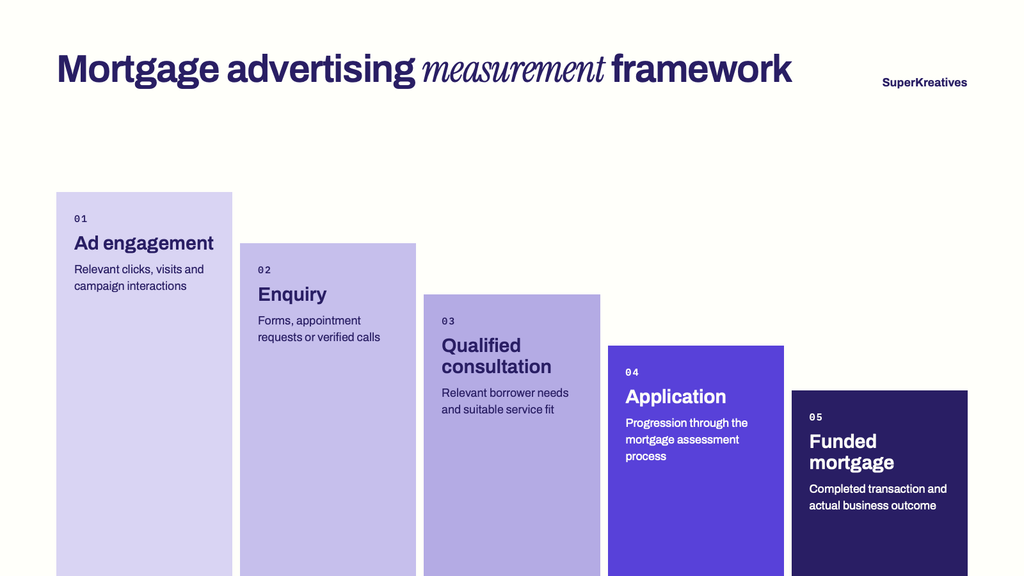
A brokerage can evaluate campaigns using cost per enquiry, qualified consultation rate, application rate, and acquisition cost per funded mortgage.
These metrics reveal different weaknesses.
If an advertisement generates irrelevant traffic, campaign targeting needs attention. If the landing page attracts suitable visitors but few enquiries, its content or conversion process may require improvement.
If enquiries are relevant but remain unanswered, improving advertising creative will not solve the operational issue.
Account for Overlapping Attribution
A borrower may view a Meta advertisement, read a mortgage article, and later search Google for the brokerage before requesting assistance.
Both platforms may report influence over that conversion.
Avoid simply adding their reported results together without checking for duplicated enquiries.
CRM records, campaign identifiers, and privacy-appropriate attribution methods can help develop a clearer picture of the customer journey.
A 90-Day Google Ads vs. Meta Ads Testing Plan
A practical testing programme should begin with clearly defined business objectives and reliable measurement.
| Timeline | Priority | Recommended activities |
| Days 1–30 | Prepare | Identify target services, audit landing pages, verify compliance, configure conversion tracking, and establish lead qualification criteria |
| Days 31–60 | Test | Launch focused Google and/or Meta campaigns, review enquiries, monitor costs, and evaluate creative relevance |
| Days 61–90 | Improve | Compare qualified consultations, refine targeting and landing pages, and assess available application or funding outcomes |
During the first month, choose one or two services where the brokerage has genuine expertise and capacity.
Launching unrelated campaigns for every mortgage product makes it harder to understand which messages are effective.
During the second month, review both platform performance and actual lead handling.
A Meta campaign generating many inexpensive leads may require adjustments to the advertised offer. A Google campaign receiving clicks from irrelevant searches may need better keyword control.
By the third month, evaluate which approach contributes to suitable consultations.
Avoid making major budget decisions from a handful of conversions. Low-volume campaigns may need longer observation periods before performance differences become dependable.
Common Mistakes Mortgage Brokers Make With Paid Advertising
The first mistake is selecting a platform solely because another brokerage reports success with it. Their service region, campaign budget, client base, and qualification process may be entirely different.
Another problem is optimizing for the cheapest possible leads. Low-cost enquiries are not especially valuable when they generate little relevant business.
Mortgage brokerages also sometimes use the same advertising approach across Google and Meta. A search advertisement should usually respond directly to the user’s query, while a social advertisement may need to explain why the subject deserves attention.
Weak landing pages create further problems. An advertisement about mortgage renewal should lead to useful renewal information rather than an unrelated generic homepage.
Finally, compliance cannot be treated as something to review only after campaigns are launched. Financial claims, brokerage identification, targeting restrictions, and privacy requirements should be considered during campaign planning.
Final Thoughts: Choose the Platform That Produces Meaningful Mortgage Opportunities
Effective mortgage marketing advertising is not defined by which platform generates the largest number of clicks, impressions, or inexpensive contact forms.
For Canadian mortgage professionals, the more important objective is reaching borrowers with relevant financial needs and helping them connect with appropriate professional assistance.
Google Ads can provide opportunities to capture existing demand. Meta Ads can introduce educational content and encourage borrowers to consider financing questions before they actively search for help.
Both platforms require accurate messaging, relevant landing pages, responsible data handling, and dependable follow-up.
At SuperKreatives, our approach is to evaluate advertising through the complete customer journey. That means understanding how the borrower discovered the brokerage, what prompted the enquiry, whether the consultation was relevant, and how the opportunity progressed.
Start with a clearly defined service, choose the advertising approach suited to that objective, and establish reliable performance measurement.
The strongest campaigns aren’t simply those that attract attention. They’re the ones that connect suitable borrowers with credible mortgage professionals through an experience that is useful, trustworthy, and commercially sustainable.
Frequently Asked Questions
Is Google Ads or Meta Ads better for mortgage brokers in Canada?
Google Search may be more suitable for capturing existing demand from borrowers actively searching for mortgage services. Meta can help introduce educational content and build interest among eligible audiences. The better option depends on business objectives, market conditions, lead quality, and acquisition costs.
Which platform generates cheaper mortgage leads?
Neither platform consistently delivers cheaper leads across all markets. Meta may generate lower-cost initial enquiries in some campaigns, while Google may attract stronger immediate service intent. The brokerage should compare cost per qualified consultation and funded mortgage rather than cost per form submission alone.
Can mortgage brokers advertise on Facebook and Instagram?
Yes, subject to Meta’s applicable advertising policies and provincial mortgage regulations. Mortgage advertisements may need to be categorized under financial products and services or housing, with corresponding audience targeting restrictions.
How much should Canadian mortgage brokers spend on advertising?
There is no universally appropriate budget. Spending should reflect the brokerage’s financial capacity, geographic competition, service specialization, and client acquisition economics. A controlled test with clear performance measurement is generally preferable to immediately committing to a large budget.
Are Google Ads effective for mortgage refinancing campaigns?
They can help reach borrowers actively searching for refinancing assistance. Effective campaigns require relevant keywords, accurate advertising claims, suitable landing pages, and follow-up processes that distinguish genuine opportunities from general information requests.
What does academic research say about mortgage advertising?
Research such as Advertising Expensive Mortgages examines the relationship between mortgage advertising and consumer borrowing outcomes. It highlights concerns about the prominence of introductory rates and the importance of complete financial information. It does not establish which modern advertising platform performs best for Canadian mortgage brokers.
Should mortgage brokers use lead forms or landing pages?
Both are possible. Native lead forms can reduce steps for users, while dedicated landing pages provide more space to explain financing considerations and establish credibility. The choice should reflect the complexity of the offer, privacy requirements, and the quality of enquiries produced.
Can Google Ads and Meta Ads work together?
Yes. Search advertising can address existing demand, while Meta can help introduce educational messages and generate interest. A combined strategy should use consistent messaging, appropriate attribution, and CRM reporting to avoid counting the same borrower as multiple independent leads.