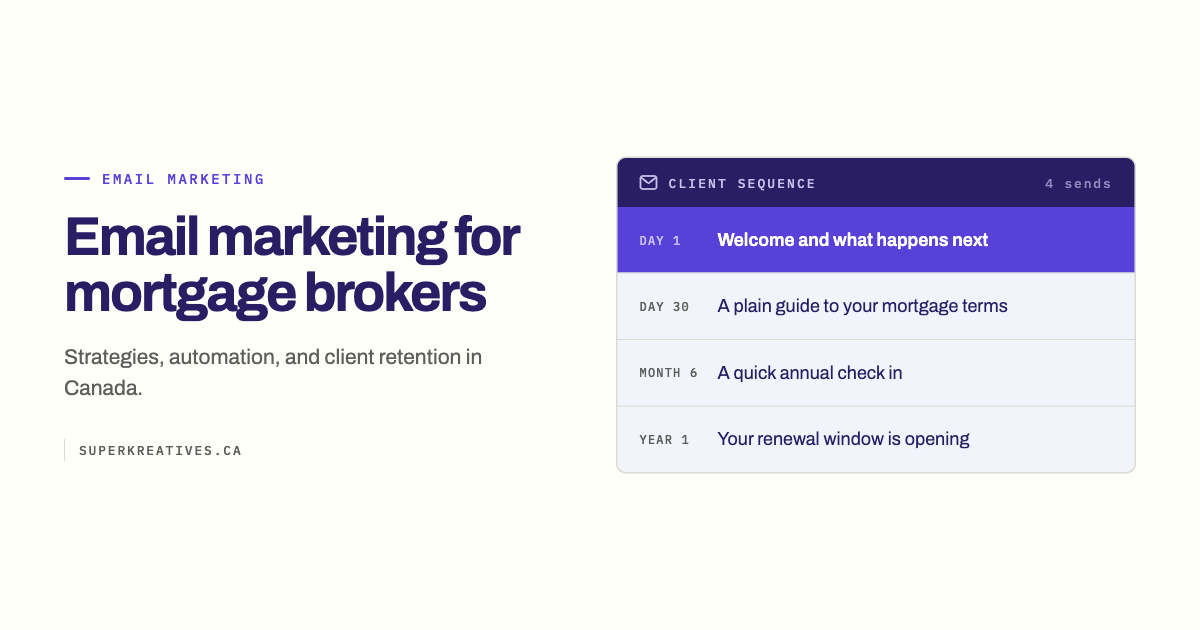
Mortgage clients don’t disappear because they stop needing financial guidance. Often, they disappear because communication stops once the mortgage closes. A first-time homebuyer may eventually refinance, a homeowner will approach another renewal, and an existing client may recommend a broker to friends or family. Yet these opportunities can be missed when mortgage professionals rely entirely on new enquiries instead of maintaining relationships with people they have already served.
That’s where email marketing for mortgage brokers becomes valuable. It allows Canadian mortgage professionals to communicate with prospective borrowers, explain important financing decisions, provide application updates, and remain accessible throughout the mortgage lifecycle.
However, effective email marketing involves considerably more than distributing monthly promotional messages. It requires audience segmentation, relevant information, responsible automation, and a clear understanding of Canadian privacy and anti-spam requirements.
In this guide, we’ll explain how mortgage brokers and agents can build an effective email strategy, choose suitable software, create useful newsletters, automate loan status updates, and measure whether their communication efforts contribute to actual business growth.
Why Email Marketing Matters for Canadian Mortgage Professionals
The mortgage business has an unusual customer relationship cycle. A client may work closely with a broker for several weeks during an application, complete the transaction, and then have no immediate need for another mortgage service.
That doesn’t mean the relationship has lost its value.
A homeowner may require advice when their mortgage term approaches expiration. Someone who originally purchased a condominium might later consider buying a larger property. Another borrower may explore refinancing because of renovation plans, debt obligations, or changing financial circumstances.
Email communication creates opportunities to remain relevant between these events.
According to the Canada Mortgage and Housing Corporation (CMHC) 2026 Mortgage Consumer Survey, renewals accounted for 66% of recent mortgage transactions among surveyed consumers, followed by refinancing at 19% and first-time home purchases at 11%. The survey included more than 4,100 Canadian mortgage consumers.
These figures reinforce why a mortgage marketing strategy should extend beyond first-time buyer acquisition.
A broker serving homeowners in Toronto may benefit from keeping existing clients informed about renewal considerations. Someone working with first-time buyers in Calgary could use educational communication to help them prepare for future financing decisions.
The underlying principle is straightforward: communication should reflect the borrower’s current situation rather than the broker’s immediate need to generate another sale.
Email Marketing Is More Than Sending Promotional Messages
Mortgage professionals generally need three different types of email communication.
Marketing emails introduce services, share educational information, and encourage appropriate future engagement. Transactional or operational messages communicate necessary information about an existing application or service. Relationship-building emails help clients remain informed about relevant mortgage subjects over time.
Although these messages may appear in the same inbox, they serve different purposes.
A borrower waiting for a document review needs an accurate application update, not a promotional newsletter. A previous client approaching renewal may benefit from a timely educational reminder. A prospective buyer who requested a guide may appreciate follow-up information relevant to their original enquiry.
The challenge is building a system that recognizes these distinctions.
How to Build an Effective Mortgage Email Marketing Strategy
A successful email programme begins before the first message is written.
Mortgage brokers need to understand whom they’re contacting, why the communication matters, and what the recipient should reasonably expect from it.
1. Segment Your Audience by Mortgage Journey
Sending identical messages to every contact is rarely the best approach.
A first-time homebuyer and an existing homeowner approaching renewal have different concerns. One may be researching down payments and pre-approval requirements, while the other is evaluating a lender’s renewal offer.
Useful audience segments include:
- Prospective homebuyers: People researching affordability, mortgage qualification, and purchase financing.
- Active mortgage applicants: Borrowers currently progressing through an application who require accurate operational communication.
- Existing homeowners: Previous clients who may have future renewal, refinancing, or property purchase needs.
- Mortgage renewal clients: Homeowners with a known upcoming mortgage maturity date, where the information has been appropriately collected and retained.
- Professional referral contacts: Real estate agents, accountants, and other relevant professionals who may benefit from business-related educational content.
Each segment should receive information appropriate to its needs and the permissions held by the brokerage.
Segmentation does not necessarily require complicated software. Smaller mortgage businesses can begin with a properly maintained customer relationship management (CRM) system containing accurate contact records, relevant lifecycle information, and communication preferences.
2. Create a Relevant Mortgage Marketing Email
Every marketing email should have one clear purpose.
A message explaining mortgage renewal considerations shouldn’t suddenly become a lengthy promotion for investment property financing. That change of subject makes the communication less useful and can weaken the relationship with the reader.
A practical message has four components: a recognizable subject, a relevant opening, helpful supporting information, and a clear next step.
For example, an email directed at homeowners approaching renewal could explain why reviewing the proposed mortgage term, payment expectations, and switching costs may be worthwhile.
The call to action could invite the reader to schedule a renewal discussion.
Avoid using exaggerated subject lines such as “Your Mortgage Payment Is About to Double” unless that statement is accurate and specific to the recipient. Fear-based messaging may attract attention, but it can undermine trust and create misleading financial expectations.
3. Personalize Communication Without Becoming Intrusive
Personalization should make an email more useful, not make the recipient uncomfortable.
Using a client’s preferred name is a basic starting point. More meaningful personalization comes from sending information related to their circumstances.
For example, a person who subscribed to receive a first-time homebuyer guide should not automatically receive every refinancing promotion.
A previous client approaching a known renewal date may benefit from information about reviewing their current agreement, but the message should not expose private financial details unnecessarily.
Good personalization depends on accurate records, appropriate consent, and restrained use of personal information.
The Office of the Privacy Commissioner of Canada identifies income, banking information, and loan records as personal information and emphasizes meaningful consent for its collection and use.
This makes privacy a core consideration when designing automated mortgage communications.
Email Marketing for Mortgage Agents: Communicating Across the Client Lifecycle
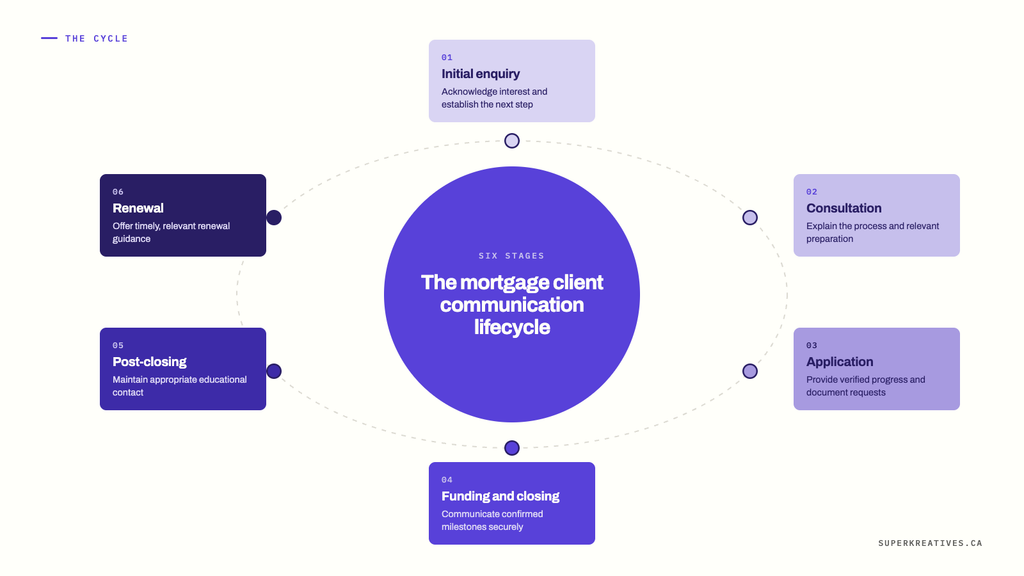
Mortgage agents often manage multiple relationships simultaneously. Some clients are just beginning their search, while others are submitting documents, reviewing options, or preparing for closing.
Without an organized communication process, important follow-ups can be missed.
The solution is to align messages with meaningful client milestones.
Initial Enquiry and Consultation Follow-Ups
The first communication should acknowledge the person’s enquiry and explain what happens next.
If someone requests a consultation through the brokerage website, an acknowledgement can confirm receipt and provide scheduling instructions.
Where appropriate, the email may also explain what general information the broker will discuss during the initial meeting.
Avoid immediately requesting sensitive documents through ordinary email. Financial statements, tax returns, identification records, and other confidential information should be handled through appropriately secured channels.
Application and Underwriting Updates
Once an application begins, communication should become more operational.
Borrowers want to know whether documents have been received, whether additional information is required, and whether an important milestone has occurred.
An effective system can help prevent unnecessary uncertainty, but accuracy must take priority over speed.
For example, an automated email should never declare that financing has been approved simply because a predetermined number of days has passed.
The system must rely on a verified application status or an authorized staff member’s confirmation.
Post-Closing Communication
After closing, an appropriate follow-up can thank the client, explain where to direct future questions, and provide useful information about ongoing mortgage responsibilities.
Subsequent promotional communication should follow the client’s preferences and applicable legal requirements.
The objective is not to keep selling immediately after funding. It is to preserve a professional relationship that may remain relevant for years.
Best Email Marketing for Mortgage Brokers: Loan Status Updates That Build Confidence
Mortgage application status updates deserve particular attention because they influence the borrower’s experience during an important financial process.
A generic message saying “Your application is being processed” provides limited reassurance if it doesn’t explain what has happened or whether the client needs to act.
Useful updates should communicate verified progress, relevant responsibilities, and the next expected step.
Which Mortgage Application Milestones Should Trigger an Email?
| Application milestone | Communication purpose | Suggested next step |
| Application received | Confirm successful receipt | Explain the review process |
| Documents requested | Identify missing information | Direct borrower to secure upload |
| Documents received | Acknowledge submission | Explain that review may continue |
| Application submitted to lender | Confirm verified submission | Set reasonable communication expectations |
| Conditional approval | Explain confirmed conditions | Identify outstanding requirements |
| Final approval confirmed | Communicate the verified decision | Explain remaining closing steps |
| Funding confirmed | Confirm the completed milestone | Provide appropriate post-closing information |
Not every borrower will pass through every stage in the same order. Procedures vary by lender, product, and transaction.
These messages should therefore follow the actual workflow instead of a rigid sequence of assumed outcomes.
Example: Mortgage Application Status Update
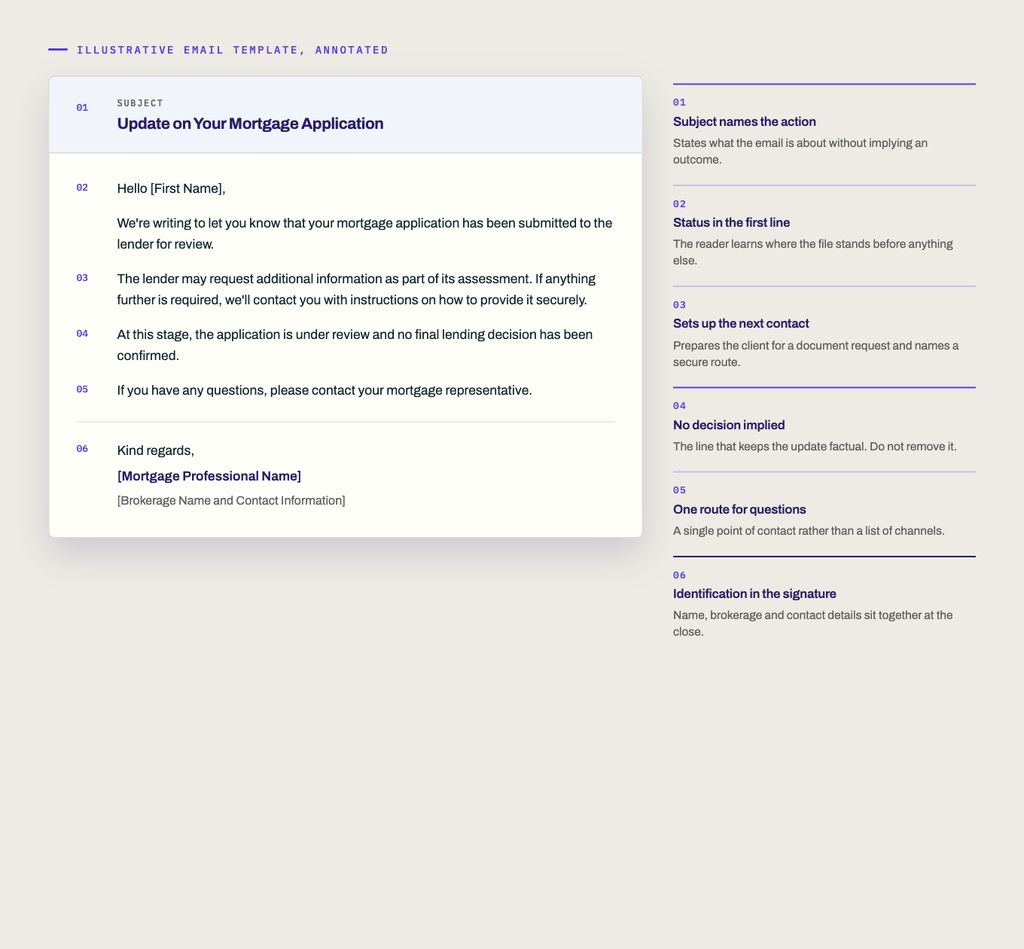
This message explains what has happened without making unsupported promises about approval or timelines.
It is also important to distinguish a genuine service update from a marketing message. Under Canada’s Anti-Spam Legislation, certain messages that solely facilitate or confirm a transaction may be exempt from the usual consent requirement, while other obligations or exemptions depend on the message’s precise content and circumstances.
Adding promotional offers to an operational update can change its regulatory treatment.
Brokerages should classify their communications properly instead of assuming every existing client email is automatically exempt from anti-spam requirements.
Best Email Marketing Software for Mortgage Brokers: Loan Status Updates and Automation
Choosing software is not simply a matter of finding a platform that sends attractive newsletters.
Mortgage professionals need to consider whether the system supports contact management, application status tracking, automation, data protection, and integration with the tools already used by the brokerage.
A dedicated mortgage CRM may be more suitable for application communication, while a general email marketing platform may be sufficient for educational newsletters.
What Features Should Mortgage Brokers Look For?
Before comparing providers, evaluate the following capabilities.
CRM and mortgage lifecycle management: The software should allow the business to organize contacts according to relevant stages, such as prospective client, active application, funded mortgage, and approaching renewal. Reliable lifecycle information helps prevent the wrong message from reaching the wrong person.
Event-based email automation: The system should support communications triggered by real events, not merely the passage of time. A verified application milestone should determine when a status email is sent.
Marketing segmentation and consent records: The platform should distinguish contacts eligible for promotional communication from those receiving necessary operational messages. Maintaining consent history and unsubscribe preferences is particularly important for Canadian businesses.
Security and integration: Evaluate access controls, audit records, data storage arrangements, secure document handling, and integration with mortgage origination or lender systems. A platform that works well for newsletters may not be appropriate for communicating sensitive application information.
Reporting and support: The software should provide useful delivery, engagement, and workflow reporting. Mortgage-specific technical support and implementation assistance can also be valuable.
Comparing Popular Software Options
| Platform | Primary strength | Suitable use |
| HubSpot | CRM-connected email segmentation and workflows | Lead nurturing, newsletters, and marketing follow-ups |
| Mailchimp | Email campaigns and audience automation | Educational newsletters and subscriber communication |
| BluMortgage | Mortgage-focused CRM workflows | Evaluating mortgage lifecycle and renewal management |
| Pipedrive | Customizable contact and deal pipelines | Brokerages managing structured enquiry and follow-up processes |
HubSpot documents automated marketing emails through its workflows, although advanced capabilities depend on the subscription. Mailchimp also supports automation flows triggered by subscriber actions and other supported events.
Mortgage-oriented systems deserve separate evaluation because managing an application is not equivalent to running an ordinary promotional email sequence.
No single platform should be considered the best for every brokerage. A sole mortgage agent managing a modest subscriber list may need relatively simple software. A larger team coordinating multiple active applications may require mortgage-specific integrations, controlled staff permissions, and more sophisticated workflow management.
Before committing to a provider, ask for a demonstration of a complete borrower journey. Confirm whether status changes can trigger accurate emails, whether the required integration is native or third-party, and which functions require additional licensing.
Also verify the vendor’s privacy and security documentation, Canadian suitability, and current pricing directly. Feature availability and subscription terms can change.
How to Create a Mortgage Marketing Newsletter People Actually Read
A newsletter should give recipients a reason to remain subscribed.
One common mistake is turning every edition into a rate advertisement or a repeated invitation to schedule a consultation.
While a relevant mortgage offer can occasionally be appropriate, consistent educational value is generally a stronger foundation for ongoing communication.
A good mortgage marketing newsletter answers questions that homeowners and prospective borrowers may be thinking about.
Choose Topics Based on Borrower Concerns
For Canadian mortgage audiences, useful subjects may include understanding renewal offers, comparing fixed and variable mortgage features, planning for closing costs, and recognizing refinancing expenses.
Market updates can also provide value, but they should be factual, dated, and interpreted carefully.
For example, a newsletter discussing a Bank of Canada interest rate announcement should explain that changes in the policy rate do not necessarily translate into identical changes across all mortgage products.
Readers benefit more from understanding the potential implications than from receiving an unsupported prediction about future mortgage rates.
Other relevant topics include mortgage portability, prepayment privileges, common qualification misunderstandings, and the financial considerations of purchasing an investment property.
These subjects can connect naturally to more detailed resources on the brokerage’s website.
How Often Should Mortgage Marketing Newsletters Be Sent?
There is no universal frequency that works for every audience.
For many smaller mortgage businesses, a carefully prepared monthly newsletter provides a manageable starting point. A business with a highly engaged audience and regular educational material may test more frequent communication.
The decision should be based on content relevance, subscriber expectations, and measurable responses rather than the assumption that more emails will always produce more business.
An edition that offers useful guidance about an upcoming renewal can be more valuable than several repetitive messages featuring generic promotional claims.
Example Monthly Newsletter Structure
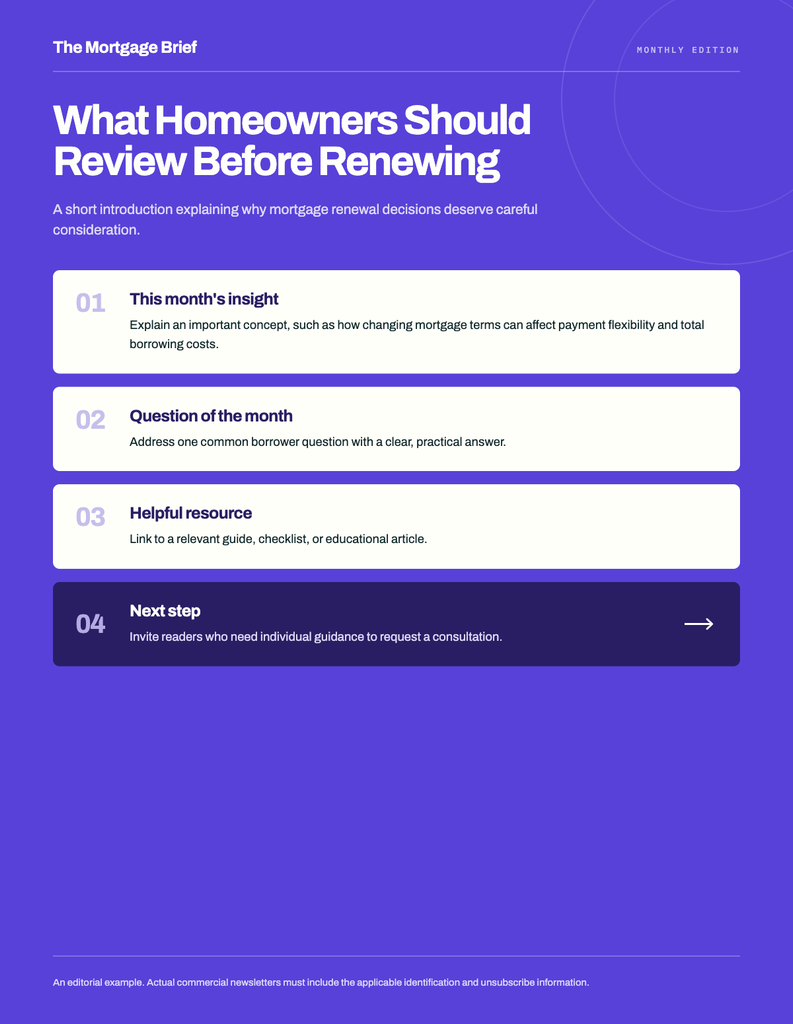
This structure combines helpful information with a modest commercial objective.
It also gives the business opportunities to reuse existing educational articles rather than creating entirely new material for every edition.
Mortgage Marketing Emails: Five Campaigns Worth Building
A complete email programme should support both customer acquisition and relationship management.
Instead of developing dozens of unrelated campaigns, begin with a small collection connected to clear stages of the mortgage journey.
1. New Subscriber Educational Series
When someone voluntarily subscribes for home financing information, the initial messages should deliver what was promised.
A first-time buyer sequence might begin with down payment preparation, continue with pre-approval considerations, and then explain common closing expenses.
Avoid assuming every subscriber is ready to apply immediately. Educational content can support prospects who are still several months away from making a decision.
2. Consultation Follow-Up Campaign
After a legitimate consultation, a relevant follow-up can summarize agreed next steps, identify outstanding actions, and provide useful educational resources.
This communication should reflect the actual conversation. Automated messages that incorrectly describe the borrower’s situation can create confusion.
Marketing follow-ups should only be sent where the brokerage has a valid legal basis and the appropriate communication permissions.
3. Mortgage Renewal Reminder Campaign
Renewal reminders can be particularly useful because mortgage maturity dates provide a meaningful opportunity for timely communication.
An illustrative workflow might begin approximately six months before a known renewal date, followed by more focused reminders as the date approaches.
The timing should account for the borrower’s circumstances, lender process, and whether the client has already taken action.
For instance, a client who has completed a renewal should be removed from the previous renewal sequence rather than continuing to receive irrelevant reminders.
4. Post-Funding Relationship Campaign
A completed mortgage transaction creates an opportunity to maintain a professional relationship.
A post-funding sequence could provide general information about payment management, where to seek assistance, and what borrowers should know about mortgage terms or prepayment options.
Future marketing content should respect the client’s consent and preferences.
An occasional helpful message is more likely to preserve goodwill than constant refinancing promotions directed at someone who has only recently completed a mortgage.
5. Professional Referral Newsletter
Mortgage professionals may also maintain appropriate business relationships with real estate agents, accountants, and other relevant referral contacts.
A referral-oriented newsletter should focus on useful professional information, such as financing process considerations, documentation requirements, or common transaction delays.
It should not disclose confidential borrower information or assume that business relationships eliminate all consent obligations.
A professional newsletter that consistently provides relevant information can support familiarity and collaboration without becoming an aggressive sales channel.
Canadian Email Marketing Compliance: CASL and Borrower Privacy
Mortgage businesses handle information that may reveal income, financial liabilities, borrowing arrangements, property ownership, and other sensitive details.
That makes compliance more than a technical requirement. It is fundamental to protecting client trust.
Two important considerations are Canada’s Anti-Spam Legislation (CASL) and applicable private-sector privacy laws.
Understanding Consent Under CASL
The Canadian Radio-television and Telecommunications Commission (CRTC) explains that commercial electronic messages generally require consent, sender identification, and a functioning unsubscribe mechanism, subject to applicable exceptions.
Consent may be express or implied, but implied consent is only available under specific circumstances and may expire. Express consent generally continues until withdrawn.
Mortgage businesses should not assume that collecting an email address during an enquiry permits indefinite promotional messaging.
Maintain records showing how and when consent was obtained, what the person agreed to receive, and whether that permission has changed.
Under CASL, unsubscribe requests must generally be honoured within 10 business days.
Transactional Emails Versus Promotional Emails
Not every email associated with a mortgage application has the same legal character.
A message containing a genuinely necessary application update may qualify for different treatment from a newsletter encouraging the recipient to purchase additional services.
For example, an email confirming that requested documents were received serves an operational purpose. Adding an unrelated refinancing promotion or marketing offer could introduce a commercial purpose.
Some transactional or relationship-based messages are exempt from CASL‘s section 6 requirements, while others are exempt only from consent and must still meet identification and unsubscribe requirements.
The precise distinction depends on the message and the applicable legal provisions. Brokerages should obtain appropriate compliance advice before designing automated classifications or relying on exemptions.
Protect Sensitive Mortgage Information
Ordinary marketing platforms are not necessarily appropriate places to store or transmit confidential borrower documents.
A newsletter system may only need a name, email address, consent status, and general content preferences.
A mortgage origination system may contain substantially more sensitive information. These records should not be indiscriminately transferred into marketing software.
Where detailed application information must be accessed, use authorized systems with suitable security controls. Email notifications can often direct a borrower to a secure portal without disclosing the underlying financial information in the message itself.
Canadian organizations must also consider the privacy legislation applicable to their province and activities. Federal PIPEDA requirements and substantially similar provincial private-sector laws may apply in different circumstances.
The appropriate approach is to minimize unnecessary data collection, restrict access, document the purpose of processing, and review service providers before integrating systems.
How to Measure Email Campaign Performance
Email marketing should be evaluated through more than the number of messages sent.
Open rates and click-through rates can provide useful directional information, but they don’t independently demonstrate whether a campaign generates qualified conversations or funded mortgages.
Open tracking is also imperfect because privacy features and automated image loading can distort the measurement.
A more practical approach connects email activity to real business outcomes.
| Metric | What it helps measure |
| Email delivery rate | Whether messages reach receiving mail systems |
| Click-through rate | Whether recipients engage with useful links |
| Unsubscribe rate | Whether content or frequency may be misaligned |
| Consultation booking rate | Whether recipients take a meaningful next step |
| Qualified enquiry rate | Whether responses fit the offered services |
| Renewal engagement | Whether timely communication supports client conversations |
| Funded mortgage attribution | Whether email influences completed business, where tracking permits |
Consider a hypothetical monthly newsletter sent to 1,000 eligible subscribers. It generates 45 tracked link clicks, 12 consultation requests, and four qualified opportunities.
The campaign’s value should not be assessed using the 45 clicks alone.
The more important questions are whether the opportunities are relevant, whether consultations progress, and how the campaign contributes to the broader client relationship.
A simple operating framework is to review three areas: deliverability, engagement, and commercial outcomes.
If messages are not being delivered, resolve data quality and authentication issues. If recipients are not responding, examine relevance, audience segmentation, subject lines, and calls to action. If enquiries fail to progress, investigate the consultation and follow-up process.
This makes improvement more systematic than repeatedly rewriting subject lines without understanding the underlying problem.
A 90-Day Implementation Plan for Mortgage Email Marketing
Mortgage businesses don’t need to build a complex automation system immediately. A phased approach helps establish the necessary data, communication standards, and performance measures.
| Period | Primary objective | Recommended actions |
| Days 1–30 | Establish the foundation | Review contact records, verify consent, choose software, map client stages, and create approved templates |
| Days 31–60 | Launch essential workflows | Implement initial enquiry responses, approved status updates, renewal reminders, and an educational newsletter |
| Days 61–90 | Review and optimize | Test segmentation, evaluate engagement and consultation outcomes, refine messages, and audit workflow accuracy |
During the first month, prioritise contact data quality. Duplicate records, outdated renewal dates, and unclear consent information can undermine automation before a campaign begins.
The second month should focus on a limited set of high-value communications. Test them internally to ensure recipients receive the correct message under the correct conditions.
By the third month, evaluate performance using actual client activity. Review whether recipients are responding, whether application updates are accurate, and whether communication creates useful opportunities.
More advanced campaigns can be introduced after the essential systems are stable.
This approach reduces the risk of investing in sophisticated software before the brokerage has defined what it needs the technology to accomplish.
Common Email Marketing Mistakes Mortgage Brokers Should Avoid
One of the biggest mistakes is treating every contact as an active sales prospect. Existing clients, current applicants, and newsletter subscribers require different communications and may have different permissions.
Another is allowing automation to operate without oversight. A system that sends an incorrect approval update or continues a renewal campaign after the client has renewed can cause confusion and damage credibility.
Mortgage professionals should also avoid excessive promotional frequency. Repeatedly sending messages about the latest rates without explaining their relevance provides little ongoing value.
Buying contact lists is another poor foundation. Besides producing questionable lead quality, it can create serious consent and privacy concerns.
Finally, relying exclusively on email software dashboards can lead to misleading conclusions. The goal is not simply to increase campaign activity but to support better borrower communication and meaningful business relationships.
At SuperKreatives, we recommend treating automation as a way to improve consistency, not as a replacement for professional judgment.
An automated message can acknowledge an enquiry or communicate a verified milestone. It cannot independently determine whether a particular mortgage product is suitable for someone’s financial circumstances.
Final Thoughts: Make Every Email Relevant to the Mortgage Journey
Effective email marketing for mortgage brokers is built around knowing when to communicate, what information the borrower needs, and how to make the next step easier.
Canadian mortgage professionals should distinguish operational updates from promotional campaigns, segment audiences according to real borrowing circumstances, and prioritize accurate, helpful communication.
A well-organized system can help prospective buyers understand their options, reassure applicants through verified progress updates, and keep existing clients informed as their mortgage needs change.
At SuperKreatives, our perspective is that mortgage marketing should be measured by the relationships and opportunities it develops, not simply the number of emails distributed.
The most useful starting point is to audit the current communication process. Identify where clients are left without information, where enquiries fail to receive relevant follow-ups, and where renewal conversations could begin earlier.
Build around those needs, introduce automation carefully, and measure the results. A good email system doesn’t need to send more messages than necessary. It needs to send the right information at the right stage.
Frequently Asked Questions
Is email marketing for mortgage brokers effective in Canada?
It can be effective for nurturing prospective borrowers, maintaining existing client relationships, sharing educational information, and communicating relevant renewal opportunities. Results depend on the quality of the contact database, consent practices, audience segmentation, and the usefulness of each message. Success should be evaluated through meaningful enquiries and client outcomes rather than email volume alone.
What is the best email marketing software for mortgage brokers needing loan status updates?
The best choice depends on the brokerage’s existing mortgage origination software and operational requirements. Mortgage-focused CRM systems may offer more suitable lifecycle workflows, while platforms such as HubSpot can support marketing automation. Before selecting a provider, verify its actual loan-status integrations, data security, event triggers, and Canadian compliance suitability.
How often should mortgage brokers send marketing emails?
A monthly educational newsletter is a reasonable starting point for many smaller mortgage businesses. Additional messages should be based on relevant borrower needs, preferences, and consent. Application status updates should follow verified events rather than arbitrary promotional schedules.
What should a mortgage marketing newsletter include?
A useful newsletter can include an explanation of a mortgage-related topic, relevant Canadian market context, a common borrower question, and a link to a more detailed educational resource. It should offer genuine value while keeping promotional content proportionate and complying with applicable requirements.
Can mortgage agents automate loan application status emails?
Yes, provided the chosen systems support the required workflow and information can be communicated appropriately. Updates should be triggered by verified application events, and sensitive documents should be handled through secure channels. Automation must not imply approvals or completed milestones that have not actually occurred.
Do mortgage brokers need consent to send newsletters in Canada?
Commercial newsletters generally fall under CASL and require a valid basis for consent, appropriate identification, and an unsubscribe mechanism, subject to applicable exceptions. Express and implied consent have different requirements. Brokers should maintain reliable records rather than assuming every previous client has granted indefinite marketing permission.
What kinds of mortgage marketing emails generate useful enquiries?
Messages addressing timely borrower concerns can encourage relevant conversations. Examples include renewal preparation guidance, first-time buyer educational resources, refinancing cost explanations, and appropriate consultation follow-ups. Their effectiveness depends on audience relevance and the quality of the offer rather than the subject line alone.
Can mortgage marketing newsletters help with client retention?
Yes. Regular, relevant educational communication can help past clients remain familiar with their mortgage professional and understand when they may benefit from further guidance. Renewal reminders and useful homeowner resources may support ongoing relationships, provided communications respect the client’s consent and preferences.