The Canadian mortgage market is competitive, and attracting borrowers requires more than offering attractive interest rates. Homebuyers, homeowners approaching renewal, and borrowers considering refinancing want clear information, trustworthy advice, and professionals who understand their financial circumstances. Effective mortgage broker marketing strategies help mortgage professionals connect with these audiences, establish credibility, and turn enquiries into long-term client relationships.
For Canadian mortgage brokers and lenders, the opportunity lies in combining local visibility, educational content, digital advertising, and consistent follow-up. The objective isn’t simply to generate more leads. It’s to attract qualified borrowers, earn their confidence, and build a marketing system that supports sustainable business growth.
Why Mortgage Marketing in Canada Requires a Different Approach
Mortgage decisions are rarely impulsive. Borrowers compare rates, evaluate lending options, research qualification requirements, and seek reassurance before committing to a financial obligation that may last decades.
According to the Canada Mortgage and Housing Corporation (CMHC) 2026 Mortgage Consumer Survey, 66% of surveyed recent mortgage consumers were renewers, while 19% were refinancers and 11% were first-time homebuyers. The survey also found that, among respondents who searched online for mortgage information, 32% used mortgage broker websites and 31% used lender websites.
These findings highlight an important reality: mortgage marketing must address different borrowing situations rather than treating everyone as a first-time homebuyer.
A borrower in Toronto approaching mortgage renewal may be concerned about higher monthly payments. A self-employed buyer in Vancouver may want to understand income documentation. A first-time homebuyer in Calgary may be comparing down payment requirements and available mortgage options.
Each situation involves different questions, priorities, and decision-making timelines.
From a marketing perspective, this means the message should match the borrower’s immediate needs. Generic advertisements promoting the lowest rates may attract attention, but relevant information about qualification, affordability, and available options is more likely to initiate a meaningful conversation.
10 Mortgage Broker Marketing Strategies That Can Generate Qualified Leads
Successful marketing for mortgage brokers generally involves several channels working together. Search visibility helps borrowers discover your services, educational content establishes expertise, and conversion-focused systems turn interest into enquiries.
The following strategies provide a practical foundation for Canadian mortgage professionals looking to improve acquisition, engagement, and client retention.
1. Build a Search-Optimized Mortgage Website
A mortgage brokerage website should function as more than an online business card. It should help potential clients understand your services, evaluate your credibility, and contact you without unnecessary friction.
Start by developing individual pages for the mortgage services you actually offer. These may include first-time homebuyer mortgages, mortgage renewals, refinancing, pre-approvals, investment property financing, and self-employed borrower solutions.
Each page should answer questions relevant to that particular service.
For example, a refinancing page should explain why homeowners refinance, what lenders may consider, how penalties or fees affect the decision, and when refinancing might not be financially beneficial.
A strong mortgage website should also include:
- Clear service information: Explain who each service is intended for, what the process involves, and what factors may affect eligibility.
- Trust indicators: Display accurate licensing information, relevant professional credentials, and authentic client feedback where permitted.
- Simple enquiry options: Offer accessible contact forms, appointment booking, and telephone contact without overwhelming visitors with unnecessary fields.
- Mobile-friendly navigation: Ensure potential borrowers can read content, compare services, and submit enquiries comfortably on their phones.
The website’s underlying technical performance matters too. Slow pages, confusing navigation, inaccessible forms, and poorly structured content can undermine both search visibility and user confidence.
At SuperKreatives, we view a mortgage website as the centre of the acquisition process. Advertising, search optimization, and social media may introduce borrowers to your business, but the website must help them take the next step.
2. Strengthen Local SEO and Google Business Profile Visibility
Most mortgage professionals compete within identifiable geographic markets, even when they can serve borrowers across a wider region.
Someone searching for a mortgage broker in Mississauga may prefer a professional familiar with the Greater Toronto Area. Similarly, a borrower in Edmonton may value someone who understands the local housing market.
Local SEO helps mortgage businesses become discoverable through geographically relevant searches.
Begin with an accurate Google Business Profile where your business is eligible. Include the appropriate business name, category, contact information, location details, and genuine business photographs.
Google requires business profiles to represent real, eligible locations accurately. Virtual offices that do not meet its operational requirements cannot simply be used to create additional local listings.
Your website should support this presence through locally relevant service pages. A page addressing mortgage refinancing in Ottawa, for instance, should contain useful information connected to that service and market, rather than replacing the city name in otherwise identical text.
Encourage satisfied clients to leave genuine reviews without offering incentives or selectively soliciting only positive feedback. Respond professionally to reviews while protecting borrowers’ personal financial information.
Local visibility is particularly valuable because it connects your business with consumers who are already looking for assistance within your service area.
3. Develop Educational Content Around Borrower Questions
One of the most sustainable mortgage marketing ideas is to publish content that helps consumers make informed decisions.
Mortgage terminology, qualification requirements, interest calculations, and renewal conditions can be difficult for borrowers to interpret. A professional who explains these subjects clearly has an opportunity to earn trust before the first consultation.
Consider articles addressing questions such as:
- Fixed vs. variable mortgages: Explain how the options differ, how payment structures may work, and what risks borrowers should assess.
- Mortgage renewal preparation: Discuss when to review renewal offers, how to compare options, and what switching lenders may involve.
- Self-employed mortgage applications: Describe common income documentation challenges and why qualification assessments can differ.
- Mortgage refinancing costs: Explain the relationship between interest savings, prepayment penalties, legal fees, and overall borrowing costs.
Educational content should connect related subjects logically. An article about renewals could link to a detailed guide about switching lenders, while a first-time buyer resource might introduce the mortgage stress test.
This creates a useful reading experience and helps search engines understand how your content relates to broader mortgage topics.
Avoid publishing articles simply because a keyword has search volume. A subject is worth covering when it addresses a real borrower concern and connects meaningfully to your services.
4. Use Google Ads to Reach Borrowers With Immediate Intent
Organic search can support long-term visibility, while paid search advertising helps mortgage professionals reach people actively researching a specific service.
For instance, a borrower searching for mortgage refinancing options in Ontario may be closer to requesting professional assistance than someone casually watching general real estate videos.
This makes Google Ads valuable when campaigns are organized around clearly defined borrowing intentions.
Separate campaigns or ad groups by relevant services, geography, and search intent. Someone researching renewal options should generally encounter an advertisement and landing page addressing renewals, rather than a generic homepage.
Successful campaigns require more than choosing keywords. They also depend on negative keyword management, accurate conversion tracking, careful budgeting, and ongoing evaluation of lead quality.
Consider this hypothetical example: two campaigns each generate 40 enquiries. One produces mostly unqualified contacts, while the other produces 12 suitable consultations. Judging performance purely by enquiry volume would overlook the difference in business value.
For this reason, advertising effectiveness should be measured through qualified consultations, applications, funded mortgages, and acquisition costs wherever reliable tracking is available.
5. Create Mortgage Broker Marketing Ideas for Social Media
Social media is useful for building familiarity, answering common questions, and demonstrating how mortgage professionals approach real borrowing situations.
However, not every platform serves the same purpose.
Instagram and Facebook can support accessible educational videos and local community engagement. LinkedIn may be more suitable for professional relationships with real estate agents, financial professionals, and other potential referral partners. YouTube can accommodate longer explanations of complex mortgage decisions.
Instead of repeatedly posting rate announcements, create content around relevant consumer concerns.
For example, a short video titled “Three Things to Review Before Accepting Your Mortgage Renewal Offer” offers a clear educational benefit. A carousel explaining how mortgage pre-approval differs from final approval can address common misconceptions.
The strongest content usually focuses on one question at a time, provides a useful explanation, and encourages viewers to learn more when appropriate.
Avoid implying guaranteed approvals, guaranteed savings, or universal eligibility. These claims can damage credibility and may conflict with applicable advertising requirements.
6. Build Referral Relationships With Real Estate Professionals
Referral relationships remain an important part of mortgage business development because borrowers often interact with several professionals during the homebuying process.
Real estate agents, lawyers, accountants, and financial planners may encounter clients who need mortgage-related guidance. Building professional relationships with these groups can create opportunities for relevant introductions.
Effective referral marketing should focus on mutual professional value rather than simply requesting leads.
For example, a mortgage broker could provide a real estate agency with an educational session explaining common financing conditions, pre-approval limitations, or mortgage qualification challenges.
This helps agents better understand financing concerns that may affect their clients’ transactions.
Consistency is essential. Maintain professional communication, provide useful updates, and establish clear expectations when introductions occur. Any referral arrangement must comply with applicable provincial requirements, including rules concerning compensation and disclosure.
The objective is to become a reliable professional contact whose knowledge and communication make the referral process easier for everyone involved.
7. Create a Mortgage Renewal and Client Retention System
Mortgage marketing shouldn’t end when a transaction closes.
Existing clients may need assistance when their mortgage term expires, their financial circumstances change, or they consider refinancing.
The CMHC’s 2026 Residential Mortgage Industry Report notes that renewals dominated Canadian mortgage activity in 2025. Although renewal volumes were expected to ease during 2026, the report identifies continued payment pressures for many borrowers renewing mortgages originated at lower interest rates.
This makes retention an important component of mortgage broker marketing strategies.
A practical retention system begins by maintaining accurate mortgage maturity dates, recording communication preferences, and identifying suitable opportunities for future conversations.
For example, a broker might establish a review process several months before a client’s anticipated renewal date, allowing time to discuss available options and the client’s changing circumstances.
Educational communication can address potential payment changes, renewal negotiations, switching considerations, or refinancing questions. Communications should be timely, relevant, and based on applicable consent requirements.
The goal is not to pressure past clients into another transaction. It is to remain accessible when they need professional guidance.
8. Use Email Marketing to Nurture Mortgage Enquiries
Mortgage applicants do not always make decisions immediately. Some are gathering information months before purchasing, while others are waiting for changes in income, savings, or property availability.
Email marketing can help mortgage professionals remain useful during this period.
Instead of sending repetitive promotional messages, structure communication around the borrower’s stage in the mortgage journey.
A first-time homebuyer might benefit from educational emails covering down payment preparation, pre-approval considerations, and closing expenses. A homeowner considering refinancing may appreciate explanations of total borrowing costs and the possible consequences of breaking an existing mortgage.
Canadian businesses must take Canada’s Anti-Spam Legislation (CASL) seriously. Commercial electronic messages generally require a valid basis for consent, appropriate sender identification, and a functioning unsubscribe mechanism, subject to applicable exemptions.
This means collecting an email address for an enquiry does not automatically authorize unlimited promotional communication.
Maintain proper consent records and distinguish necessary transactional communication from ongoing marketing.
A smaller, engaged subscriber base can provide greater value than a large contact database with little interest in your services.
9. Develop Dedicated Landing Pages for Specific Mortgage Services
Sending every advertisement to a homepage often creates unnecessary steps between the borrower’s initial interest and the information they need.
Dedicated landing pages can address this problem.
Imagine a homeowner searching for refinancing assistance in British Columbia. A relevant landing page should immediately explain refinancing considerations, the service offered, and how to request an assessment.
A page about first-time homebuyer mortgages would require a different message because the audience’s concerns are different.
Each landing page should establish the service’s relevance, explain the process, address common objections, provide appropriate credibility signals, and offer a clear next action.
Keep initial enquiry forms proportionate to the purpose of the interaction. Sensitive financial documents and detailed personal information should be collected through appropriate secure processes rather than unnecessarily requested in an introductory marketing form.
The Office of the Privacy Commissioner of Canada emphasizes meaningful consent and clear disclosure regarding the collection and use of personal information.
For mortgage businesses, conversion optimization and privacy protection should work together. An effective landing page makes it easier to request assistance without compromising borrower confidence.
10. Measure Mortgage Marketing Performance Beyond Lead Volume
One of the most common marketing mistakes is evaluating success entirely through website traffic, advertisement clicks, or the number of enquiries received.
These metrics are useful, but they cannot independently demonstrate whether marketing activities are producing commercially valuable outcomes.
Mortgage professionals should connect marketing data with their client management process.
A practical performance framework tracks the progression from visitor to enquiry, qualified lead, consultation, application, and funded mortgage.
For example, consider a hypothetical campaign generating 100 enquiries at a cost of $5,000. Its cost per lead would be $50. However, if only five enquiries become suitable consultations, the cost per qualified consultation would be $1,000.
This distinction makes it easier to determine whether the problem lies in campaign targeting, the enquiry process, follow-up, or borrower suitability.
Measure longer-term outcomes as well, including repeat transactions and client referrals. A campaign that generates fewer immediate enquiries may still prove valuable if it consistently attracts borrowers with suitable financing needs.
Marketing Ideas for Mortgage Lenders: How Their Approach Should Differ
Although mortgage brokers and lenders operate within the same industry, their marketing priorities are not identical.
A broker may emphasize access to multiple lending options, personalized guidance, and assistance navigating mortgage choices. A lender typically promotes its own products, eligibility criteria, service standards, distribution relationships, and particular lending capabilities.
This distinction should influence campaign messaging.
Marketing ideas for mortgage lenders may include product-specific educational pages, borrower eligibility explainers, broker partnership resources, and communication campaigns focused on clearly defined lending programs.
For example, a lender offering financing for particular borrower circumstances could develop detailed resources outlining its documentation expectations and general eligibility considerations.
These materials may support both direct consumer understanding and mortgage professionals evaluating lending options for their clients.
Lenders should also ensure their campaigns accurately reflect available products. Broad promises about approval, speed, or pricing can create misleading expectations when important qualifications are not adequately disclosed.
The principle applies across both business models: marketing should communicate genuine capabilities rather than create demand through unrealistic promises.
How to Build a Practical Mortgage Marketing Framework
Individual campaigns can generate enquiries, but sustainable growth requires coordination between marketing activities.
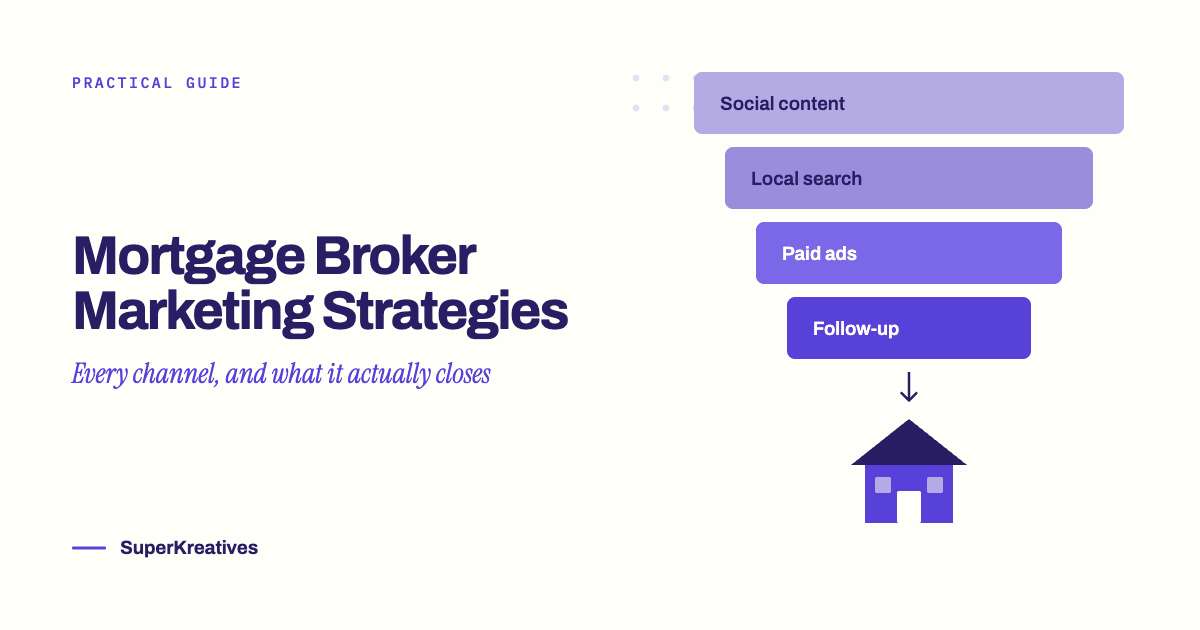
At SuperKreatives, our recommended approach is to organize the process around five connected stages: visibility, education, engagement, conversion, and retention.
(Image)
The first stage ensures relevant borrowers can discover the business. Educational resources then help them understand their options and develop confidence in the professional providing the information.
Engagement occurs when the borrower explores services, asks questions, or schedules a consultation. Conversion depends on the suitability of the enquiry, the quality of communication, and the ability to guide eligible clients through the next stages.
Retention extends the relationship beyond the original transaction.
These stages should also inform budgeting. Increasing advertisement expenditure is unlikely to solve poor lead handling, an unclear website, or an ineffective consultation process.
Identifying the weakest stage often provides a more productive starting point than launching additional campaigns.
A 90-Day Action Plan for Marketing Strategies for Mortgage Brokers
Mortgage professionals do not need to implement every channel simultaneously. A phased approach makes it easier to establish foundations, measure performance, and improve results.
| Timeline | Priority | Recommended actions |
| Days 1–30 | Establish foundations | Audit the website, verify business listings, clarify target audiences, review compliance, and establish conversion tracking. |
| Days 31–60 | Build acquisition channels | Publish high-intent service content, improve local SEO, test focused search campaigns, and develop relevant educational resources. |
| Days 61–90 | Improve performance | Review enquiry quality, optimize landing pages, strengthen follow-up processes, and expand channels showing credible results. |
During the first month, identify which services and geographic markets represent genuine business opportunities. Prioritize the pages and campaigns that address those needs.
The second month should focus on establishing traffic and engagement opportunities through content and appropriately targeted advertising.
By the third month, review whether enquiries are progressing toward consultations and applications. Use those findings to refine targeting, messaging, and conversion processes.
Ninety days can provide useful early performance data, but it should not be treated as a guarantee of search rankings, funded mortgage volume, or positive advertising returns.
Common Mortgage Marketing Mistakes to Avoid
Several recurring mistakes can limit the effectiveness of otherwise promising mortgage campaigns.
Competing exclusively on interest rates: Borrowers often compare rates, but mortgage suitability also involves terms, penalties, features, qualifications, and broader financial circumstances. Advertising should explain value without oversimplifying the decision.
Publishing generic content: Articles that merely repeat familiar definitions offer limited differentiation. Useful content addresses real borrower concerns, explains financial implications, and acknowledges situations where a particular option may not be appropriate.
Ignoring lead follow-up: A qualified enquiry has limited commercial value if no one responds effectively. Establish a clear process for assigning enquiries, scheduling consultations, and recording outcomes.
Using identical messaging across audiences: First-time buyers, renewers, refinancers, and investors have different concerns. Marketing should reflect those differences rather than assume one message will persuade everyone.
Overlooking regulatory requirements: Mortgage advertising is subject to rules that vary by jurisdiction. For example, Ontario’s Financial Services Regulatory Authority of Ontario (FSRA) requires specific brokerage identification in relevant public-facing materials and prohibits false or misleading statements.
Brokerages operating elsewhere in Canada should review the requirements of their applicable regulator and obtain the necessary internal approvals before publishing marketing materials.
Should You Hire a Mortgage Marketing Coach or a Specialized Marketing Agency?
Mortgage professionals sometimes seek a mortgage marketing coach when they need guidance on positioning, prospecting, referral development, or building more consistent business development habits.
Coaching may be suitable when the primary challenge involves planning, accountability, communication, or sales processes.
A specialized marketing agency generally serves a different function. Its responsibilities may include search engine optimization, paid advertising, website performance, landing page optimization, content development, and marketing analytics.
The distinction is between advising on the activities a business should perform and helping execute, measure, and improve those activities.
However, the two approaches are not necessarily competing alternatives. A brokerage with internal marketing resources may benefit from strategic coaching, while another business may require external execution support.
Before choosing a provider, evaluate their understanding of Canadian mortgage advertising requirements, ability to connect campaigns with business outcomes, reporting methodology, and experience with financially sensitive services.
Avoid selecting a provider solely on promises of large lead volumes or immediate search rankings.
Where to Find Top Canadian Mortgage Marketing Blogs and Industry Insights
Mortgage professionals researching top Canadian mortgage marketing blogs should prioritize credible information rather than relying exclusively on promotional advice.
The most useful reading resources often combine mortgage industry research, consumer behaviour data, regulatory information, and practical digital marketing guidance.
CMHC publishes housing finance research and mortgage consumer surveys that can help identify changing borrower concerns. Provincial regulators provide guidance on advertising requirements and professional conduct. The CRTC publishes information about commercial electronic communications and marketing consent.
Industry publications, professional associations, and marketing-focused educational resources can complement these authoritative sources with operational insights and campaign ideas.
When assessing any marketing publication, consider whether its advice reflects Canadian lending conditions, identifies verifiable information, and distinguishes general recommendations from actual performance evidence.
A strategy developed for a different lending market may still contain useful principles, but it should not be adopted without considering Canadian consumer expectations and regulatory requirements.
Final Thoughts: Build a Mortgage Marketing System That Earns Trust
Effective mortgage broker marketing strategies are not defined by how many advertisements a brokerage runs or how frequently it publishes on social media. Their value comes from connecting the right borrowers with relevant information, credible professionals, and accessible mortgage services.
For Canadian mortgage businesses, this requires a clear understanding of borrower concerns, local competition, lending conditions, and the regulatory environment.
A search-optimized website creates discoverability. Educational content establishes credibility. Targeted advertising introduces relevant audiences to your services. Consistent follow-up and client retention help turn individual transactions into lasting professional relationships.
At SuperKreatives, we believe mortgage marketing should be built around measurable business outcomes rather than disconnected promotional activities. The strongest starting point is understanding where potential borrowers lose confidence, encounter unanswered questions, or abandon the enquiry process.
Address those weaknesses systematically, and marketing becomes more than a lead-generation expense. It becomes a structured part of how a mortgage business attracts, serves, and retains clients.
Frequently Asked Questions
What are the most effective mortgage broker marketing strategies in Canada?
Local SEO, educational content, Google Ads, referral development, and client retention programs are useful channels for Canadian mortgage professionals. Their effectiveness depends on the target audience, geographic market, available budget, and ability to convert enquiries into suitable consultations. A coordinated approach generally provides a stronger foundation than relying on one channel alone.
How can mortgage brokers generate leads without spending heavily on advertising?
Mortgage brokers can build organic visibility through search-optimized service pages, informative articles, genuine client reviews, and professional referral relationships. Maintaining contact with existing clients, subject to applicable communication rules, can also create opportunities for renewals and referrals. These approaches require consistent effort, but they do not depend entirely on recurring paid advertising expenditure.
What are some low-cost mortgage lender marketing ideas?
Educational blog articles, borrower FAQs, short explanatory videos, professional networking, and improvements to existing website content are relatively accessible starting points. Lenders can also create informative resources explaining their specific mortgage programs and eligibility requirements. The priority should be making useful information available to the audiences most likely to benefit from it.
Is social media marketing effective for mortgage brokers?
Social media can help mortgage professionals build familiarity, explain borrowing concepts, and maintain visibility among potential clients and referral partners. However, followers and engagement should not be confused with qualified enquiries. Assess performance through meaningful conversations, consultations, and business outcomes rather than impressions alone.
How often should mortgage brokers publish marketing content?
There is no universally effective publication frequency. A brokerage producing two thoroughly researched articles each month may provide more value than one publishing frequent, repetitive posts. Choose a sustainable schedule, prioritize important borrower questions, and update existing content when lending requirements or market conditions change.
How long does SEO take to work for mortgage brokers?
SEO results depend on website condition, local competition, content quality, existing authority, and technical implementation. Improvements may become measurable over several months, while competitive searches can require considerably longer. Mortgage professionals should monitor relevant organic visibility, qualified traffic, and enquiries rather than expecting guaranteed rankings within a fixed timeframe.
Should mortgage brokers focus on SEO or Google Ads first?
The choice depends on business objectives and resources. Google Ads can help test demand and reach actively searching borrowers relatively quickly, while SEO supports longer-term organic discovery. Businesses seeking immediate enquiry opportunities may prioritize carefully controlled advertising, whereas those building sustained visibility should invest in useful service pages and educational content. Both channels benefit from a website that converts visitors effectively.