A mortgage brokerage can receive 100 enquiries in a month and still struggle to close enough business. Some prospects may not qualify for the products offered. Others may be researching financing years before they intend to purchase. A few might submit their information to several brokers and move forward with whoever responds first.
The problem isn’t necessarily a shortage of leads. It may be a shortage of relevant, qualified prospects and a reliable process for converting their interest into consultations.
This distinction matters because how to get leads for mortgage brokers with online marketing is ultimately a question of attracting the right borrowers, reaching them when financing becomes relevant, and guiding them toward an appropriate professional conversation.
For Canadian mortgage brokers, the opportunities extend beyond first-time homebuyers. Existing homeowners approaching renewal, borrowers exploring refinancing, self-employed applicants, and property investors may all require different mortgage services. Each group has distinct concerns and responds to different marketing messages.
At SuperKreatives, we approach mortgage lead generation as a complete acquisition system rather than a collection of disconnected advertisements. Search visibility, paid campaigns, educational content, landing pages, professional referrals, and CRM workflows should support one another.
This guide explains how Canadian mortgage professionals can generate relevant online enquiries, improve lead quality, choose acquisition channels, measure performance, and develop a practical marketing plan without depending on unrealistic promises or arbitrary lead targets.
Understanding Mortgage Leads in the Canadian Market
Before deciding how to generate more enquiries, a brokerage needs to define what constitutes a valuable lead.
A visitor reading a mortgage blog, someone requesting a renewal consultation, and a borrower submitting a financing application represent different levels of engagement.
Treating all three as equivalent can produce misleading marketing reports.
The Difference Between an Enquiry and a Qualified Mortgage Lead
An enquiry is an expression of interest. Someone may submit a form, request a phone call, or ask about mortgage options.
A qualified mortgage lead, for marketing purposes, is someone whose expressed needs broadly align with the services, geography, and client categories the brokerage can support.
That does not mean the person has been approved for mortgage financing.
Formal mortgage suitability, qualification, and lending decisions require further professional assessment and applicable lender processes.
For example, a brokerage specializing in residential mortgage renewals may receive an enquiry from someone seeking commercial construction financing. The enquiry is genuine, but it may not be suitable for that brokerage.
Lead generation should therefore prioritize relevance instead of simply maximizing form submissions.
What Canadian Mortgage Research Reveals About Borrower Behaviour
The Canada Mortgage and Housing Corporation (CMHC) 2026 Mortgage Consumer Survey provides useful insight into how recent Canadian mortgage consumers research financing.
Among surveyed consumers who searched online for mortgage information, 33% used interest rate comparison websites, 32% used mortgage broker websites, and 31% used lender websites. The survey also found that 16% used artificial intelligence tools for mortgage research.
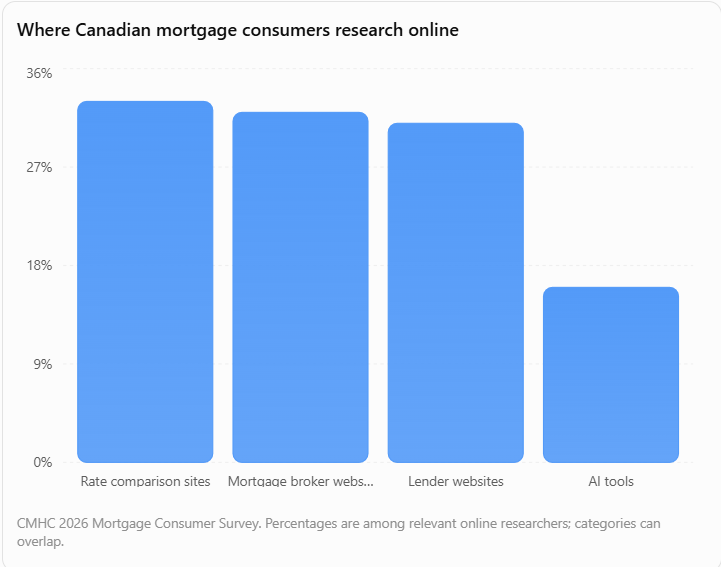
These findings reinforce the importance of having an informative website rather than relying entirely on paid advertising.
Borrowers may discover your business through several sources before contacting you. Someone might first encounter an Instagram video, later search for refinancing information, and eventually request a consultation through your website.
The acquisition process should make these interactions consistent and useful.
10 Proven Approaches to Mortgage Lead Generation Marketing
No single channel consistently delivers the best leads for every Canadian mortgage brokerage.
The right mix depends on service specializations, target geography, competition, existing visibility, and operational capacity.
The following methods address different stages of the borrower journey.
1. Use Google Ads to Reach Borrowers Actively Searching for Mortgage Assistance
Google Search advertising can be valuable because it reaches people who are already expressing a need through their searches.
Someone searching for mortgage refinancing assistance in Mississauga may be closer to contacting a professional than someone casually watching a general homeownership video.
The strongest campaigns separate audiences based on their immediate requirements.
A mortgage renewal campaign should use renewal-related keywords, appropriate advertising copy, and a dedicated landing page explaining the service.
A first-time buyer campaign should address a different set of questions, including the preparation process, qualification considerations, and financing expectations.
Avoid combining unrelated mortgage services within a single generic campaign if that prevents meaningful control over budgets, advertisements, and landing pages.
Focus on Search Intent Rather Than Keyword Volume
High search volume does not necessarily mean high commercial value.
A broad query such as “mortgage calculator” may attract consumers who only want to estimate payments.
A service-oriented query indicating that someone wants a mortgage consultation may represent a different level of intent.
Keyword research should distinguish informational searches from service-seeking searches.
Negative keyword management is equally important. If your brokerage does not offer a particular financing product, searches related to that product may need to be excluded.
This helps reduce expenditure on irrelevant traffic.
Connect Advertisements With Dedicated Landing Pages
An advertisement about refinancing should not send visitors to a homepage requiring them to search for refinancing information.
A dedicated landing page should explain what the brokerage offers, who may benefit from a consultation, and what happens after someone submits an enquiry.
Google’s financial products and services advertising policy also requires appropriate landing-page disclosures, including the provider’s physical address and associated fees, along with verification of relevant affiliations where asserted.
A well-aligned landing page can improve the user experience while providing more meaningful information about the advertised service.
2. Build Local SEO Visibility Across Relevant Canadian Markets
Local SEO helps mortgage professionals become discoverable through geographically relevant searches.
A brokerage operating in Ottawa may want to reach homeowners and buyers within its genuine service area. Similarly, a mortgage professional serving Edmonton may benefit from appearing in searches that combine mortgage services with the city.
Start by maintaining an accurate Google Business Profile where eligible.
The business name, contact information, address or permitted service-area details, and website should reflect the actual business.
The website should support this local presence through service pages that provide genuinely relevant information.
For example, a mortgage broker serving Toronto could develop a detailed page explaining available mortgage renewal services and how consultations work in that market.
Avoid generating dozens of nearly identical pages that only substitute different city names.
Local credibility should come from real service coverage, relevant information, and verifiable professional details.
Treat Reviews as Trust Signals, Not Shortcuts
Genuine reviews can help prospective borrowers evaluate their experience with a mortgage business.
Encourage feedback without offering incentives or manufacturing positive testimonials.
Avoid revealing private financial details when responding publicly.
Reviews should complement, not replace, clear information about licensing, services, and the consultation process.
3. Create SEO Content Around High-Intent Mortgage Questions
Content marketing supports lead generation by helping borrowers understand decisions before they are ready to contact a professional.
A person researching mortgage refinancing costs may be evaluating whether a consultation is worthwhile. Someone approaching renewal might want to understand how switching lenders works.
These questions create opportunities for detailed educational articles.
The key is connecting the subject to an actual service offered by the brokerage.
For example, an article about mortgage renewal preparation can explain timelines, payment considerations, mortgage features, and potential switching costs.
Relevant internal links can then connect readers to a mortgage renewal service page.
The article should remain useful as a standalone resource. Readers should not have to submit their contact information simply to understand basic mortgage concepts.
Build Related Content Rather Than Isolated Blog Posts
A comprehensive renewal guide could support detailed articles about switching lenders, fixed versus variable renewal options, and common renewal mistakes.
A refinancing guide could connect to resources about prepayment penalties, debt consolidation considerations, and home equity.
This structure helps visitors explore related information and creates logical paths toward professional assistance.
For a brokerage investing in long-term organic visibility, a useful content library can become an important source of discovery.
4. Use Meta Ads to Introduce Relevant Mortgage Services
Facebook and Instagram advertising can help mortgage businesses reach eligible audiences who may not be actively searching for a broker.
These channels often require a different approach from search advertising.
Rather than assuming immediate purchase intent, use educational messages that introduce recognizable borrower concerns.
A video might explain questions homeowners should review before renewing a mortgage. An advertisement could introduce an educational first-time buyer guide.
The objective is to create relevant interest and guide users toward a useful resource or appropriate consultation.
Mortgage advertisers must follow Meta’s current financial products and services policies, including applicable restrictions on audience targeting, verification, and advertising claims.
Do not assume that every demographic targeting option is available for mortgage campaigns.
5. Offer Useful Resources Instead of Generic Lead Magnets
A downloadable resource can create an opportunity for someone to engage with the brokerage.
However, not every free checklist deserves a person’s contact information.
A resource should solve a recognizable problem.
For example, a mortgage renewal preparation checklist could help homeowners identify information worth reviewing before discussing their next term.
A first-time homebuyer checklist could explain common financial preparation steps and documentation considerations.
The resource should be genuinely useful, not a short advertisement disguised as a guide.
Also explain clearly what happens when someone requests it. Accessing an educational resource should not automatically result in indefinite promotional messages without the required consent basis.
6. Develop Online Referral Relationships With Real Estate Professionals
Professional referrals are not exclusively an offline marketing channel.
Mortgage brokers can use LinkedIn, educational webinars, co-authored resources, and appropriate digital networking to build relationships with real estate professionals.
The strongest approach is to demonstrate expertise before requesting client introductions.
For example, a mortgage broker could organize a webinar explaining the differences between pre-approval and final mortgage approval, with particular attention to the questions real estate agents commonly encounter during transactions.
The session could help agents recognize when clients need additional mortgage guidance.
A useful educational relationship provides more substance than repeatedly asking agents to send their buyers.
Any referral arrangement involving financial compensation, benefits, or client information sharing must comply with the applicable provincial regulatory requirements and obtain necessary approvals.
7. Improve Mortgage Website Conversion Rates
A brokerage can increase enquiries without purchasing additional traffic if its existing website has avoidable conversion barriers.
Someone arriving on a mortgage refinancing page should quickly understand whether the service is relevant, what the process involves, and how to request assistance.
A confusing website can discourage visitors even when the underlying marketing campaign is well targeted.
Important conversion elements include clear headlines, accurate professional credentials, relevant service information, mobile-friendly navigation, accessible consultation options, and concise initial enquiry forms.
Avoid asking for sensitive financial documents through ordinary marketing forms when those details are not necessary for the initial interaction.
A form requesting someone’s name, appropriate contact information, and service interest may be sufficient to arrange an introductory conversation.
Further information can be collected through secure, authorized processes when necessary.
8. Use Email Marketing to Nurture Interested Borrowers
Some borrowers need several weeks or months to make a financing decision.
Email marketing can help maintain appropriate communication during that period, particularly when recipients have requested educational information.
The content should reflect the person’s interests.
A first-time buyer may appreciate explanations of pre-approval, down payment requirements, and closing costs.
A homeowner preparing for renewal may prefer information about reviewing lender offers and evaluating mortgage terms.
These audiences should not receive identical sequences simply because they are stored in the same CRM.
Canada’s Anti-Spam Legislation (CASL) generally requires consent, sender identification, and a functioning unsubscribe mechanism for commercial electronic messages, subject to applicable exemptions.
A brokerage should therefore distinguish necessary operational communication from promotional emails and maintain appropriate consent records.
9. Use Mortgage Marketing Automation for Faster Lead Follow-Up
Generating a relevant enquiry is only useful if the brokerage can respond appropriately.
Automation can help ensure that new enquiries enter the CRM, receive an acknowledgement, and are assigned to a responsible mortgage professional.
For example, a prospect requesting a refinancing consultation might receive confirmation that their request has been received, together with information about scheduling the next conversation.
The broker can receive an internal notification and review the enquiry.
If an appointment is booked, the original follow-up workflow should update so the client isn’t repeatedly asked to schedule again.
Automated communication should not make unverified mortgage approval claims or replace a professional’s responsibility to evaluate individual circumstances.
10. Reconnect With Existing Clients Approaching Renewal
Not every mortgage lead needs to come from a stranger.
Past clients may require additional mortgage services when their terms approach maturity, when they consider purchasing another property, or when their financial circumstances change.
A brokerage with accurate records can create internal reminders to review these opportunities.
For example, a client whose mortgage term expires in several months may benefit from a timely discussion about their renewal options.
This can be more relevant than sending generic financing promotions to every previous client.
Existing-client marketing still requires respect for consent, privacy, and communication preferences.
The objective is to remain helpful when a legitimate financing need emerges, not to pressure someone into an unnecessary mortgage transaction.
Which Online Channels Generate the Most Valuable Mortgage Leads?
Mortgage businesses often ask which channel produces the best leads.
A more useful question is which channel attracts suitable borrowers at an economically sustainable cost.
Search advertising may reach consumers actively seeking assistance. Social media may introduce the brokerage to people earlier in their financial journey. SEO content can support ongoing educational discovery, while referral relationships may bring prospects who already have some familiarity with the business.
These channels should not be judged using identical expectations.
| Channel | Primary strength | Important limitation |
| Google Search Ads | Reaches people expressing specific search intent | Costs and competition vary by market |
| Local SEO | Supports discovery through geographically relevant searches | Requires genuine presence, accuracy, and ongoing work |
| Educational SEO content | Answers borrower questions and builds organic visibility | Results may take time to develop |
| Meta advertising | Introduces services to broader eligible audiences | Interest doesn’t necessarily indicate immediate mortgage intent |
| Professional referrals | Connects relevant clients through established relationships | Depends on trust, consent, and relationship development |
| Email and CRM | Supports nurturing, retention, and renewals | Requires accurate records and lawful communication |
A new brokerage with little organic visibility may initially rely more on focused paid search campaigns while building useful website resources.
An established business with a substantial client database may find that renewal communication and improvements to existing landing pages deserve attention before additional advertising.
The most effective mix depends on where suitable business opportunities can be generated and managed reliably.
A Digital Marketing Strategist’s Approach to Mortgage Lead Generation
A capable digital marketing strategist mortgage lead generation process should start with the brokerage’s business economics, not a list of marketing platforms.
Before launching campaigns, determine which services the brokerage wants to grow, which borrowers it can serve, and how much it can sustainably spend to acquire a funded client.
At SuperKreatives, we recommend evaluating the acquisition process through five connected stages.
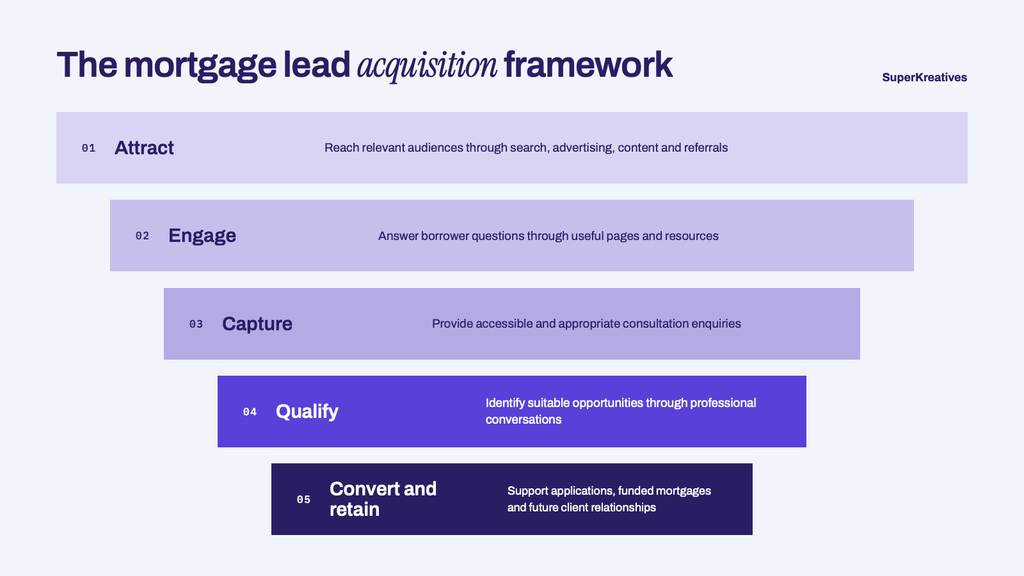
This framework helps identify where the actual marketing problem occurs.
If traffic is low, acquisition may need improvement. If the site attracts relevant visitors but few enquiries, page clarity or usability may be the issue.
If enquiries are plentiful but few become consultations, review lead targeting, qualification processes, and follow-up.
Increasing advertising expenditure without identifying the weak point can amplify inefficiency.
How to Generate More Leads for Mortgage Marketing Without Lowering Lead Quality
More leads do not necessarily mean better results.
Imagine a campaign that increases enquiries by 50% but attracts mainly consumers seeking products the brokerage doesn’t provide. The marketing dashboard may look impressive, while the team spends additional time handling unsuitable requests.
A better approach is to improve the relevance of the traffic and the expectations created by the campaign.
Use Service-Specific Campaigns and Landing Pages
A general message promising mortgage assistance may attract many types of enquiries.
A service-specific campaign can communicate more clearly.
For example, a mortgage renewal advertisement could direct visitors to a page explaining renewal considerations and the brokerage’s consultation process.
The content helps the visitor decide whether the service meets their needs.
Similarly, a self-employed mortgage campaign should explain that eligibility depends on documentation, income assessment, lender criteria, and individual circumstances.
This approach may produce fewer enquiries than exaggerated or overly broad advertising, but the conversations can be more relevant.
Improve Follow-Up Rather Than Simply Increasing Traffic
A brokerage should examine how quickly and reliably it acknowledges enquiries.
A relevant lead may become difficult to convert if a consultation request sits unanswered.
Set clear internal responsibilities for checking enquiries, arranging consultations, and maintaining CRM records.
Where automation is used, test what happens when the same person submits multiple forms, schedules an appointment, or asks not to receive further promotional communication.
These details influence the experience after the marketing campaign has done its job.
Evaluate the Borrower’s Experience
The person submitting an enquiry should understand what happens next.
Will someone call them? Can they book an appointment? Are they requesting general information or beginning an actual application?
Uncertainty can create unnecessary hesitation.
Keep initial forms proportionate and provide a clear confirmation after submission.
Do not imply that completing a contact form means the borrower has been pre-approved or that financing is guaranteed.
How Much Does Mortgage Lead Generation Cost in Canada?
There is no reliable single cost per mortgage lead that applies across Canada.
Advertising costs can differ according to location, competition, mortgage service, search intent, campaign quality, and the time of year.
A campaign targeting refinancing enquiries in Toronto may perform differently from one promoting first-time buyer consultations in a smaller Canadian market.
The most useful approach is to calculate actual acquisition costs rather than rely on broad online benchmarks.
Calculate Cost Per Lead and Cost Per Qualified Consultation
Consider a hypothetical campaign with the following results.
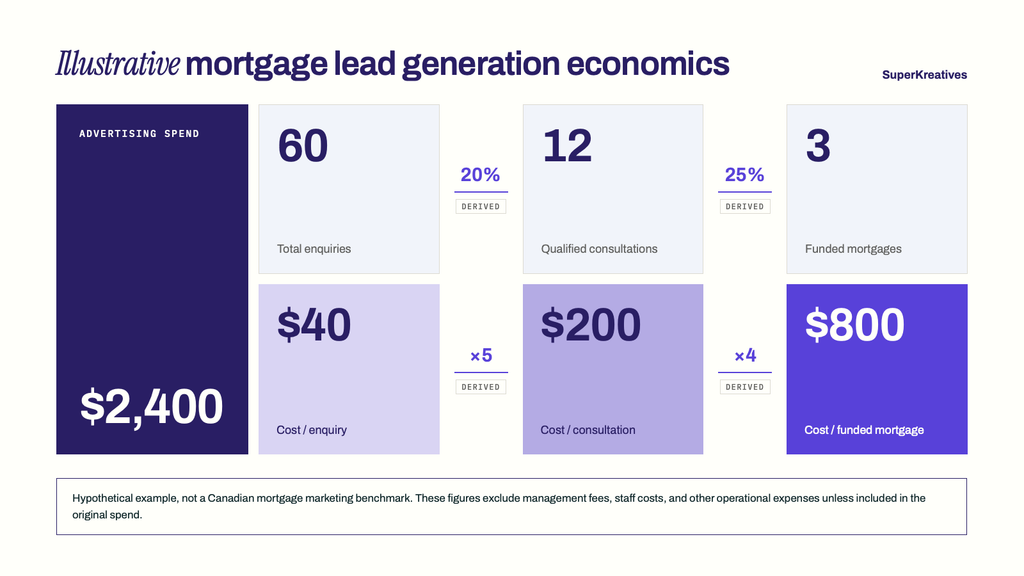
The basic cost per lead formula is:
(Image)
However, a low cost per lead doesn’t necessarily indicate profitable marketing.
The brokerage should calculate its cost per qualified consultation and cost per funded mortgage, then compare those amounts with its actual contribution margin.
Revenue per funded mortgage can vary depending on product characteristics, lender arrangements, and the brokerage’s compensation structure.
Marketing decisions should reflect those differences.
Should Mortgage Brokers Buy Leads?
Purchasing third-party mortgage leads is another potential acquisition method, but it introduces questions about quality, exclusivity, consent, and the source of the information.
A lead advertised as exclusive may still have been exposed to other brokers. Someone who completed a general comparison form may not expect contact from a particular brokerage.
Before purchasing leads, verify how the information was collected, what disclosures were presented, whether the proposed sharing and outreach are legally permitted, and what the supplier actually guarantees.
A purchased contact list should never be treated as automatic permission for unrestricted promotional emails or text messages.
For brokerages without an established lead qualification and follow-up process, improving owned acquisition channels may be a more useful starting point.
Canadian Mortgage Lead Generation Compliance
Mortgage marketing involves regulated services and sensitive financial information.
Advertising that produces enquiries but misleads consumers or mishandles personal data can create substantial business risks.
In Ontario, the Financial Services Regulatory Authority of Ontario (FSRA) requires mortgage-related advertising to clearly and prominently identify the authorized brokerage name and licence number. When an individual broker or agent is identified, the appropriate licensed name and title must also appear.
FSRA prohibits false, misleading, and deceptive claims in public-facing marketing materials. These requirements include websites, advertisements, and relevant email communications.
British Columbia’s BC Financial Services Authority also provides mortgage services advertising guidance requiring clear brokerage identification and appropriate advertising practices.
A brokerage operating across several provinces should verify the requirements applicable to each jurisdiction.
Protect Personal and Financial Information
Initial lead forms should collect information appropriate to the enquiry.
A consultation form normally does not need copies of identification documents, tax returns, bank statements, or other detailed financial records.
Such information should be collected through authorized secure processes when necessary.
Review privacy notices, consent mechanisms, CRM permissions, and third-party advertising integrations to ensure borrower information is handled appropriately.
Avoid Misleading Mortgage Advertising
Claims such as guaranteed approval, universal access to the lowest rate, or certain refinancing savings can create inaccurate expectations.
Mortgage eligibility and product suitability depend on the borrower’s circumstances and applicable lender requirements.
Advertising should clearly describe the service offered without promising outcomes that haven’t been established.
A 90-Day Online Mortgage Lead Generation Plan
Building a dependable lead generation process requires coordinated work rather than continuously launching unrelated campaigns.
The following plan offers a practical starting framework for a Canadian mortgage brokerage.
| Timeline | Primary objective | Recommended activities |
| Days 1–30 | Establish acquisition foundations | Define target borrowers, audit the website, review compliance, establish CRM stages, and configure reliable conversion tracking |
| Days 31–60 | Launch focused acquisition activities | Improve local SEO, publish relevant service content, test search advertising, and develop suitable landing pages |
| Days 61–90 | Improve enquiry quality | Review lead sources, optimize campaign targeting, strengthen follow-up, and evaluate qualified consultations |
Days 1–30: Establish the Baseline
Begin by documenting existing marketing performance.
Identify where enquiries originate, which mortgage services they relate to, and how many progress to consultations.
Review the website’s most important service pages and confirm that consultation forms work correctly on desktop and mobile devices.
If the business already receives sufficient traffic, conversion improvements may deserve priority over launching another advertising campaign.
Days 31–60: Test Relevant Acquisition Channels
Launch a limited number of campaigns based on the brokerage’s actual strengths.
For example, a business specializing in mortgage renewals might prioritize one renewal service page, supporting educational content, and a carefully controlled paid search campaign.
Maintain consistent messaging between advertisements and landing pages.
Review search terms, lead relevance, and the quality of initial consultations rather than immediately increasing budgets based on click volume.
Days 61–90: Optimize Based on Business Outcomes
By the third month, the brokerage should have a clearer picture of which activities generate suitable enquiries.
Investigate campaigns that produce high enquiry volume but few consultations.
Also review any channel delivering lower volumes of more relevant prospects.
Continue improving lead handling, contact records, and follow-up processes.
A 90-day plan provides an initial learning period, not a guarantee of specific lead numbers or funded mortgage results.
Common Mistakes in Marketing for Mortgage Leads
Several mistakes can prevent online acquisition campaigns from producing meaningful results.
Treating every enquiry as qualified: A contact form submission indicates interest, not confirmed financing suitability. Distinguish initial enquiries from professionally assessed opportunities.
Using generic campaigns for every service: First-time buyers, renewal clients, and refinancing borrowers have different concerns. The messaging should reflect their actual needs.
Sending paid traffic to unrelated pages: A mortgage renewal advertisement should lead to relevant renewal information, not an unfocused homepage.
Ignoring enquiry follow-up: A suitable prospect may become difficult to convert when communication is delayed or confusing.
Overlooking compliance: Misleading approval promises, inadequate disclosures, or improper use of contact information can create risks that outweigh the value of additional enquiries.
Measuring only cost per lead: Low-cost enquiries are not necessarily valuable. Follow the progression toward consultations, applications, and funded transactions.
At SuperKreatives, we recommend correcting these issues before expanding advertising investment. More traffic will rarely solve a broken acquisition process.
Final Thoughts: Focus on Qualified Borrowers, Not Just More Leads
Learning how to get leads for mortgage brokers with online marketing is not simply about increasing advertising expenditure or collecting more contact details.
It requires identifying the borrowers a brokerage is best equipped to serve, understanding where those people research financing, and building useful connections between marketing channels and professional consultations.
For Canadian mortgage businesses, Google Ads can help reach active searchers, local SEO can improve geographic discoverability, educational content can establish credibility, and CRM processes can support timely communication.
At SuperKreatives, we believe the most important question is not how many leads a campaign produces. It’s how many relevant borrowers move through a trustworthy, efficient process toward appropriate mortgage assistance.
Start with accurate audience targeting, clear service information, and a reliable enquiry experience. Measure the progression from visitor to qualified consultation and completed business wherever possible.
When those foundations work together, online marketing becomes a more dependable source of mortgage opportunities rather than a continual effort to purchase the next batch of enquiries.
Frequently Asked Questions
How can mortgage brokers generate leads online in Canada?
Mortgage brokers can generate online enquiries through relevant Google Ads, local SEO, educational articles, service-specific landing pages, social media, and professional referral relationships. The most effective approach connects those channels with clear consultation options and a reliable follow-up process.
What is the best mortgage lead generation marketing strategy?
There is no single strategy that works best for every brokerage. Paid search may be useful for reaching borrowers with immediate service intent, while SEO and educational content can support longer-term discovery. The best approach depends on the target audience, service specialization, competition, and acquisition costs.
How do I generate more leads for mortgage marketing without increasing my budget?
Start by improving existing landing pages, simplifying consultation forms, reviewing search targeting, and fixing gaps in lead follow-up. Re-engaging eligible existing clients through appropriate communication may also create relevant opportunities. Measure whether these changes improve qualified enquiries rather than form submissions alone.
Are Google Ads effective for mortgage broker leads?
Google Ads can help brokerages reach people actively searching for mortgage services. Campaign performance depends on keyword selection, geographic relevance, competition, landing page quality, and follow-up. Lead quality and funded mortgage outcomes are more meaningful than clicks alone.
Is SEO better than paid advertising for mortgage leads?
SEO and paid advertising serve different purposes. SEO can support long-term organic discovery through useful service pages and content, while paid search can provide controlled access to relevant searches. A brokerage may benefit from both, with the allocation determined by its budget and existing visibility.
Should mortgage brokers buy mortgage leads from third-party companies?
Purchased leads may be worth evaluating, but the brokerage should verify lead origin, exclusivity claims, contact permissions, privacy practices, and actual quality. The cost of unsuitable enquiries and follow-up time should be included when comparing purchased leads with direct acquisition campaigns.
What is a good cost per mortgage lead in Canada?
There is no universal cost per lead that applies to every Canadian market or mortgage service. Costs vary with competition, targeting, and lead definitions. A brokerage should compare its actual cost per enquiry with qualified consultation rates, funded mortgage outcomes, and business economics.
Can mortgage marketing automation improve lead conversion?
Automation can support timely acknowledgements, enquiry assignment, appointment reminders, and consistent internal follow-up. Its value depends on accurate records and properly configured workflows. It should not replace professional mortgage assessments or send unverified approval information.