A mortgage brokerage can spend thousands of dollars on Google Ads, invest months in search engine optimization, and consistently publish educational content, yet struggle to generate qualified enquiries. Sometimes, the problem isn’t the traffic or the marketing campaigns. It’s what happens after a potential borrower arrives on the website.
Imagine a homeowner in Toronto searching for mortgage refinancing options. They click through to a brokerage’s website, but the homepage talks about every mortgage service at once. The contact form asks for too much information, the professional credentials are difficult to find, and the visitor isn’t sure what happens after submitting an enquiry.
They leave without contacting the brokerage.
This is one of the biggest conversion challenges facing Canadian mortgage marketing websites. Attracting visitors is only the beginning. A successful mortgage website must help prospective borrowers understand their options, establish confidence in the business, and take the next step without unnecessary confusion.
For Canadian mortgage brokers, agents, and lenders, website conversion optimization is not simply about changing button colours or adding more enquiry forms. It involves understanding borrower intent, simplifying the user experience, providing credible information, protecting personal data, and measuring which interactions lead to suitable consultations.
In this guide, we’ll explore how to structure a mortgage website for conversions, which elements matter most, how to improve landing pages and enquiry forms, and how to build a reliable system for turning website visitors into qualified mortgage opportunities.
Why Mortgage Website Conversions Matter More Than Traffic Alone
Website traffic shows how many people arrive. Conversion performance helps explain what those visitors do once they get there.
A mortgage brokerage receiving 5,000 monthly website visits may initially appear to be performing better than a competitor receiving only 1,500. However, traffic volume alone tells us little about how many visitors need the services offered or whether they take meaningful action.
Consider the following hypothetical comparison.
| Performance metric | Website A | Website B |
| Monthly visitors | 5,000 | 1,500 |
| Enquiries received | 50 | 45 |
| Visitor-to-enquiry rate | 1% | 3% |
| Qualified consultations | 10 | 18 |
Website A attracts considerably more traffic, but Website B generates more qualified consultations.
These are illustrative numbers, not Canadian mortgage industry benchmarks. They demonstrate why acquisition and conversion should be evaluated together.
A visitor reading an article about mortgage qualification is not necessarily ready to apply. Someone searching for a broker who handles self-employed borrowers may have a much clearer service requirement.
An effective website recognizes those differences and provides an appropriate next step for each audience.
At SuperKreatives, we approach mortgage website performance by examining the full journey from search query or advertisement to landing page, enquiry, consultation, and subsequent business outcome.
The objective isn’t simply to increase the number of completed forms. It’s to help the right borrowers reach the right mortgage professionals.
What Makes Canadian Mortgage Marketing Websites Convert?
A high-converting mortgage website generally performs five functions well: communicates relevance, explains services, establishes credibility, removes unnecessary friction, and directs visitors toward an appropriate action.
These elements must work together.
A beautifully designed website may still underperform if visitors cannot determine whether the brokerage offers the mortgage service they need. Similarly, a website with detailed educational content can lose enquiries when its contact process is confusing.
1. A Clear Value Proposition Above the Fold
The first visible section of a mortgage website should help visitors understand what the business does, whom it serves, and why they should continue exploring.
An introductory headline such as “Your Dreams, Our Commitment” sounds appealing but provides almost no information about the service.
A more useful headline might be:
“Mortgage Guidance for Homebuyers, Homeowners, and Refinancing Clients in Ontario.”
The supporting description could explain that the brokerage assists with mortgage renewals, refinancing, first-time purchases, and other services it actually offers.
A prominent consultation link can then provide a relevant next step.
This doesn’t mean every website should use the same headline. A brokerage specializing in private lending or self-employed mortgages may need a more focused message.
The key is to establish relevance immediately rather than making visitors interpret vague promotional language.
2. Straightforward Website Navigation
Mortgage consumers should not have to search through multiple menus to find basic service information.
The primary navigation should reflect how visitors think about their borrowing needs.
For a brokerage offering several common services, the menu could contain mortgage purchases, renewals, refinancing, first-time buyer resources, about the brokerage, and contact information.
Educational articles can sit within a dedicated resource section.
Avoid placing every service, location, calculator, promotional offer, and blog category into the main navigation. An overcrowded menu can make important pages harder to discover.
On mobile devices, navigation deserves particular attention. Menus should open reliably, link labels should remain readable, and contact options should be easy to access.
3. Credible Information Before Aggressive Calls to Action
Mortgage transactions involve substantial financial commitments. Visitors may want reassurance before sharing their contact information.
A website should provide enough information for potential borrowers to evaluate whether the business is relevant and legitimate.
Useful trust signals include accurate professional credentials, brokerage identification, a clear explanation of services, genuine reviews where permitted, and information about what happens during a consultation.
Trust shouldn’t depend on exaggerated statements such as “Canada’s Most Trusted Mortgage Broker” unless the claim is verifiable and appropriately substantiated.
In a regulated industry, authenticity is more valuable than unsupported superlatives.
Structuring a Mortgage Marketing Website Around Borrower Intent
One of the most important conversion improvements is creating dedicated pages for distinct mortgage services.
A homepage can introduce the brokerage, but it cannot always answer every question a borrower has about a particular financial situation.
Someone researching refinancing needs different information from someone preparing to purchase their first home.
Build Individual Pages for Major Mortgage Services
A brokerage website should have a clear page for each meaningful service it offers.
For example, a mortgage renewal page could explain the renewal process, what homeowners should review before accepting a lender’s offer, and how consultation services work.
A refinancing page should discuss why people refinance, what costs may arise, and why extending a repayment period can influence total borrowing expenses.
A first-time buyer page may need explanations of pre-approval, down payments, closing costs, and financial preparation.
These pages should be detailed enough to answer common questions while remaining focused on their specific purpose.
The call to action should also reflect the service.
“Request a Mortgage Renewal Review” is more relevant on a renewal page than a generic “Get Started” button that doesn’t explain what will happen.
Create Educational Content for Visitors Who Aren’t Ready to Enquire
Not every visitor is prepared to speak with a mortgage professional.
Someone searching for the difference between fixed and variable mortgages may be gathering information before making a decision.
A useful educational article can answer that question without forcing an immediate sales conversation.
Relevant internal links can then direct readers to detailed service pages or related guides when appropriate.
For example, an article about refinancing costs might naturally link to a mortgage refinancing service page and a supporting guide about prepayment penalties.
This allows the website to support readers at different stages of the decision-making process.
Use Location Pages Only When They Provide Genuine Local Value
Canadian mortgage businesses often target several cities or communities.
Location-specific pages can be useful when they accurately describe services available in those areas and provide information relevant to the local audience.
However, creating dozens of nearly identical pages that only replace “Toronto” with “Mississauga,” “Brampton,” or “Ottawa” is unlikely to create a useful experience.
A meaningful location page should explain actual service coverage, offer appropriate local context, and clarify how the brokerage assists clients in that market.
Where provincial regulatory requirements differ, those differences should be addressed accurately.
Geographic relevance should never be fabricated merely to produce another search-optimized page.
How to Design High-Converting Mortgage Landing Pages
A mortgage landing page is generally created to support a specific visitor action, such as requesting a consultation, registering for a webinar, or obtaining an educational resource.
Unlike the homepage, a landing page should concentrate on one primary audience and objective.
Consider a Google Ads campaign targeting homeowners interested in mortgage refinancing.
Sending those visitors to a generic homepage forces them to identify the relevant service themselves. A dedicated refinancing landing page can address their questions immediately.
The Essential Elements of a Mortgage Landing Page
An effective landing page begins with a headline aligned with the visitor’s original search or advertisement.
If the advertisement discusses refinancing options, the landing page should continue that subject rather than introduce an unrelated financing product.
The supporting content should explain what the service involves, who may benefit from professional guidance, and which considerations could influence the decision.
Trust information should be accessible without requiring extensive navigation. The page should also explain what happens after someone submits a consultation request.
A practical page structure might look like this:
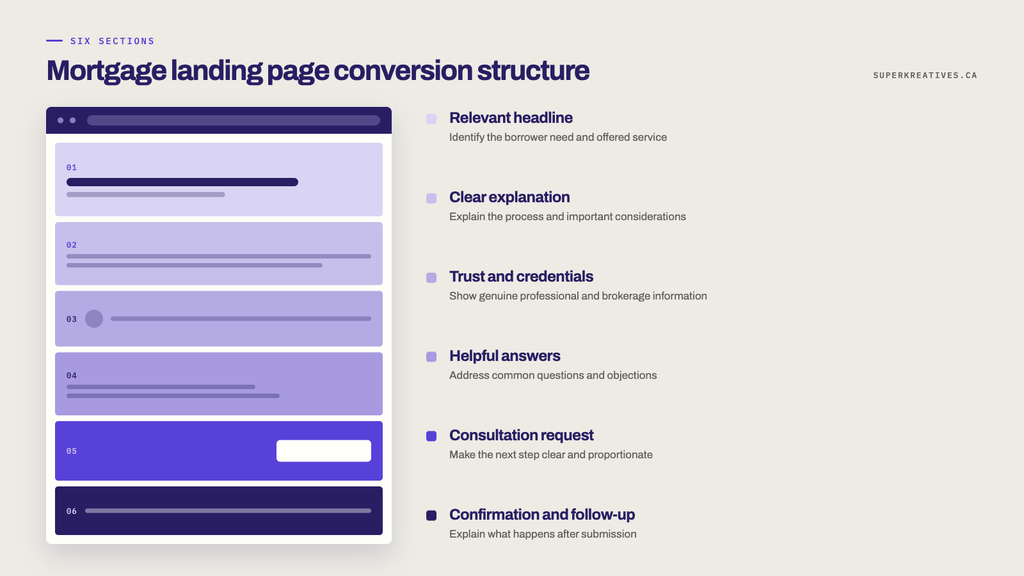
Each section should serve a clear purpose.
A lengthy introduction about the history of mortgages may not belong on a conversion-focused refinancing landing page. Likewise, a generic testimonial slider should not displace essential information about costs or eligibility.
The page should help visitors make an informed decision about whether to seek assistance.
Build Landing Pages Around One Primary Call to Action
A landing page can offer supporting navigation and educational links, but it should have one obvious next step.
For example, a mortgage renewal page might encourage users to request a renewal consultation.
Avoid placing several equally prominent actions in the same section, such as applying immediately, downloading a guide, joining a newsletter, calling the office, and completing a financial questionnaire.
These options may all have a place on the website, but presenting them with equal priority can create confusion.
The primary call to action should match the visitor’s likely readiness.
Someone researching mortgage qualification may prefer an introductory conversation. A returning client with an approaching maturity date may be ready to schedule a renewal review.
How to Improve Mortgage Website Forms Without Sacrificing Lead Quality
Contact forms are an important source of friction on many mortgage websites.
A visitor may be willing to request a consultation but unwilling to provide detailed financial information before speaking with a professional.
The form should therefore collect information proportionate to the action being requested.
Ask Only for What the Initial Conversation Requires
For a general consultation request, useful fields may include the person’s name, contact information, service of interest, and preferred method of communication.
A short optional message field can allow the visitor to provide relevant context.
Detailed employment history, tax returns, banking records, identification documents, and other sensitive information generally belong in an appropriately secured application or document collection process, not an ordinary marketing contact form.
The Office of the Privacy Commissioner of Canada explains that meaningful consent requires individuals to understand how their personal information will be collected, used, and disclosed. The sensitivity of the information also affects how consent should be obtained.
This is particularly relevant to mortgage websites because financial information can be highly sensitive.
Explain What Happens After Submission
A confirmation message should do more than display “Thank you.”
It can explain that the request was received, identify the next expected step, and provide appropriate contact options.
Avoid promising a callback within a specific period unless the brokerage has a reliable process to meet that commitment.
If a scheduling system is available, users may be offered the option of booking an appointment directly.
Automated acknowledgement emails can also be useful, provided the system distinguishes an operational acknowledgement from promotional messages.
Keep Marketing Consent Separate
A person requesting mortgage assistance should be able to understand whether they are also being asked to subscribe to promotional emails.
Canada’s Anti-Spam Legislation generally requires an appropriate basis for consent, sender identification, and an unsubscribe mechanism for commercial electronic messages, subject to applicable exceptions. The CRTC also explains that obtaining express consent involves an affirmative opt-in action.
Do not rely on confusing consent language or assume that every enquiry permits indefinite newsletter subscriptions.
Separate, clear choices create a more transparent experience.
Why Trust Signals Are Essential for Mortgage Marketing Websites
Mortgage borrowers may evaluate several professionals before deciding whom to contact.
The website should make it easy to verify who operates the business and understand what kind of assistance is available.
Show Accurate Brokerage and Professional Credentials
Ontario’s Financial Services Regulatory Authority of Ontario (FSRA) requires public-facing mortgage materials, including websites, to clearly and prominently disclose the brokerage’s authorized name and licence number.
Where an individual agent or broker is named, the licensed name and appropriate authorized title must also be used.
These are regulatory requirements, not merely optional conversion features.
For mortgage businesses operating in other provinces, the applicable regulator’s rules should be reviewed.
British Columbia’s Financial Services Authority also provides guidance on prominent brokerage identification and accurate mortgage service advertising.
Where appropriate, official licence verification links can help visitors independently assess professional credentials.
Use Real Client Reviews and Testimonials Responsibly
Genuine reviews may help prospective borrowers understand the experience of working with a mortgage professional.
However, testimonials should not be invented, manipulated, or presented in a misleading way.
A statement about a client’s experience should not imply that other borrowers will receive identical mortgage terms or financial outcomes.
Obtain appropriate permission before publishing identifiable customer information, photographs, or transaction details.
It is also important to avoid using only exaggerated praise without any context. Reviews are most useful when they provide credible information about the service experience.
Explain the Mortgage Consultation Process
Uncertainty about the next step can discourage enquiries.
A simple explanation of the process may help.
For example, a brokerage can explain that an introductory conversation typically involves discussing the borrower’s objectives, reviewing general circumstances, identifying possible next steps, and outlining any documentation that may eventually be required.
The process must reflect how the business actually operates.
Visitors should understand whether they are requesting an introductory consultation, a mortgage application, or a general information session.
These are different commitments and should not be presented interchangeably.
Mobile Optimization and Website Speed: Why They Affect Conversions
Many borrowers discover mortgage websites through mobile search, social media, or digital advertisements.
A landing page that works well on a desktop computer may still create substantial friction on a phone.
Small text, poorly positioned buttons, intrusive pop-ups, and forms that are difficult to complete can make a website frustrating to use.
Design for Mobile Users First
Important mortgage information should be readable without excessive zooming.
Navigation menus should be simple, consultation buttons should be easy to tap, and form fields should work with mobile keyboards.
A click-to-call option may be useful for visitors who prefer speaking directly with a professional.
However, it should not obstruct the content or interfere with other controls.
Mobile optimization is not simply a matter of shrinking the desktop layout. It requires prioritizing the information and actions that matter most on a smaller screen.
Monitor Core Web Vitals
Google identifies three Core Web Vitals that measure aspects of real-world page experience.
| Metric | What it measures | Google’s good-performance threshold |
| Largest Contentful Paint (LCP) | Loading performance | 2.5 seconds or less |
| Interaction to Next Paint (INP) | Responsiveness | 200 milliseconds or less |
| Cumulative Layout Shift (CLS) | Visual stability | 0.1 or less |
Google recommends achieving good Core Web Vitals as part of providing a positive page experience.
These measurements are useful diagnostic indicators, not guarantees of higher rankings or more mortgage enquiries.
From a practical conversion perspective, a page that takes too long to display important content may discourage engagement. Unexpected layout movements can also cause users to interact with the wrong element.
Review image sizes, unnecessary scripts, third-party widgets, fonts, and hosting performance when diagnosing these problems.
Tools such as Google PageSpeed Insights and Search Console can help identify technical issues.
Mortgage Website Conversion Tracking: Measure More Than Form Submissions
A mortgage business should understand which website activities contribute to meaningful enquiries.
Tracking every click as a conversion can create misleading performance reports.
For example, someone opening the navigation menu is not equivalent to a borrower submitting a consultation request.
A useful measurement setup distinguishes engagement actions from meaningful business outcomes.
Track the Right Conversion Events
| Event | Measurement purpose |
| Consultation form submission | Records a completed enquiry |
| Appointment booking | Indicates a scheduled discussion |
| Phone link click | Shows an attempt to initiate a call |
| Qualified consultation | Confirms an enquiry meets relevant service criteria |
| Mortgage application started | Indicates progression beyond an initial conversation |
| Funded mortgage | Records a completed business outcome where attribution is possible |
A phone link click does not prove that a call connected, and an enquiry does not prove that the person qualifies for a mortgage.
These distinctions matter when evaluating campaigns.
Connect Website Tracking With the CRM
Suppose a mortgage brokerage receives 60 enquiries through its website.
Thirty originate from organic search, 20 from Google Ads, and 10 from referral traffic.
The next step is to understand how many become appropriate consultations and applications.
A CRM can help record these stages when the team maintains accurate information.
Connecting website analytics with CRM outcomes allows the business to compare acquisition sources based on lead quality rather than enquiry volume alone.
Any integration must handle personal information appropriately. Sensitive financial records should not be indiscriminately transferred into advertising or analytics platforms.
Calculate Conversion Rates Properly
The basic website conversion rate formula is:
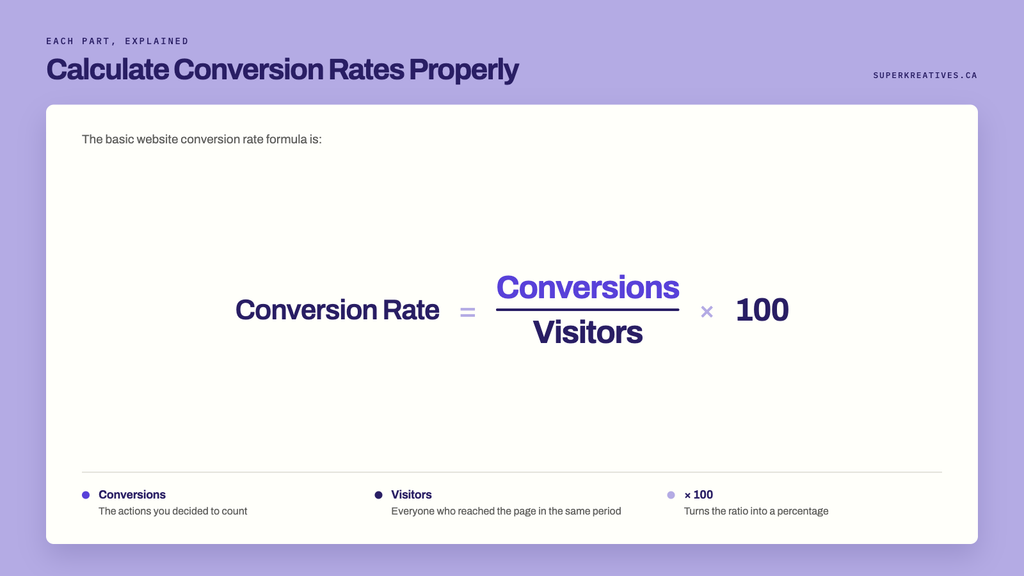
For example, if a landing page receives 1,000 visitors and generates 35 consultation enquiries, its visitor-to-enquiry rate is 3.5%.
However, the number becomes more meaningful when the brokerage also evaluates the quality of those enquiries.
If only five become suitable consultations, the business needs to understand whether the problem involves traffic targeting, unclear messaging, form submissions, or the qualification process.
There is no single conversion rate that every Canadian mortgage website should achieve. Performance depends on audience intent, traffic source, service type, and the definition of a conversion.
A Practical Conversion Framework for Canadian Mortgage Marketing Websites
Website conversion optimization becomes easier when improvements are organized into a repeatable process.
At SuperKreatives, we recommend examining five connected stages rather than making isolated design changes.
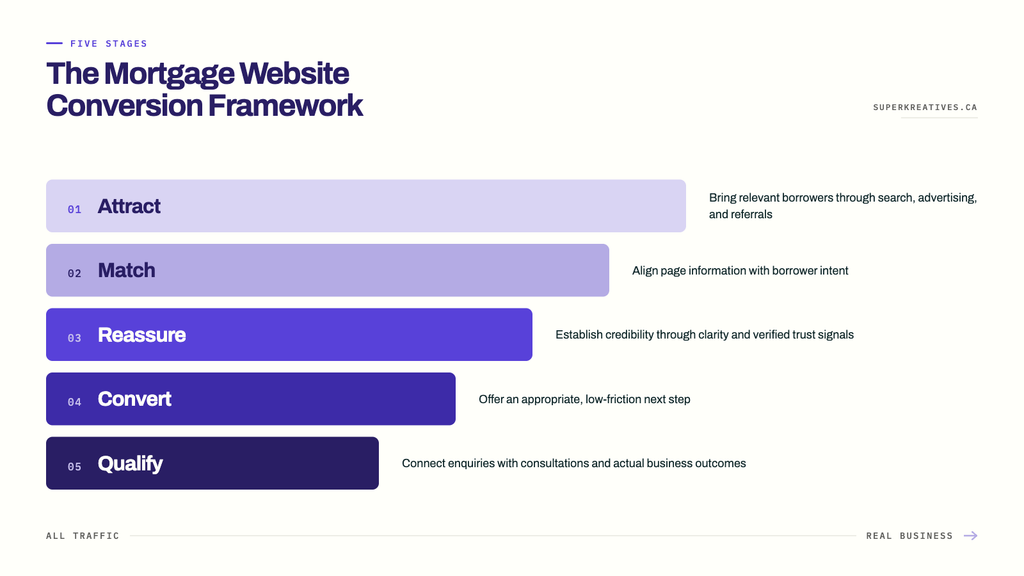
This framework helps identify why a website may receive traffic without generating suitable mortgage opportunities.
If visitors arrive through irrelevant search terms, the acquisition strategy needs improvement. If relevant visitors reach a page that doesn’t address their concerns, the content and message require attention.
When borrowers understand the service but remain uncertain about the business, trust and credibility may be the underlying issue.
If visitors reach the form but abandon it, investigate whether the information requested is excessive, the form is difficult to use, or the next step is unclear.
Finally, if a website generates many enquiries but few suitable consultations, the business should evaluate targeting, qualification, and follow-up processes.
The weakest stage often provides the most valuable starting point for optimization.
How to Test and Improve Mortgage Website Conversions
Conversion rate optimization should be based on evidence rather than assumptions about what visitors prefer.
For example, adding a large enquiry form to the homepage may appear logical, but it could discourage visitors who only want to understand available services.
Similarly, replacing a detailed service explanation with a short promotional message may reduce the information borrowers need before contacting the brokerage.
Start With Behaviour and Performance Data
Review which pages attract relevant visitors, where those visitors navigate, and which actions they complete.
Tools such as Google Analytics, Google Search Console, and appropriately configured behaviour analytics software can provide different perspectives.
Search Console helps identify the queries and pages generating organic visibility. Website analytics can show engagement and recorded conversion events.
Behaviour analytics may help reveal where users encounter navigation or form problems. Where recordings or heatmaps are used, privacy protections must be configured carefully to prevent sensitive borrower information from being captured.
Use these findings to formulate specific improvement hypotheses.
Run Focused A/B Tests
An A/B test compares two versions of a page or element to assess whether a change affects a defined outcome.
For instance, a brokerage could compare a generic “Contact Us” button against a service-specific “Book a Mortgage Renewal Consultation” button.
Another test might compare a long introductory form with a shorter form that collects only the information needed to arrange a conversation.
Change one meaningful element or a clearly defined group of related elements at a time, and evaluate results using adequate data.
Small mortgage websites may not receive enough traffic to support reliable statistical conclusions quickly. In those cases, usability reviews, user feedback, and larger structural improvements may be more useful than interpreting a handful of form submissions as proof of success.
Prioritize Lead Quality Alongside Conversion Volume
A shorter contact form could increase submissions while reducing the percentage of suitable enquiries.
That doesn’t necessarily make the change beneficial.
Likewise, an advertisement promising unrealistic approval outcomes could attract many contacts but create unsuitable leads and compliance concerns.
Every major conversion experiment should consider both the volume of enquiries and their progression into appropriate consultations.
A 90-Day Mortgage Website Conversion Improvement Plan
Mortgage brokerages can approach conversion optimization in phases rather than redesigning the entire website immediately.
| Timeline | Primary objective | Recommended activities |
| Days 1–30 | Audit the conversion journey | Review service pages, mobile usability, forms, credentials, analytics, and existing enquiry quality |
| Days 31–60 | Improve important pages | Refine headlines, service explanations, landing pages, form design, and calls to action |
| Days 61–90 | Test and measure | Monitor conversion events, evaluate lead quality, address technical friction, and test selected improvements |
During the first month, examine the pages receiving the most commercially relevant traffic.
A mortgage renewal page attracting qualified visitors may deserve attention before a low-traffic article about general financial terminology.
The second month should focus on correcting the clearest barriers to conversion. These may include confusing navigation, insufficient service explanations, missing trust information, or unnecessarily complex enquiry forms.
By the third month, compare performance against the established baseline.
Review whether consultation requests have changed and whether those enquiries are relevant to the services offered.
Avoid claiming success solely because a button receives more clicks. The objective is to create a better pathway toward meaningful business outcomes.
Common Conversion Mistakes Mortgage Websites Should Avoid
Several recurring problems can limit the effectiveness of otherwise well-designed mortgage websites.
Sending every campaign to the homepage: Different borrower groups need different information. Dedicated service pages or landing pages can provide greater relevance.
Asking for sensitive information too early: A consultation request should not unnecessarily require tax returns, banking information, or detailed financial records. Use secure application processes for information that becomes necessary later.
Overusing generic claims: Statements such as “Best Rates Guaranteed” or “Instant Mortgage Approval” can create misleading expectations. Financial claims must be accurate and appropriately qualified.
Hiding important brokerage information: Visitors should be able to identify the business and its licensed professionals. Required regulatory disclosures must also be displayed appropriately.
Ignoring the mobile experience: Small text, difficult forms, intrusive pop-ups, and poorly positioned buttons can prevent interested borrowers from completing basic actions.
Failing to follow up: Even a well-optimized website cannot compensate for enquiries that remain unanswered or appointments that are not managed reliably.
Measuring only website traffic: Traffic, form submissions, consultations, and funded mortgages represent different stages. Treating them as interchangeable makes it harder to assess marketing effectiveness.
Effective optimization addresses these problems systematically instead of continuously redesigning pages without a clear reason.
Final Thoughts: A Mortgage Website Should Do More Than Attract Visitors
The success of Canadian mortgage marketing websites should not be measured only by how modern they look, how many visitors they receive, or how prominently they display consultation buttons.
A useful mortgage website makes complicated financial subjects easier to understand, helps potential borrowers evaluate professional credibility, and provides an accessible next step when someone is ready for assistance.
For Canadian mortgage brokers and lenders, achieving this requires coordination between website structure, content, search visibility, advertising, user experience, privacy, and lead management.
At SuperKreatives, we believe mortgage website optimization should begin with identifying where relevant visitors encounter unnecessary friction.
Are they landing on pages that don’t address their needs? Are essential credentials difficult to find? Are enquiry forms asking for too much information? Or are qualified enquiries failing to receive appropriate follow-up?
Answering these questions provides a stronger foundation than making design changes based purely on preference.
When every stage is built around borrower understanding, trust, and measurable outcomes, a mortgage website becomes more than an online presence. It becomes a dependable part of the business’s client acquisition process.
Frequently Asked Questions
What makes Canadian mortgage marketing websites effective?
Effective websites combine clear service information, accurate credentials, useful educational resources, mobile-friendly design, and accessible consultation options. They should also reflect applicable Canadian mortgage advertising rules and provide appropriate protection for personal information. Performance is best evaluated through qualified enquiries and subsequent business outcomes.
How can a mortgage marketing website generate more leads?
Start by matching each important service page to the needs of its intended audience. Improve the clarity of headlines, explain services thoroughly, establish credibility, and simplify initial enquiry forms. Relevant traffic acquisition and reliable follow-up are also essential to converting website interest into suitable consultations.
What is a good conversion rate for mortgage marketing websites?
There is no universally reliable conversion rate for every mortgage website. Results depend on traffic source, geography, visitor intent, service type, and what qualifies as a conversion. A brokerage should establish its own baseline and measure both enquiry volume and lead quality before setting improvement targets.
Should mortgage brokers create separate landing pages for Google Ads?
Dedicated landing pages are often useful when campaigns promote specific services such as mortgage renewals, refinancing, or first-time buyer consultations. They allow the page to address the same need communicated in the advertisement. The content must remain accurate, provide required disclosures, and explain the next step clearly.
Which pages should a Canadian mortgage broker website include?
The essential pages depend on the services offered, but a useful structure generally includes a homepage, service pages, professional or brokerage information, contact details, a privacy policy, and relevant educational resources. Required licensing disclosures should also be accessible and prominently displayed where applicable.
How can mortgage brokers improve website conversions without increasing advertising budgets?
Begin by reviewing existing traffic and conversion data. Improving high-traffic service pages, mobile usability, enquiry forms, trust information, and consultation scheduling may reduce unnecessary friction without increasing advertising expenditure. Evaluate the changes using actual enquiry and consultation outcomes.
Should mortgage websites use live chat or AI chatbots?
Live chat can be useful for answering basic service questions and directing visitors to the appropriate team. AI chatbots may assist with general navigation or appointment scheduling, but they should not provide unsupported personalized mortgage advice, guarantee approvals, or collect sensitive financial information through unapproved systems. Human assistance should remain accessible when necessary.
Does website speed affect mortgage lead generation?
Website speed can influence the user experience, particularly on mobile devices. Slow-loading pages and unresponsive controls may discourage visitors from continuing. Google recommends monitoring Core Web Vitals, but speed improvements alone do not guarantee higher conversion rates. Content relevance, credibility, and form usability also matter.