A Canadian mortgage brokerage runs Google Ads, publishes educational content, and promotes its services through social media. The campaigns generate website visits, consultation requests, and contact form submissions. Yet the team struggles to determine which enquiries have been contacted, which prospects need follow-ups, and how many leads eventually become funded mortgages.
The advertising is generating interest. The problem is what happens after someone responds.
One enquiry arrives through a website form. Another comes through Facebook. A third is introduced by a real estate agent. Without a connected system, these contacts may end up scattered across email inboxes, spreadsheets, and different software platforms.
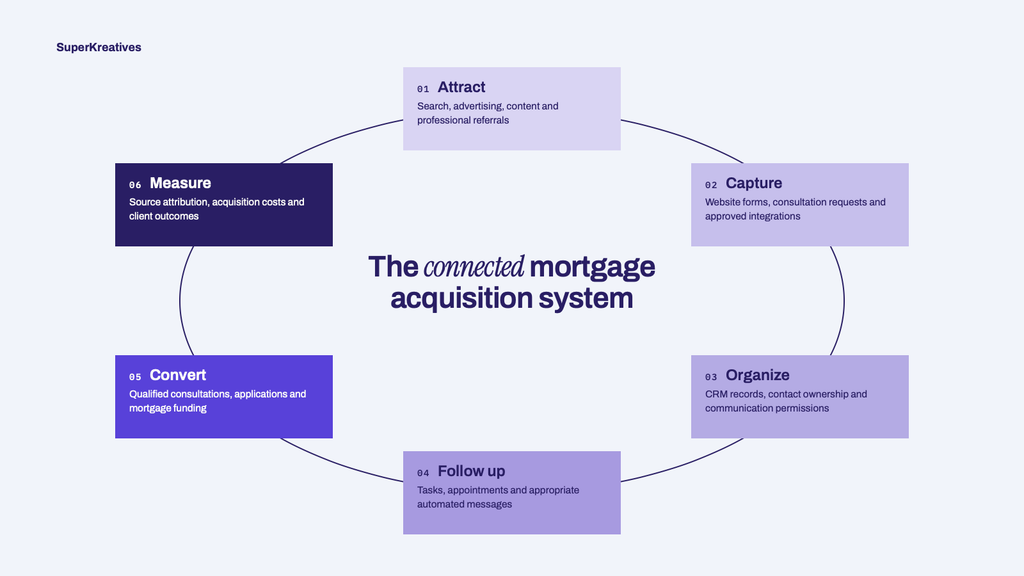
This is why choosing the best integrated mortgage marketing and lead capture platform involves more than comparing CRM features or automation templates. Canadian mortgage brokers need a reliable connection between attracting borrowers, recording their enquiries, managing follow-ups, and measuring meaningful business outcomes.
However, technology alone cannot generate qualified borrowers. A brokerage still needs relevant marketing messages, a credible website, suitable acquisition channels, and a clear understanding of the clients it can serve.
At SuperKreatives, we approach mortgage lead generation as a connected process. Marketing brings potential borrowers into the business, while lead capture and relationship management systems help ensure those opportunities are handled consistently.
This guide explains how mortgage brokers in Canada can attract more relevant enquiries, compare integrated marketing platforms, improve lead conversion, and build a practical acquisition system that supports sustainable growth.
Why Mortgage Brokers Need More Than a Lead Generation Tool
A lead generation tool typically helps attract or collect potential customer information. A customer relationship management (CRM) system organizes contacts and interactions. A mortgage origination platform supports application-related processes.
These systems can perform different functions, even when their features overlap.
For example, a mortgage brokerage might use Google Ads to attract homeowners searching for refinancing assistance.
A potential borrower clicks an advertisement, visits a landing page, and submits a consultation request.
At this point, several things need to happen. The enquiry should be recorded accurately, the responsible mortgage professional should receive it, the borrower should understand what happens next, and the source should be available for reporting.
If those processes depend entirely on manual actions, there are more opportunities for enquiries to be overlooked or handled inconsistently.
An integrated system can reduce these gaps by connecting the relevant stages.
The Difference Between More Leads and Better Lead Management
Imagine two hypothetical brokerages receiving 80 enquiries each month.
Brokerage A stores enquiries in several spreadsheets and relies on individual agents to check their email. Brokerage B uses a centralized CRM with enquiry assignments, consultation tracking, and internal follow-up reminders.
Brokerage B may find it easier to identify unanswered enquiries and maintain consistent communication.
However, that doesn’t automatically mean its leads are more financially suitable or that it will fund more mortgages.
Lead quality still depends on the audience, the service offered, the acquisition channel, and the prospective borrower’s circumstances.
The real advantage of integration is greater operational control and visibility. It helps the business understand what happens to an opportunity after the first contact.
How Mortgage Marketing Lead Capture Works
Mortgage marketing lead capture begins when someone expresses interest in obtaining information or professional assistance.
That interest can originate from several channels.
A homeowner may complete a refinancing enquiry form after finding the brokerage on Google. A first-time buyer might request a consultation after watching an educational video. A real estate professional may introduce a client who has agreed to speak with a mortgage broker.
All three are legitimate potential enquiry sources, but they should not automatically enter the same workflow.
Match the Lead Capture Method to the Borrower’s Intent
Someone downloading a first-time homebuyer checklist may be in the early stages of financial preparation.
A person requesting a mortgage renewal consultation may have a more immediate need.
These differences should be reflected in the next steps.
An educational resource request can trigger delivery of the promised material, with any additional marketing communications subject to the appropriate consent requirements.
A consultation request should instead prompt appointment scheduling or direct follow-up from the responsible professional.
An application-related request may require secure collection of additional information through an approved process.
The key is to avoid treating every form submission as an immediate mortgage application.
What Information Should an Initial Mortgage Lead Form Collect?
A basic consultation form may need the prospective client’s name, relevant contact details, service interest, and preferred communication method.
An optional message field can allow the borrower to explain their question.
Detailed banking records, tax documents, identification files, and employment information should generally be collected later through suitable secure systems when necessary.
A shorter form may reduce unnecessary friction, but removing all context can make it difficult to route enquiries correctly.
The appropriate balance depends on the action the person is taking.
A form offering a general consultation should not require the same information as a formal mortgage application.
Mortgage Marketing Strategies for Lead Generation in Canada
An integrated platform can organize incoming opportunities, but the business still needs effective acquisition channels.
The strongest strategy combines relevant traffic sources with useful information and appropriate conversion opportunities.
1. Use Google Search Ads for Existing Mortgage Demand
Google Search advertising can help reach borrowers actively looking for mortgage services.
Someone searching for mortgage renewal assistance in Toronto has expressed a different level of immediate interest from someone casually reading a general homeownership article.
Campaigns should therefore be organized around the services the brokerage actually provides.
Separate renewal, refinancing, first-time buyer, and other relevant service categories when doing so improves targeting and reporting.
Each campaign should direct users toward information that matches their search.
For example, a refinancing advertisement should connect with a landing page explaining refinancing considerations, possible costs, and the consultation process.
Do not promise guaranteed approval or universally available interest rates.
2. Improve Local Search Visibility
Many borrowers search for mortgage professionals within a particular city or service area.
A brokerage operating in Edmonton may want to appear for relevant mortgage service searches in Edmonton and surrounding communities.
Local SEO begins with an accurate website, appropriate Google Business Profile information where eligible, and useful location-related content.
A legitimate service page should explain what the brokerage offers in the market rather than repeat generic content with a different city name.
Genuine reviews and accurate professional details can further support credibility.
Local SEO works best when search visibility connects with a clear route to the appropriate service.
3. Develop Educational Mortgage Content
Mortgage decisions often require significant research.
A homeowner approaching renewal may want to understand switching costs. A self-employed borrower may be concerned about documenting income. A first-time buyer may be comparing pre-approval requirements.
Educational articles, videos, and checklists can help address those questions.
The information should remain accurate, comprehensive, and connected to relevant services.
For example, a detailed article about refinancing penalties could link naturally to the brokerage’s refinancing consultation page.
Content should help the reader understand the issue even if they do not contact the business immediately.
4. Use Social Advertising to Introduce Relevant Services
Facebook and Instagram can help mortgage professionals introduce educational information to audiences who are not actively searching for a broker.
A short video discussing renewal preparation may create interest among homeowners who had not previously considered reviewing their options.
However, social engagement does not automatically indicate financing readiness.
Meta advertisements should use clear, appropriate messaging and comply with applicable financial product advertising policies and audience restrictions.
The lead capture process should make the next step understandable and avoid collecting unnecessary personal financial information.
5. Support Professional Referral Relationships
Real estate agents, accountants, and other professionals may encounter people who need mortgage guidance.
Mortgage brokers can support these relationships through educational workshops, relevant financing resources, and consistent professional communication.
A referral should not involve sharing confidential client details without appropriate authorization.
Compensation and disclosure requirements vary by province, so any paid referral arrangement needs the relevant brokerage and compliance review.
6. Reconnect With Eligible Existing Clients
Past clients may have future mortgage needs, including renewals, refinancing, or another property purchase.
A CRM can help organize known mortgage maturity dates and prompt appropriate review.
However, maintaining a client record does not automatically create unlimited permission to send promotional messages.
Renewal communication should be relevant, accurate, and consistent with applicable consent and privacy requirements.
How to Choose the Best Integrated Mortgage Marketing and Lead Capture Platform
The right platform depends on the brokerage’s operational requirements.
A sole mortgage broker may need website lead capture, appointment scheduling, contact records, and renewal reminders.
A larger brokerage might require multiple agent accounts, lead distribution rules, team reporting, approval workflows, and integrations with existing origination systems.
Before reviewing software demonstrations, define which activities the platform must support.
Look for Reliable Lead Capture and Assignment
The platform should record enquiries from supported sources without requiring staff to repeatedly copy information between systems.
If a form creates a new contact, the brokerage should be able to identify its source, service interest, and assigned professional.
Duplicate records should also be managed appropriately.
For example, a homeowner who downloads a guide and later requests a consultation should not necessarily become two unrelated client records.
Prioritize Workflow Accuracy Over Automation Volume
A platform may advertise hundreds of automation templates, but that number says little about whether the workflows suit a Canadian mortgage business.
Useful automation might include acknowledging an enquiry, creating a follow-up task, notifying an agent about an appointment, or flagging a known renewal date.
More sensitive events, such as lender decisions or funding confirmations, should only trigger communication when the information is verified.
A scheduled message should never announce approval simply because a certain number of days have passed.
Review CRM, POS, and Origination Integrations
A mortgage point-of-sale (POS) platform may help collect borrower application information.
A loan origination system (LOS) can support the processing and submission workflow.
A CRM may organize enquiries, client relationships, and marketing activity.
Some products combine these functions, but others require integrations.
Ask vendors which data fields are exchanged, whether information synchronizes in both directions, and what happens when an integration fails.
This is especially important for brokerages already using Finmo, Filogix Expert, Velocity, or other mortgage processing platforms.
Comparing Mortgage Marketing and Lead Capture Software for Canadian Brokers
There is no universally best platform for every mortgage brokerage.
Canadian mortgage-specific platforms may offer integrations and workflows that general marketing CRMs do not provide out of the box. General CRMs, on the other hand, may offer broader flexibility for website acquisition, segmentation, and digital marketing operations.
The following solutions are worth evaluating based on their publicly documented capabilities.
| Platform | Relevant capabilities | Suitable evaluation scenario |
| BluMortgage | Mortgage lead follow-up, marketing workflows, renewals, and supported Canadian mortgage system integrations | Brokerages seeking mortgage-specific CRM and workflow integration |
| Canadian Mortgage App | Consumer-facing app, lead capture, pre-qualification activity, and supported CRM/LOS data transfer | Brokers wanting app-based engagement connected with existing systems |
| Brokeredge | Mortgage stage management and integrations with supported submission systems | Teams comparing application-driven client communication workflows |
| HubSpot | Contact capture, marketing workflows, website-related acquisition and reporting | Brokerages prioritizing broad digital marketing capabilities |
These are evaluation candidates rather than a universal ranking. Product availability, integrations, permissions, and subscription features should be verified directly with each vendor.
BluMortgage: Mortgage-Specific CRM and Marketing Workflows
BluMortgage is designed for Canadian mortgage professionals.
Its published product information identifies lead capture and follow-up functions, marketing workflows, renewal communication, and integrations with systems including Velocity, Filogix Expert, Finmo, and Scarlett DOS.
This makes it relevant to brokerages that want their CRM to work alongside existing mortgage applications and processing systems.
For example, a brokerage may want to avoid manually maintaining contact records in separate lead-generation and mortgage processing tools.
However, an advertised integration does not necessarily mean every status, document, or field can be synchronized automatically.
A demonstration should confirm the exact capabilities required.
Canadian Mortgage App: Connecting Borrower Engagement to Existing Systems
The Canadian Mortgage App offers an approach focused on connecting consumer-facing activity with brokerage systems.
Its published integration documentation explains that client registrations, pre-qualification activity, and requests for assistance can be transferred into supported CRM and origination systems.
The listed integrations include BluMortgage, Brokeredge, MyBrokerPro, Finmo, Filogix Expert, Scarlett, and Velocity, alongside webhook options.
This can be useful when the brokerage wants to connect an educational or calculation-focused borrower experience with an existing lead management workflow.
However, the app and its integrations do not replace the need for a CRM, professional qualification process, or appropriate consent management.
Brokeredge: Mortgage Stage Management
Brokeredge is another Canadian mortgage CRM option worth evaluating.
Its documentation describes how mortgage application stages can be mapped from different submission systems.
The documentation also shows that stage information may vary by platform. A particular status available through Finmo may not be supplied in the same form through Velocity or Filogix.
This distinction matters when designing automated client messages.
If a workflow depends on a specific application milestone, the brokerage needs to confirm whether its connected origination system actually provides that event reliably.
HubSpot: General Marketing Acquisition and CRM
HubSpot is relevant when a mortgage business places considerable emphasis on digital advertising, website enquiries, content marketing, and lead nurturing.
Its CRM and marketing products can support contact records, segmentation, forms, and marketing automation, depending on the selected subscription.
A brokerage could use it to organize prospective borrowers by service interest and manage suitable educational campaigns.
However, native integrations with Canadian mortgage origination systems should not be assumed.
If the business requires mortgage application information inside HubSpot, it needs to establish whether a suitable supported integration or carefully governed custom connection is available.
Which Platform Should a Brokerage Choose?
A brokerage already using Canadian mortgage origination software may place greater value on native integrations than on advanced general-purpose marketing features.
A business focused on inbound digital enquiries may prioritize campaign attribution and marketing workflows.
A smaller team may prefer simplicity over a complex enterprise configuration.
The best selection process is to demonstrate the same real-world workflow in several products.
Ask each vendor to show how a website enquiry is received, assigned, followed up, converted into an application, and linked to a confirmed funded mortgage.
That demonstration is more meaningful than comparing software feature counts alone.
Large Lenders Mortgage Marketing Tools and Lead Conversion Requirements
Large lenders and financial institutions often face additional operational requirements compared with individual mortgage brokers.
They may need to manage enquiries across several branches, mortgage specialists, product teams, and service regions.
A centralized platform can help organize those interactions, but the system must also support governance, permissions, and reliable customer data.
Lead Routing Across Multiple Teams
A large lender may receive enquiries from advertising campaigns, websites, mobile applications, and professional distribution channels.
The system should have clear rules governing which team receives each enquiry.
For example, an application involving a particular mortgage product may need to reach a specialist authorized to handle that request.
Routing should reflect legitimate service needs and approved operating procedures.
Centralized Reporting and Campaign Attribution
Large organizations may need to compare how different regions, products, and acquisition channels contribute to business outcomes.
Marketing dashboards should distinguish advertising activity from qualified consultations and completed applications.
The reporting process must also account for duplicate contacts and borrowers who interact with several channels.
Without deduplication, a single customer journey may appear as multiple independent leads.
Approval Workflows and Data Governance
Financial institutions may need controlled publishing processes for advertisements, landing pages, emails, and other promotional communications.
Access to sensitive customer records should depend on staff responsibilities.
Not every marketing user needs access to income documentation, credit records, or detailed mortgage application information.
The technology should support the organization’s actual security and compliance requirements rather than simply promise enterprise-grade capabilities.
For larger lenders, the integration architecture, governance model, and support arrangements can be as important as the software’s marketing features.
How to Turn Mortgage Marketing Leads Into Qualified Consultations
Capturing an enquiry is not the end of lead generation.
The borrower needs to understand what happens next, and the brokerage needs a consistent process for handling the opportunity.
A useful workflow can be divided into acknowledgement, routing, consultation, professional assessment, and appropriate follow-up.
Respond With Relevant Information
Someone requesting a mortgage renewal consultation should receive confirmation related to that service.
A person downloading a general mortgage guide should receive the promised educational resource.
The initial communication shouldn’t suggest that a formal application has begun or that eligibility has been established.
A clear acknowledgement reduces confusion about the purpose of the interaction.
Assign Ownership of Every Enquiry
A shared inbox may work temporarily, but it becomes harder to manage when several agents are involved.
Each enquiry should have an identifiable owner and a visible status.
Internal reminders can help the assigned professional manage required actions without relying exclusively on memory.
If someone has already booked a consultation, the system should stop sending reminders asking them to book the same appointment.
Record Meaningful Outcomes
Not every enquiry will progress into a mortgage application.
Some consumers may not need financing immediately. Others may require a service the brokerage doesn’t offer.
These distinctions should be recorded consistently.
For example, a CRM may distinguish new enquiry, consultation scheduled, consultation completed, application in progress, and funded mortgage.
The specific structure should reflect the brokerage’s actual process.
This information helps the marketing team understand whether its campaigns are attracting relevant borrowers.
Measuring Mortgage Lead Generation Performance
A platform should help the brokerage understand the relationship between marketing expenditure and actual outcomes.
Counting leads without measuring their progression can create an incomplete picture.
Consider the following hypothetical campaign.
| Metric | Example result |
| Advertising expenditure | CAD $3,000 |
| Enquiries captured | 75 |
| Cost per enquiry | $40 |
| Qualified consultations | 15 |
| Cost per qualified consultation | $200.00 |
| Funded mortgages | 3 |
| Advertising cost per funded mortgage | $1,000.00 |
These values are illustrative and do not represent Canadian mortgage lead-generation benchmarks.
The brokerage should also include management fees, software expenses, and attributable internal costs when evaluating the complete acquisition economics.
A Simple Lead Generation Performance Calculator
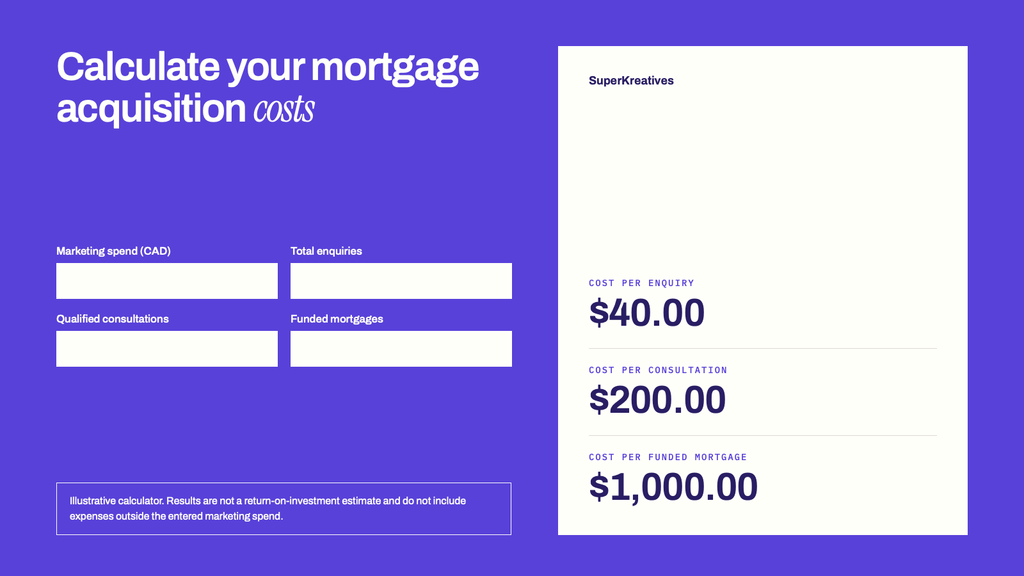
A lower cost per enquiry is not necessarily an improvement if the brokerage receives fewer suitable consultations.
Likewise, a campaign with a higher initial acquisition cost can still be worth evaluating when it consistently produces appropriate business opportunities.
Actual profitability depends on revenue, compensation arrangements, servicing costs, and other expenses.
Canadian Compliance Requirements for Mortgage Lead Capture Platforms
Mortgage businesses handle information that may reveal a person’s financial situation, borrowing plans, income, and property ownership.
A lead capture system should therefore be evaluated for privacy and regulatory suitability, not simply ease of use.
Canada’s Anti-Spam Legislation
Under Canada’s Anti-Spam Legislation (CASL), commercial electronic messages generally require a valid consent basis, sender identification, and an unsubscribe mechanism, subject to applicable exemptions.
The Canadian Radio-television and Telecommunications Commission (CRTC) distinguishes express consent from implied consent. Implied consent is available only under particular circumstances and can expire.
This matters when an enquiry enters a CRM.
Someone requesting an appointment has not necessarily agreed to receive indefinite promotional newsletters.
The system should distinguish consultation acknowledgements from promotional email sequences and maintain the necessary consent records.
Mortgage Advertising Requirements
Ontario’s Financial Services Regulatory Authority of Ontario (FSRA) requires mortgage-related public materials to clearly and prominently identify the brokerage’s authorized name and licence number.
When an individual broker or agent is identified, the appropriate licensed name and title must also be used. False, misleading, and deceptive advertising is prohibited.
British Columbia’s BC Financial Services Authority (BCFSA) published updated advertising guidance in July 2026 addressing accurate advertising and identification of licensed mortgage businesses.
The requirements differ across Canadian jurisdictions, so brokerages should review the rules applicable to the regions in which they operate.
Protect Borrower Information
Initial marketing forms should avoid collecting sensitive information unnecessarily.
The brokerage should also review where CRM data is stored, who can access it, how third-party integrations handle information, and what happens when a client requests correction or deletion where applicable.
A vendor’s general claim of secure infrastructure is not a substitute for examining its actual security controls and contractual commitments.
Particular care is needed when synchronizing mortgage origination records with advertising or general marketing systems.
A newsletter platform generally does not require detailed borrower financial documents merely to distribute educational content.
A 90-Day Plan to Generate More Mortgage Leads
Rather than purchasing a new platform and immediately launching several campaigns, mortgage brokerages should develop the system in stages.
The first phase should establish accurate data and clear responsibilities. The second should connect relevant acquisition channels. The third should focus on results and improvement.
| Timeline | Primary objective | Recommended activities |
| Days 1–30 | Establish the foundation | Audit existing lead sources, choose appropriate software, review consent records, define CRM stages, and confirm tracking |
| Days 31–60 | Launch acquisition workflows | Connect forms and approved integrations, improve landing pages, test search or social campaigns, and implement enquiry assignment |
| Days 61–90 | Improve conversion | Review qualified lead rates, follow-up performance, CRM accuracy, campaign costs, and relevant business outcomes |
Days 1–30: Identify Where Leads Are Being Lost
Begin by mapping every source of enquiries.
Determine how website forms, phone enquiries, referral introductions, and advertising contacts currently enter the business.
Identify where staff manually copy information or where enquiries can remain unanswered.
Review the tools already used before purchasing replacements. A new platform may create unnecessary duplication when an existing CRM simply needs better configuration.
Establish clear lead stages and identify who is responsible for maintaining each one.
Days 31–60: Connect Marketing and Follow-Up
Once the basic system is dependable, connect selected acquisition channels.
A brokerage might test a focused Google Search campaign for mortgage renewals, supported by a relevant landing page and CRM-connected consultation form.
The objective should be to verify that enquiries arrive correctly, receive appropriate attention, and can be traced through the consultation process.
Test failure scenarios as well.
What happens when an integration stops working? What happens if a person submits a form twice? What if they book an appointment before an automated reminder is sent?
Reliable handling of these situations can prevent avoidable frustration.
Days 61–90: Optimize Lead Quality and Business Outcomes
By the third month, begin comparing acquisition sources using consistent definitions.
Review which channels produce suitable consultations and which create large volumes of unrelated enquiries.
Investigate whether low conversion rates result from campaign targeting, weak landing pages, poor qualification, or operational follow-up.
Do not interpret a short testing period as proof that a platform will always perform at a particular level.
Mortgage applications can take time to progress, and campaigns with few completed transactions may need a longer evaluation window.
Common Mistakes When Choosing a Mortgage Lead Capture Platform
One frequent mistake is selecting software based on the number of advertised features instead of the workflows the brokerage needs.
Another is assuming that a platform with extensive automation can compensate for poor marketing.
Software cannot independently create meaningful borrower demand. The brokerage must still attract relevant audiences and provide useful information.
Poor data quality is another concern. Duplicate records, inaccurate renewal dates, missing source attribution, and outdated communication permissions can cause automation problems.
Brokerages should also avoid treating every contact as a qualified mortgage opportunity.
An individual who downloads a first-time buyer guide may simply be researching. A formal mortgage assessment involves additional information and professional judgment.
Finally, avoid deploying complex automations without testing them.
A workflow that sends the wrong application status or continues promotional communication after someone unsubscribes can undermine trust and create regulatory risks.
At SuperKreatives, we recommend starting with a dependable lead capture and follow-up process, then expanding automation based on clearly demonstrated needs.
Final Thoughts: Build a Lead Generation System, Not Just a Contact Database
The most effective mortgage lead generation process connects three essential activities: attracting relevant borrowers, handling their enquiries reliably, and understanding which opportunities become meaningful business outcomes.
For Canadian mortgage brokers, the decision to adopt a new CRM or marketing platform should begin with the actual challenges faced by the business.
Are enquiries being lost between advertising platforms and the CRM? Are prospective borrowers receiving unclear follow-ups? Is the brokerage unable to distinguish qualified consultations from ordinary website submissions? Or is the marketing team struggling to understand which acquisition channels deserve additional investment?
These are the questions an integrated system should help answer.
At SuperKreatives, our view is that marketing technology should improve the relationship between the brokerage and its prospective clients, not add unnecessary complexity to it.
Choose tools that work with the systems you already depend on. Connect acquisition channels carefully, protect borrower information, maintain appropriate communication permissions, and measure performance through qualified consultations and completed business outcomes.
The goal isn’t simply to capture more contact details. It’s to build a dependable process that helps suitable borrowers reach knowledgeable mortgage professionals when they need assistance.
Frequently Asked Questions
What is the best integrated mortgage marketing and lead capture platform in Canada?
There is no universally best platform for every brokerage. BluMortgage is worth evaluating for Canadian mortgage-specific CRM workflows and supported origination integrations. Canadian Mortgage App offers lead capture connections to several mortgage systems, while general platforms such as HubSpot may suit broader digital marketing requirements. The appropriate choice depends on existing software, business processes, security, and budget.
How can mortgage brokers generate more qualified leads online?
Mortgage brokers can attract relevant enquiries through search advertising, local SEO, educational articles, useful landing pages, professional referrals, and appropriately targeted social campaigns. The business should then connect those enquiries with reliable follow-up and qualification processes. More traffic alone doesn’t guarantee better leads.
What is mortgage marketing lead capture?
It is the process of recording relevant enquiries from prospective mortgage clients through forms, consultation requests, applications, approved integrations, or other appropriate channels. Effective lead capture also records necessary source information and routes the enquiry toward the next suitable action.
Can one platform manage mortgage marketing leads and applications?
Some platforms offer both marketing and mortgage workflow capabilities, while others connect with dedicated origination systems. The brokerage should verify exactly which functions are native, which require integration, and which processes must remain within a separate authorized system.
How do large lenders manage mortgage marketing lead conversion?
Larger lenders may use centralized enquiry management, lead routing, CRM integration, controlled communication workflows, and detailed performance reporting. They often require additional access permissions, compliance processes, and data governance. The exact technology depends on the institution’s operating model.
Is a mortgage CRM necessary for a small brokerage?
A dedicated mortgage CRM is not always mandatory, but a reliable system for organizing contacts, follow-ups, application stages, and communication preferences becomes increasingly useful as enquiry volume grows. Smaller businesses should prioritize accurate records and manageable workflows rather than unnecessary complexity.
How much should a mortgage brokerage spend on lead generation software?
There is no universally appropriate amount. Costs depend on user licences, integration requirements, implementation, training, support, and any usage-based charges. Evaluate the complete operating expense alongside the time saved and the business outcomes supported, rather than choosing solely on the advertised monthly subscription.
Can mortgage marketing automation improve lead conversion?
Automation can help acknowledge enquiries, assign responsibilities, create follow-up tasks, and maintain consistent communication. However, improvements depend on the quality of incoming leads and the accuracy of workflows. Automation should support professional mortgage assessments, not replace them.