A homeowner in Edmonton receives a mortgage renewal notice but isn’t sure whether to accept the lender’s offer. They remember working with a mortgage broker several years ago, but they haven’t heard from that professional since their original mortgage closed. Instead of reaching out, they begin comparing options online and eventually contact another brokerage.
This is a missed relationship opportunity that mortgage professionals can work to prevent.
Mortgage businesses often invest considerable resources in acquiring new clients through Google Ads, search engine optimization, and social media. Yet communicating with people who have already expressed interest or completed a transaction may receive much less attention.
Mortgage broker email marketing can help close that gap. When used appropriately, email allows Canadian mortgage professionals to educate prospective borrowers, maintain meaningful client relationships, provide relevant updates, and encourage conversations when new financing needs arise.
However, the challenge isn’t simply deciding how frequently to send newsletters. It’s determining what information different borrowers need, when that information is relevant, and how to present it without sounding overly promotional.
A first-time homebuyer needs different guidance from someone approaching mortgage renewal. An active applicant needs accurate progress information, while a previous client may appreciate an occasional educational update.
This guide explores 15 practical email marketing ideas for Canadian mortgage brokers, complete with subject-line examples, audience recommendations, an Edmonton-specific approach, and a framework for converting email engagement into qualified consultations.
Why Email Marketing Still Matters for Canadian Mortgage Brokers
Mortgage relationships can extend over many years, even when actual transactions occur infrequently.
Someone who purchases their first home may eventually renew, refinance, move to another property, or explore investment financing. Their financial circumstances and borrowing needs may change substantially between transactions.
Without consistent communication, the mortgage professional who helped with the original purchase may no longer be the first person the homeowner considers.
Email creates an opportunity to remain relevant during those periods.
According to the Canada Mortgage and Housing Corporation’s (CMHC) 2026 Mortgage Consumer Survey, 66% of surveyed recent mortgage consumers were renewers, 19% were refinancers, and 11% were first-time homebuyers. The survey included more than 4,100 respondents across Canada.
These figures highlight why a mortgage business should not build its entire marketing strategy around people buying their first property. Existing homeowners represent an important audience with different financial questions.
For instance, a borrower approaching renewal may benefit from an explanation of mortgage term options, potential payment changes, and switching considerations. Someone who recently purchased a home may be more interested in understanding prepayment privileges and ongoing mortgage responsibilities.
A useful email programme recognizes these different situations and provides information accordingly.
What Makes Mortgage Email Marketing Different From Ordinary Promotional Emails?
Mortgages are complex financial products. Borrowers may be reviewing decisions involving substantial amounts of money, long-term commitments, and sensitive personal information.
That means mortgage emails require greater accuracy and care than many ordinary retail promotions.
An email promising guaranteed refinancing savings may create unrealistic expectations. A message announcing mortgage approval before receiving an actual lender decision can cause significant confusion.
Effective communication should therefore be relevant, verified, and appropriate to the recipient’s circumstances.
At SuperKreatives, our approach is to treat email as part of the mortgage customer journey rather than a separate promotional channel. Every message should have a defined purpose, whether that’s helping a prospect understand financing, providing a confirmed update, or maintaining an existing professional relationship.
15 Mortgage Broker Email Marketing Ideas Worth Implementing
The strongest email ideas generally come from situations borrowers already recognize.
Instead of developing campaigns around arbitrary calendar dates, start with the questions, concerns, and milestones that arise during actual mortgage relationships.
The following ideas can be adapted for individual mortgage agents, established brokerages, and lender-facing teams.
1. Mortgage Renewal Preparation Emails
Mortgage renewal reminders are among the most relevant communications a broker can provide to eligible existing clients.
A homeowner approaching maturity may need time to compare mortgage terms, review payment expectations, and investigate whether changing lenders makes sense.
A useful email should explain why reviewing the renewal offer matters without implying that switching will necessarily produce a better outcome.
Suggested subject line: “Your Mortgage Renewal Is Approaching. Here’s What to Review.”
The message can explain that homeowners should consider the proposed interest rate, term length, prepayment privileges, payment structure, and any relevant costs associated with changing lenders.
Where the brokerage maintains accurate renewal dates, an internal reminder can prompt a professional to review the client’s circumstances before contacting them.
Avoid automatically sending identical renewal messages to every client regardless of whether their mortgage has already renewed.
2. First-Time Homebuyer Educational Series
First-time buyers frequently require guidance before they are ready to request financing.
A short educational email series can address common questions in a logical sequence.
The first email might explain the difference between mortgage pre-approval and final approval. A subsequent message could discuss down payment preparation, followed by an explanation of common closing expenses.
Suggested subject line: “Buying Your First Home? Start With These Mortgage Basics.”
Each email should focus on a manageable topic and provide enough detail to be useful.
Avoid treating every subscriber as someone ready to apply immediately. A person researching homeownership may still be saving money or evaluating their financial circumstances.
A relevant educational series builds familiarity without applying unnecessary pressure.
3. Mortgage Pre-Approval Explainer Emails
Pre-approval is frequently misunderstood.
Borrowers sometimes assume that receiving pre-approval guarantees financing for any property within the estimated borrowing amount.
A useful email can explain that final approval depends on additional requirements, which may include updated borrower information, property evaluation, lender conditions, and supporting documentation.
Suggested subject line: “Pre-Approved for a Mortgage? Here’s What That Really Means.”
This subject is relevant to prospective buyers without using fear-based language.
The email should clarify the purpose of pre-approval, explain its limitations, and encourage readers to discuss property-specific financing questions with an appropriate professional.
4. Mortgage Refinancing Cost Awareness
Refinancing emails should do more than promote the possibility of lower monthly payments.
A homeowner may be considering refinancing to fund renovations, consolidate debts, or respond to changes in financial circumstances.
However, refinancing can involve prepayment penalties, legal expenses, changes in amortization, and additional interest costs.
Suggested subject line: “Thinking About Refinancing? Consider the Total Cost First.”
The email could explain why evaluating only the monthly payment may produce an incomplete financial picture.
This educational approach is particularly useful because it acknowledges situations in which refinancing may not be advantageous.
Readers who want to evaluate their individual circumstances can then request an appropriate consultation.
5. Fixed Versus Variable Mortgage Education
Interest rate structures remain a common source of borrower questions.
An educational email could explain the general differences between fixed and variable mortgage rates and why payment behaviour depends on the mortgage product.
Suggested subject line: “Fixed or Variable Mortgage: What Should You Compare?”
The content should address factors such as payment predictability, interest rate exposure, contractual terms, and possible penalties.
Avoid declaring one option universally better.
Individual financial circumstances, risk tolerance, product features, and available terms influence the decision.
This subject can also link naturally to a comprehensive website article comparing mortgage structures.
6. Mortgage Application Status Updates
Clients with active applications often want to understand whether their documents have been received, whether anything remains outstanding, and what happens next.
Accurate operational messages can reduce unnecessary uncertainty.
Suggested subject line: “Update on Your Mortgage Application.”
For example, once a lender submission has been verified, an appropriate message could explain that the file has been submitted for review and that further information may be requested.
The email must not imply final approval unless that decision has actually been confirmed.
Sensitive documents should be exchanged through approved secure systems rather than attached unnecessarily to ordinary marketing messages.
These communications also need to be distinguished from promotional campaigns because different legal requirements and exemptions may apply.
7. Post-Closing Client Check-In
Once a mortgage funds, communication often declines sharply.
A thoughtful post-closing email can help maintain a professional relationship without immediately promoting another financial product.
Suggested subject line: “Your Mortgage Has Closed. Here’s What to Keep Handy.”
The message could explain where to direct servicing questions, why borrowers should retain their mortgage documentation, and which contractual features they may want to understand.
It may also provide the broker’s general contact information for future questions.
The purpose is to support the client after an important transaction rather than encourage unnecessary refinancing.
8. Homeownership Anniversary Emails
A homeownership anniversary can provide a natural opportunity for relationship-building.
However, the message should feel personal and relevant rather than artificially promotional.
Suggested subject line: “One Year in Your Home. A Few Mortgage Details Worth Revisiting.”
The email might introduce general reminders about prepayment privileges, mortgage records, or planning for future financial changes.
Avoid implying knowledge of the client’s current circumstances without verification.
If the purpose becomes promotional, ensure the recipient has an appropriate consent basis for that communication.
9. Mortgage Market Update Emails
Canadian borrowers often encounter headlines about interest rates, housing markets, and lending requirements without understanding their personal implications.
A carefully researched market update can help explain important developments.
Suggested subject line: “What the Latest Bank of Canada Announcement Means for Mortgages.”
The content should identify the actual announcement date, summarize the verified information, and distinguish central bank policy rates from mortgage product pricing.
A Bank of Canada policy rate change does not necessarily produce an identical change in every fixed or variable mortgage rate.
Avoid unsupported forecasts or headlines suggesting that borrowers must act immediately.
Market commentary should clarify financial concepts, not turn uncertainty into a sales tactic.
10. Self-Employed Borrower Preparation Emails
Self-employed mortgage applicants may have questions about how their income is documented and assessed.
An email can explain common preparation considerations without promising eligibility.
Suggested subject line: “Self-Employed and Planning a Mortgage Application?”
The content might discuss income history, tax documents, business financial records, and why lender requirements can differ.
A broker who genuinely works with self-employed applicants can use this subject to demonstrate relevant knowledge.
However, the message should not suggest that self-employment automatically results in rejection or that specialized products guarantee approval.
11. Mortgage Prepayment Privilege Explainers
Many homeowners focus primarily on interest rates and monthly payments while overlooking contractual features.
Prepayment privileges can be an important part of understanding a mortgage.
Suggested subject line: “Can You Pay Down Your Mortgage Faster Without a Penalty?”
The email can explain that some mortgage contracts permit additional payments or lump-sum prepayments within specified limits.
It should also clarify that privileges vary by agreement and that exceeding permitted amounts can result in charges.
A useful message encourages borrowers to review their actual contract instead of assuming all lenders offer identical provisions.
12. Educational Newsletter Featuring Common Mortgage Questions
A recurring newsletter can help the brokerage communicate consistently without producing an entirely new promotional campaign every month.
Each edition should address a recognizable concern.
For example, one month could focus on mortgage renewals. Another could explain refinancing costs, followed by an edition about preparing for a first purchase.
Suggested subject line: “This Month’s Mortgage Question: Should You Switch Lenders at Renewal?”
A good newsletter provides a concise explanation and links to a more detailed educational resource when appropriate.
Avoid filling every edition with repetitive advertisements or vague market commentary.
The purpose is to give subscribers a reason to continue reading.
13. Webinar and Homebuyer Workshop Invitations
Mortgage professionals can use email to invite eligible contacts to relevant educational events.
A first-time buyer webinar could explain financing preparation and common mortgage terminology.
A renewal session could introduce questions homeowners should review before making a decision.
Suggested subject line: “Free Homebuyer Workshop: Understanding the Mortgage Process.”
The email should identify the organizer, event date, topics, registration requirements, and the nature of the educational session.
Avoid describing a marketing presentation as independent financial advice if its purpose is primarily to promote the brokerage’s services.
Registration forms should also disclose how attendee information will be used.
14. Professional Referral Partner Emails
Real estate agents, accountants, and other professional contacts may benefit from mortgage-related information relevant to their work.
For example, a broker could share an educational update about common mortgage pre-approval misconceptions that arise during property transactions.
Suggested subject line: “A Financing Question Your Homebuyers May Be Asking.”
The content should help the professional understand the issue and recognize when a licensed mortgage specialist should become involved.
It should not encourage unlicensed individuals to provide mortgage advice beyond their permitted role.
Professional relationships also do not automatically eliminate Canada’s commercial electronic messaging requirements.
15. Past Client Re-Engagement Emails
Some previous clients may have a legitimate future financing need, but a brokerage should not assume that every historical contact remains available for promotional campaigns.
Where a valid consent basis exists, an occasional educational message can reconnect with eligible clients.
Suggested subject line: “A Quick Mortgage Check-In: What May Have Changed Since We Last Spoke.”
The email might introduce useful mortgage considerations, explain available consultation services, and invite the recipient to engage if relevant.
Avoid implying the brokerage has reviewed their current mortgage or determined that refinancing would be advantageous without an actual assessment.
For contacts whose promotional consent has expired or cannot be established, do not use a marketing email merely to request fresh consent.
How to Turn Mortgage Email Marketing Ideas Into an Actual Campaign
Having 15 ideas does not mean a brokerage should send 15 emails to every contact.
The value comes from selecting messages that correspond to the recipient’s needs and the stage of their mortgage journey.
A first-time homebuyer may benefit from a short educational series, but a homeowner approaching renewal shouldn’t be placed into that same sequence.
Similarly, an active mortgage applicant needs accurate operational updates rather than repeated advertisements about unrelated mortgage products.
Segment Contacts Before Creating Campaigns
A useful segmentation system distinguishes prospective buyers, active applicants, existing homeowners, renewal clients, and professional referral contacts.
For each category, identify why people are in the database, what communication they reasonably expect, and whether the brokerage has the appropriate permission to contact them.
The CRM should maintain consent information separately from application data.
Someone who is receiving necessary transaction-related communication should not automatically be enrolled in promotional newsletters.
Select One Main Objective per Email
An email about mortgage renewal should help homeowners prepare for renewal.
It should not simultaneously promote refinancing, investment loans, a new webinar, and a referral programme.
A clear subject line, relevant explanation, and appropriate next step will generally create a more understandable message.
For instance, a renewal email could conclude by inviting the homeowner to schedule a discussion about their upcoming term.
A first-time buyer educational email could instead direct readers to a detailed guide.
The call to action should match the recipient’s stage, not simply the brokerage’s desire for more immediate enquiries.
Build a Consistent Editorial Calendar
For many smaller mortgage businesses, a monthly educational newsletter provides a manageable foundation.
Additional communications can be triggered by legitimate client milestones, such as an enquiry, confirmed appointment, verified application update, or approaching renewal date.
Publishing frequency should reflect relevance and recipient expectations.
More frequent communication is not automatically more effective, particularly when messages repeat the same financial information without offering anything new.
Mortgage Email Marketing Edmonton: Building Campaigns for a Local Audience
A mortgage broker serving Edmonton should approach email marketing differently from a national lender sending identical messages across Canada.
The underlying mortgage principles may be similar, but local relevance can help make the communication more useful.
For example, an Edmonton homeowner approaching renewal may appreciate information about how to compare an existing lender’s offer, while a prospective buyer in the city may want to understand Alberta closing costs and mortgage preparation requirements.
The goal is not to insert the word “Edmonton” into every subject line. It’s to address real questions from borrowers in the area.
Create Edmonton-Specific First-Time Buyer Content
An Edmonton-focused email could address the financial preparations involved in buying a home in Alberta.
Suggested subject line: “Buying Your First Home in Edmonton? Budget Beyond the Down Payment.”
The content could explain why buyers should account for legal services, applicable land-title registration fees, property tax adjustments, and other transaction-related expenses.
Specific cost claims must be checked against current Alberta requirements and the actual circumstances of the transaction.
Avoid publishing generic Canadian closing-cost percentages as though they represent a guaranteed expense for every Edmonton purchase.
The message can link to a more comprehensive homebuying resource or invite readers to discuss financing preparation with a licensed professional.
Use Relevant Mortgage Renewal Education
A brokerage serving Edmonton homeowners can create renewal-focused communication without making unsupported assumptions about individual financial circumstances.
For example, an email could explain the difference between accepting a lender’s renewal offer and exploring available alternatives.
Another might discuss how mortgage payment expectations can change when borrowers renew under different terms.
The information should focus on decisions readers can evaluate rather than predicting what will happen to their finances.
Build Professional Relationships Through Local Educational Emails
An Edmonton mortgage professional may also maintain appropriate communication with local real estate professionals.
A useful email could introduce a buyer financing checklist or an educational session about mortgage pre-approval.
The content should help professional partners better understand financing-related considerations.
When communicating with real estate professionals, follow the applicable business communication rules and obtain appropriate consent or establish another valid legal basis.
Professional relevance is more valuable than sending large volumes of unsolicited outreach.
Three Sample Mortgage Marketing Emails You Can Adapt
The following examples demonstrate how campaign ideas can become practical messages. They are illustrative templates and require appropriate customization, verification, branding, and compliance review before use.
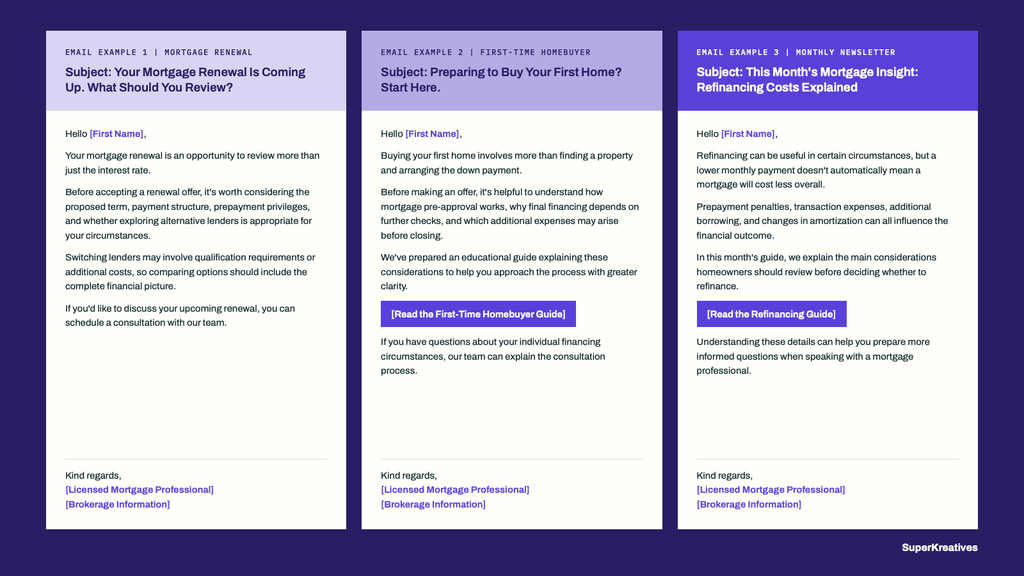
These samples intentionally omit invented brokerage details. Commercial email versions must include appropriate sender identification, required disclosures, and an unsubscribe mechanism where applicable.
Canadian Email Marketing Compliance: CASL, Privacy, and Mortgage Advertising
An email campaign that attracts enquiries but violates communication or privacy requirements is not a successful marketing campaign.
Canadian mortgage businesses must consider the purpose of the message, the recipient’s consent status, the information being used, and the applicable advertising rules.
Understand Canada’s Anti-Spam Legislation
Under Canada’s Anti-Spam Legislation (CASL), commercial electronic messages generally require a valid consent basis, proper sender identification, and a functioning unsubscribe mechanism, subject to specific exemptions.
The Canadian Radio-television and Telecommunications Commission (CRTC) distinguishes express consent from implied consent.
Express consent generally remains valid until withdrawn, while implied consent depends on specific circumstances and may expire. The CRTC also states that unsubscribe requests must be acted upon within 10 business days.
For a mortgage brokerage, this means an enquiry form should not automatically become permission for unlimited promotional communication.
Maintain records of how consent was obtained and ensure the CRM updates communication preferences when recipients unsubscribe.
Separate Application Updates From Marketing Messages
An email confirming that a requested document has been received serves a different purpose from a newsletter advertising mortgage services.
Certain transactional messages qualify for exemptions under CASL, but the precise treatment depends on the message’s content and circumstances.
A brokerage should not simply label promotional communication as a status update to avoid consent requirements.
Keep application updates accurate, necessary, and appropriately separated from marketing campaigns.
Protect Financial and Personal Information
Mortgage application records may contain sensitive details about income, debts, property ownership, and financial arrangements.
Avoid using ordinary newsletter platforms to distribute confidential borrower information.
A marketing system may need a client’s email address, consent status, and general content preferences. It does not necessarily require full access to their mortgage application documents.
Use secure authorized systems for sensitive information and review the privacy obligations applicable to the brokerage and its service providers.
Include Required Brokerage Identification
Ontario’s Financial Services Regulatory Authority of Ontario (FSRA) explicitly includes email communications among public-facing mortgage materials subject to advertising requirements.
Mortgage-related communications must clearly disclose the brokerage’s authorized name and licence number. When an individual mortgage broker or agent is named, their licensed name and approved title must also be used.
An Edmonton-based brokerage should also verify the applicable requirements of Alberta’s regulator, RECA, rather than assume Ontario’s disclosure rules are identical.
How to Measure Mortgage Broker Email Marketing Performance
Email campaign success should be evaluated beyond how many messages were sent or opened.
Open rates can provide directional information, but modern email privacy features may cause tracking inaccuracies.
The more useful question is whether the campaign encourages relevant engagement and creates meaningful business opportunities.
| Metric | What it helps evaluate |
| Email delivery rate | Whether campaigns reach receiving mail systems |
| Click-through rate | Whether readers interact with relevant resources |
| Unsubscribe rate | Whether the messaging or frequency may be unsuitable |
| Consultation booking rate | Whether readers request professional assistance |
| Qualified enquiry rate | Whether responses align with available mortgage services |
| Renewal consultation rate | Whether renewal campaigns support timely client discussions |
| Funded mortgage attribution | Whether tracked enquiries contribute to completed transactions |
Consider a hypothetical newsletter campaign sent to 1,000 eligible subscribers.
If 60 recipients click through to an article, 12 request consultations, and five of those consultations represent suitable mortgage opportunities, the campaign has created measurable engagement beyond email opens.
These figures are illustrative, not Canadian mortgage industry benchmarks.
The business should also investigate which content generated those responses and whether the audience received information appropriate to its needs.
For example, a renewal campaign that generates a smaller number of highly relevant consultations may be more commercially useful than a broad campaign producing many unrelated enquiries.
A 90-Day Email Content Plan for Canadian Mortgage Brokers
A mortgage brokerage doesn’t need to launch every campaign simultaneously.
A focused implementation plan allows the business to establish appropriate contact records, test messages, and evaluate results before expanding.
| Timeline | Main priority | Recommended actions |
| Days 1–30 | Establish the foundation | Review consent records, segment contacts, prepare approved templates, and identify priority client needs |
| Days 31–60 | Launch useful campaigns | Introduce an educational newsletter, a relevant borrower sequence, and properly configured renewal reminders |
| Days 61–90 | Review and improve | Evaluate engagement, qualified enquiries, unsubscribe trends, and workflow accuracy |
During the first month, concentrate on data quality and permissions.
Contacts should not enter promotional workflows simply because their email addresses exist in an old spreadsheet.
The second month should focus on a limited number of relevant messages rather than creating several complicated automation sequences at once.
For example, the brokerage might begin with a monthly educational newsletter and a carefully reviewed renewal communication process.
By the third month, review the results.
If recipients consistently engage with refinancing education but ignore unrelated topics, that may indicate a useful editorial preference. It does not, however, prove that those readers are ready or qualified to refinance.
Use the findings to improve relevance rather than dramatically increasing promotional frequency.
Final Thoughts: Send Emails That Borrowers Have a Reason to Read
Effective mortgage broker email marketing isn’t about sending messages as frequently as possible or turning every newsletter into a mortgage promotion.
It’s about understanding where borrowers are in their financial journey and providing information that helps them prepare for relevant decisions.
A homeowner approaching renewal needs different guidance from a first-time buyer. An active applicant needs reliable operational communication, while a previous client may benefit from occasional educational updates.
At SuperKreatives, our approach is to build mortgage email campaigns around relevance, timing, and measurable outcomes.
Start with the questions your clients genuinely ask. Develop educational messages that answer those questions clearly, organize contacts responsibly, and make it easy for recipients to seek professional assistance when appropriate.
When content, consent, timing, and follow-up work together, email becomes more than another marketing channel. It becomes a dependable way to maintain professional relationships and create opportunities for future conversations.
Frequently Asked Questions
What is mortgage broker email marketing?
It involves using email to educate prospective borrowers, maintain relationships with existing clients, communicate relevant mortgage information, and encourage appropriate consultations. Campaigns may include newsletters, renewal reminders, first-time buyer guidance, and properly verified application updates.
What are the best mortgage email marketing ideas for Canadian brokers?
Useful ideas include mortgage renewal preparation, refinancing cost explanations, first-time buyer education, fixed-versus-variable mortgage comparisons, prepayment privilege guides, and monthly newsletters. The most effective subjects depend on the recipient’s actual borrowing interests and the brokerage’s available services.
How often should mortgage brokers send marketing emails?
A monthly educational newsletter can be a manageable starting point. Additional emails should be based on meaningful borrower needs and appropriate consent. Renewal reminders and application-related communication should follow relevant events rather than an arbitrary promotional schedule.
Is mortgage email marketing in Edmonton different from other Canadian markets?
The underlying principles are similar, but Edmonton-focused content can address verified Alberta-specific transaction considerations, local service availability, and common questions from borrowers in the region. Regulatory requirements should be checked with the appropriate Alberta authorities.
Can mortgage brokers automate their email campaigns?
Yes. Automation can support enquiry acknowledgements, appointment reminders, eligible educational sequences, and renewal notifications. However, workflows need accurate information, appropriate permissions, and controls that prevent incorrect or irrelevant messages from being sent.
Do mortgage brokers need permission to send promotional emails in Canada?
Commercial electronic messages generally require a valid basis for consent under CASL, subject to specified exceptions. Businesses must also satisfy applicable identification and unsubscribe requirements. Implied consent is not unlimited, and brokerages should maintain appropriate consent records.
Can mortgage newsletters help generate leads?
Yes. Educational newsletters can encourage interested readers to visit relevant website resources or request consultations when they have a financing need. However, subscribers and clicks are not equivalent to qualified leads. Results should be evaluated through suitable enquiries and subsequent outcomes.
What should mortgage brokers avoid in marketing emails?
Avoid guaranteed approval claims, misleading rate promotions, unnecessary urgency, repetitive sales messages, inaccurate application updates, and excessive collection of personal information. Emails should provide genuine value and reflect the recipient’s consent and circumstances.