Running a mortgage brokerage in Canada has become more than a question of finding borrowers who need financing. Homeowners can compare interest rates online, research mortgage products independently, read reviews, and contact multiple professionals before making a decision. By the time someone approaches a mortgage broker, they may already have formed expectations about the services, expertise, and experience they want.
For mortgage brokerages, this creates both an opportunity and a challenge. Potential clients are actively looking for information, but appearing in front of them is only the beginning. A brokerage must demonstrate credibility, explain its services clearly, and provide a straightforward path from initial enquiry to consultation.
This is where digital marketing for mortgage brokerages becomes important. A coordinated strategy can help mortgage businesses attract relevant borrowers, improve local visibility, generate qualified enquiries, and maintain relationships with existing clients.
However, successful mortgage marketing requires more than posting on social media or running Google Ads. It involves understanding Canadian borrowing behaviour, selecting appropriate acquisition channels, developing trustworthy educational content, and measuring what happens after a lead enters the business.
In this guide, we’ll explain how to market a mortgage brokerage in Canada, which digital channels deserve attention, how to allocate resources, and how to build a practical marketing system suited to the Canadian mortgage market in 2026.
Understanding the Canadian Mortgage Market Before Developing a Strategy
Marketing should begin with the customers a mortgage brokerage actually serves.
A brokerage specializing in first-time homebuyers has different acquisition opportunities from one focusing on renewals, investment properties, or self-employed borrowers. Their audiences search differently, ask different questions, and require different information before requesting professional assistance.
Current Canadian mortgage research reinforces the importance of these distinctions.
The Canada Mortgage and Housing Corporation (CMHC) surveyed more than 4,100 recent mortgage consumers for its 2026 Mortgage Consumer Survey. The results provide useful insight into the types of transactions taking place and where borrowers obtain mortgage information.
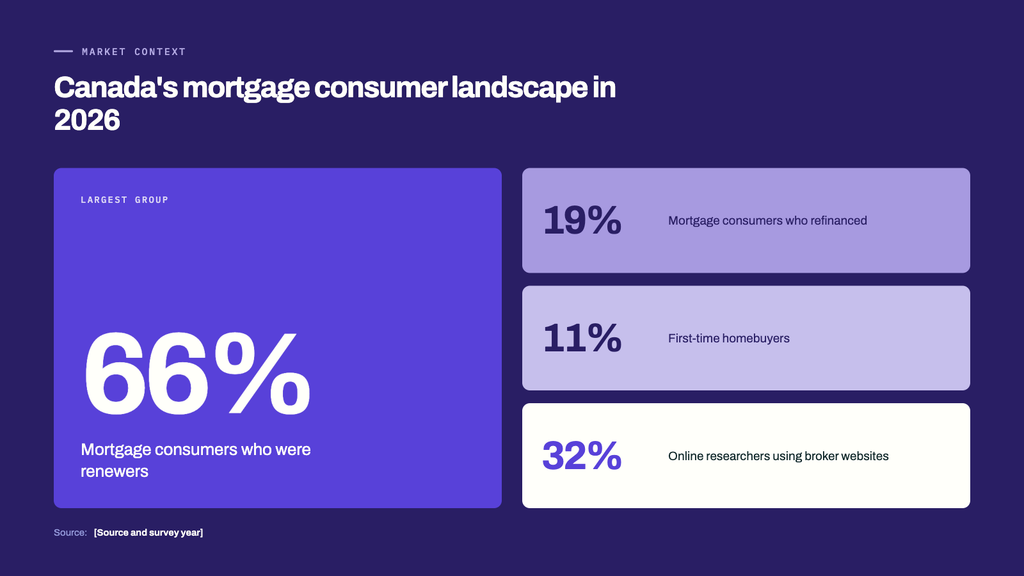
Renewals represent a particularly relevant audience, but their needs differ from those of homebuyers.
A homeowner approaching mortgage renewal may want to understand upcoming payment changes, compare available terms, or explore whether switching lenders is appropriate. A first-time buyer may need information about down payments, qualification, and closing expenses.
The messaging should reflect those differences.
What the 2026 Data Means for Mortgage Marketing
CMHC also found that 35% of surveyed renewers faced higher mortgage payments, with an average increase of $375 per month among that group. Meanwhile, 32% of refinancing respondents cited renovations as a reason for refinancing.
These findings suggest opportunities for educational campaigns addressing real borrower concerns.
For example, a brokerage might create a guide explaining what homeowners should review before accepting a renewal offer. Another campaign could explain the financial considerations involved in refinancing for renovations.
Neither campaign should imply that every homeowner can secure a lower rate or that refinancing will necessarily produce savings.
The objective is to connect useful information with borrowers who have relevant questions.
Define Your Brokerage’s Target Market
Before selecting marketing channels, identify which mortgage services the brokerage is qualified and equipped to provide.
A useful starting point is to define the target borrower, service region, primary financing need, and typical decision-making stage.
For example, a brokerage operating in the Greater Toronto Area may serve first-time buyers, existing homeowners, and property investors, but these audiences shouldn’t automatically receive identical advertisements.
Geography also matters. A brokerage serving several provinces must understand the applicable licensing, advertising, and operational requirements rather than assuming one campaign will work equally well across Canada.
8 Digital Marketing Strategies for Mortgage Brokerages in Canada
A sustainable marketing strategy typically combines channels that attract borrowers with systems that support their enquiries and longer-term relationships.
The goal is not to use every available platform. It is to select channels that make sense for the brokerage’s services, resources, and intended audience.
1. Build a Mortgage Website That Converts Visitors Into Enquiries
Your website should function as the central destination for digital marketing activity.
Whether someone discovers the brokerage through Google, social media, a referral, or an advertisement, they may visit the website before requesting assistance.
A useful mortgage website needs to establish three things quickly: what services the brokerage offers, who those services are intended for, and how to take the next step.
Instead of presenting every service in a single lengthy homepage section, develop dedicated pages for meaningful categories such as mortgage renewals, refinancing, first-time buyer financing, and self-employed mortgage applications.
Each page should answer the questions relevant to its audience.
A refinancing page, for instance, should explain why homeowners consider refinancing, what costs may be involved, and why a lower monthly payment doesn’t automatically mean lower total borrowing costs.
Trust information should also be easy to find. Include accurate licensing details, professional information, genuine reviews where permitted, and a clear explanation of the consultation process.
Finally, keep the enquiry process straightforward. Initial consultation forms generally shouldn’t demand extensive financial information that would be more appropriately collected through secure application systems.
2. Invest in Local SEO and Google Business Profile Optimization
Local visibility is particularly important for brokerages serving identifiable cities, neighbourhoods, and surrounding communities.
A borrower searching for a mortgage broker in Calgary may prefer a professional familiar with their local market. Someone seeking refinancing assistance in Mississauga may search using the city name alongside the service.
Local SEO helps connect the brokerage with those geographically relevant searches.
Start with an accurate, eligible Google Business Profile that reflects the actual business location and service information. Keep business contact details consistent with the website.
Create meaningful local website content when the brokerage genuinely serves the area. A page about mortgage services in Ottawa should provide useful information about those services and the brokerage’s coverage, not merely repeat a generic page with the city name changed.
Reviews can also support credibility. Encourage genuine feedback without buying reviews or implying that positive ratings are guaranteed.
For mortgage broker digital marketing, local SEO is most useful when it connects relevant search visibility with well-structured service pages and an accessible contact process.
3. Use Google Ads to Reach Borrowers With High Purchase or Service Intent
Search advertising can be particularly useful when borrowers are actively looking for professional assistance.
Someone searching for mortgage renewal advice may have a more immediate requirement than someone casually viewing general homeownership content.
Google Ads allows brokerages to organize campaigns around these different intentions, subject to Google’s financial services policies and applicable advertising requirements.
A practical campaign structure separates significant mortgage services rather than directing every search to the same advertisement and homepage.
For example, a refinancing campaign should use language relevant to refinancing and lead to a page explaining the service.
The landing page should clarify potential costs, eligibility considerations, and what happens after an enquiry.
Negative keyword reviews, geographic settings, and lead quality analysis are important because mortgage-related searches can include informational enquiries or services a brokerage does not provide.
A campaign should ultimately be evaluated using qualified consultations and downstream business outcomes, not clicks alone.
4. Publish Educational Content That Demonstrates Mortgage Expertise
Content marketing allows mortgage professionals to address borrower questions before an enquiry occurs.
A first-time buyer might search for information about mortgage pre-approval. A homeowner approaching renewal may want to understand switching lenders. A self-employed applicant could be researching income documentation requirements.
Each search represents a potential opportunity to provide accurate, useful information.
Mortgage blog content should explain the issue comprehensively, use reliable Canadian sources, and acknowledge where lender requirements or individual circumstances affect the answer.
For example, an article comparing fixed and variable mortgages should discuss their features and relevant risks rather than presenting one option as universally superior.
Articles can also support other channels. A comprehensive refinancing guide may become a short educational video, a newsletter topic, or a resource linked from a service page.
The best content strategy is organized around real borrower needs and the services the brokerage actually offers.
5. Use Social Media to Build Familiarity and Professional Credibility
Social media can make mortgage professionals more approachable, particularly when they explain complicated subjects in accessible language.
However, it should not be treated as a guaranteed source of immediate enquiries.
CMHC’s 2026 survey reported that social media use for mortgage information declined to 47% among online mortgage researchers, compared with 54% in 2025. Broker websites, comparison services, and other information sources continued to play important roles.
This suggests that social media should be considered one component of a broader digital strategy rather than the only channel.
Short educational videos can address common concerns about mortgage renewals, refinancing expenses, and pre-approval limitations.
LinkedIn may be useful for professional relationships with real estate agents and accountants. Facebook and Instagram can support consumer education, while YouTube allows more detailed explanations.
Avoid publishing generic rate advertisements repeatedly without explaining their relevance or limitations.
6. Build a Professional Realtor Referral Marketing System
Real estate professionals can be valuable professional contacts because financing considerations often arise during property transactions.
A mortgage broker who communicates clearly, understands financing processes, and provides appropriate professional guidance may develop relationships that lead to client introductions.
Rather than immediately asking agents for referrals, begin by providing useful information.
Educational sessions about mortgage pre-approval, financing conditions, or documentation requirements can help real estate professionals recognize when their clients should speak with a licensed mortgage specialist.
Co-branded educational content and first-time buyer workshops can also be appropriate when both businesses comply with applicable rules.
Referral arrangements involving payments or other benefits require additional scrutiny. Requirements vary by province and may involve brokerage approval, disclosure, and client consent.
Referral marketing should be based on client interests and professional credibility, not an expectation that agents direct every buyer to the same mortgage provider.
7. Use Email Marketing and Automation to Retain Clients
Mortgage relationships often continue beyond the first completed transaction.
A previous client may return for renewal, refinancing, or a later property purchase. Educational communication can help maintain an appropriate relationship between those events.
A mortgage CRM can support relevant tasks such as enquiry acknowledgements, appointment reminders, communication preference management, and renewal review notifications.
For example, an accurate mortgage maturity date may trigger an internal task to contact a client about reviewing their upcoming renewal.
Promotional emails should follow applicable consent requirements. Canada’s Anti-Spam Legislation generally requires a valid consent basis, identification information, and a functioning unsubscribe mechanism for commercial electronic messages, subject to applicable exceptions.
Application updates also need accurate workflow information. Automation must not tell a borrower their mortgage has been approved unless that milestone has actually been confirmed.
The purpose is to improve communication consistency while retaining appropriate professional oversight.
8. Track Lead Quality, Consultations, and Funded Mortgages
Marketing becomes difficult to improve when performance is judged only by impressions, traffic, or lead volume.
A brokerage may receive many enquiries but discover that few prospects are ready or suitable for the offered services.
A meaningful measurement system should connect advertising and website activity with the client relationship process.
Track the source of enquiries, whether they progress into consultations, how many become applications, and which result in funded transactions where reliable attribution is possible.
This helps distinguish problems in marketing targeting from issues in enquiry management.
For example, if Google Ads generates relevant consultations but very few website visitors submit the form, the landing page may require improvement.
If the brokerage receives many form submissions but staff struggle to contact prospects, the follow-up system needs attention.
The appropriate response depends on where the process is breaking down.
Mortgage Agent Marketing vs. Mortgage Lender Marketing: What’s Different?
Mortgage agents, brokerages, and lenders may operate in the same financial sector, but their marketing priorities aren’t identical.
An individual mortgage agent often needs to establish professional credibility and attract clients within the scope of their brokerage’s services. A brokerage may need to promote its wider service offering, support multiple agents, and manage incoming enquiries across a team.
A lender typically markets its own financial products, lending criteria, and customer experience.
These differences should influence both the message and the marketing infrastructure.
| Business type | Main marketing priority | Suitable focus |
| Individual mortgage agent | Professional recognition and relevant enquiries | Local presence, educational content, professional networking |
| Mortgage brokerage | Consistent acquisition and lead management | SEO, paid advertising, service landing pages, CRM, retention |
| Mortgage lender | Product awareness and suitable applications | Product education, lender-specific campaigns, eligibility information |
| Broker-channel lender | Relationships with intermediary professionals | Broker education, policy communication, professional resources |
Mortgage Agent Marketing: Establish Expertise Within the Brokerage
An agent can build recognition by explaining mortgage concepts clearly and developing relationships with prospective borrowers.
However, personal branding should not obscure the sponsoring brokerage or create confusion about licensing.
For example, a mortgage agent helping first-time homebuyers could develop educational content about down payments and pre-approval, but public materials must comply with the brokerage’s policies and applicable professional identification requirements.
The agent’s marketing should establish familiarity while making it clear which licensed business is providing the mortgage services.
Mortgage Lender Marketing: Explain Products Without Overselling Them
Mortgage lender marketing generally needs to communicate actual product characteristics, eligibility requirements, and potential advantages alongside material limitations.
A lender promoting a fixed-rate mortgage should not imply that every borrower qualifies for an advertised interest rate.
Similarly, communications about refinancing should acknowledge that fees, penalties, and borrower circumstances influence whether the product is appropriate.
For lenders working through broker channels, professional education may be as important as consumer advertising.
Clear information about documentation expectations and application processes can help mortgage brokers understand when particular lending products may be relevant.
How to Build a Mortgage Digital Marketing Funnel
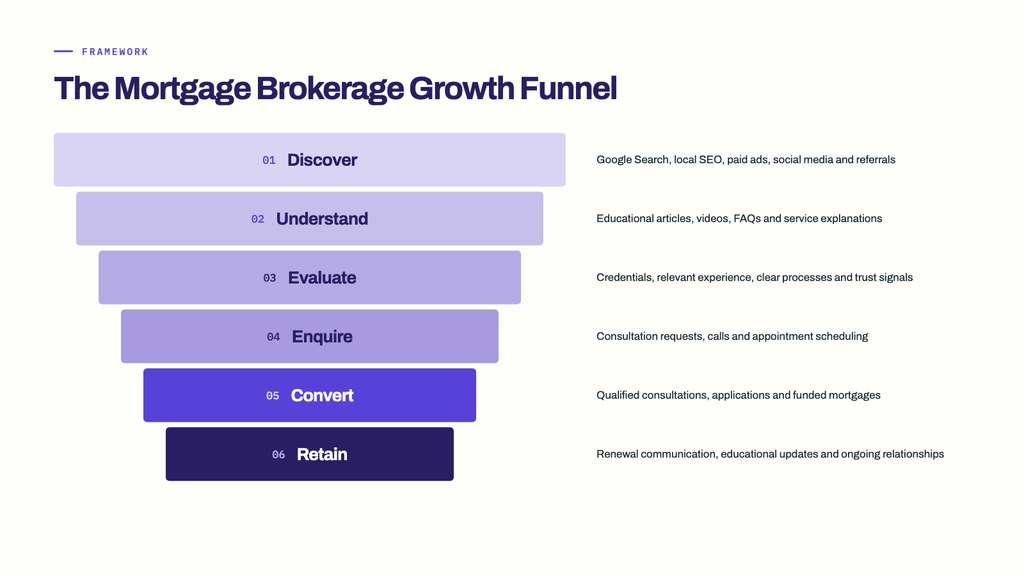
The strongest campaigns connect discovery, education, consultation, and retention instead of treating each activity as a separate marketing project.
Consider how a homeowner approaching mortgage renewal might interact with a brokerage.
They search online for information about renewal options, read an article about reviewing lender offers, explore the brokerage’s renewal service page, and eventually request a consultation.
After the enquiry, the brokerage confirms the next step, arranges an appropriate discussion, and maintains accurate records.
Each stage contributes to the overall experience.
Match the Message to the Borrower’s Stage
A first-time buyer researching minimum down payments may benefit from educational content, while a homeowner actively seeking renewal assistance may be ready for a consultation.
The website and campaigns should distinguish these situations.
For early-stage visitors, offer useful explanations and related resources. For people showing clear service intent, make the consultation process easy to understand.
Avoid forcing every visitor into the same lengthy application form.
Align Marketing With the Brokerage’s Operational Capacity
Increasing demand is not beneficial if a brokerage cannot respond appropriately.
Before increasing advertising expenditure, confirm that enquiries are assigned to the right people, consultation requests are acknowledged, and lead statuses are maintained accurately.
A smaller brokerage may benefit more from improving its enquiry process than from adding another paid channel.
The objective is not simply to create more leads. It is to build a manageable flow of suitable opportunities that the business can serve responsibly.
Using 2026 Mortgage and Small Business Lending Statistics for Marketing Decisions
One supplied research theme concerns small business lending mortgage marketing data sources statistics 2026. These subjects overlap, but residential mortgage financing and general small-business lending are different markets.
A reliable marketing analysis needs to separate those datasets rather than combining unrelated figures.
For example, a survey about business loans should not be used to estimate residential mortgage approval rates.
The following sources can support different parts of a Canadian mortgage marketing strategy.
| Source | Relevant information | How it can inform marketing |
| CMHC | Mortgage consumer behaviour, renewals, refinancing and housing finance | Borrower segmentation and content planning |
| Bank of Canada | Interest rates, lending conditions and economic indicators | Accurate economic context and time-sensitive explanations |
| Statistics Canada | Population, household and business data | Geographic and audience research |
| Innovation, Science and Economic Development Canada | Small-business financing research | Specialized business borrower research where relevant |
What the Latest Mortgage Statistics Suggest
CMHC’s Spring 2026 Residential Mortgage Industry Report notes that mortgage activity in 2025 was dominated by renewals rather than new home purchase mortgages.
The report also indicates that renewal volumes are expected to ease in 2026, although payment pressure remains relevant for many borrowers who previously obtained mortgages at lower interest rates.
For brokerages, this supports developing content and campaigns around renewal preparation, but it doesn’t establish that every renewal campaign will generate strong returns.
Local market conditions, competing offers, audience suitability, and campaign execution still matter.
Small-Business Lending Statistics Are a Separate Research Category
Innovation, Science and Economic Development Canada’s Credit Conditions Survey 2025, released in 2026, reported that 20% of surveyed small businesses requested debt financing during 2025, with a 97% approval rate among applicants covered by that measure.
These figures concern surveyed small-business financing, not residential mortgage approval rates.
They may be relevant to a brokerage exploring commercial lending opportunities or researching entrepreneurs as a potential client segment, but they should not be used to predict home mortgage applications.
Similarly, Statistics Canada’s June 2026 analysis reported that businesses with 1 to 19 employees accounted for 91.2% of Canadian employer businesses in 2024.
This provides context about the broader business environment, but it does not tell us how many business owners are seeking residential mortgages.
For a brokerage assisting self-employed borrowers, the more useful strategy is to combine verified market context with actual enquiry data and an understanding of applicable mortgage qualification requirements.
How Much Should a Canadian Mortgage Brokerage Spend on Marketing?
There is no universally appropriate monthly marketing budget for Canadian mortgage businesses.
A new brokerage entering a competitive metropolitan market may need a different investment from an established business with strong organic visibility, repeat clients, and reliable professional referrals.
The marketing budget should be connected to business capacity, acquisition objectives, expected economics, and the ability to manage enquiries.
Start With the Economics of a Qualified Client
Before establishing advertising expenditure, estimate how much the brokerage can responsibly afford to spend to acquire a funded mortgage client.
This requires understanding acquisition costs, contribution margins, operational expenses, and realistic conversion rates.
For illustration, suppose a brokerage spends $3,000 on a campaign that generates 60 enquiries. If 15 become qualified consultations and three eventually result in funded mortgages, the approximate figures would be:
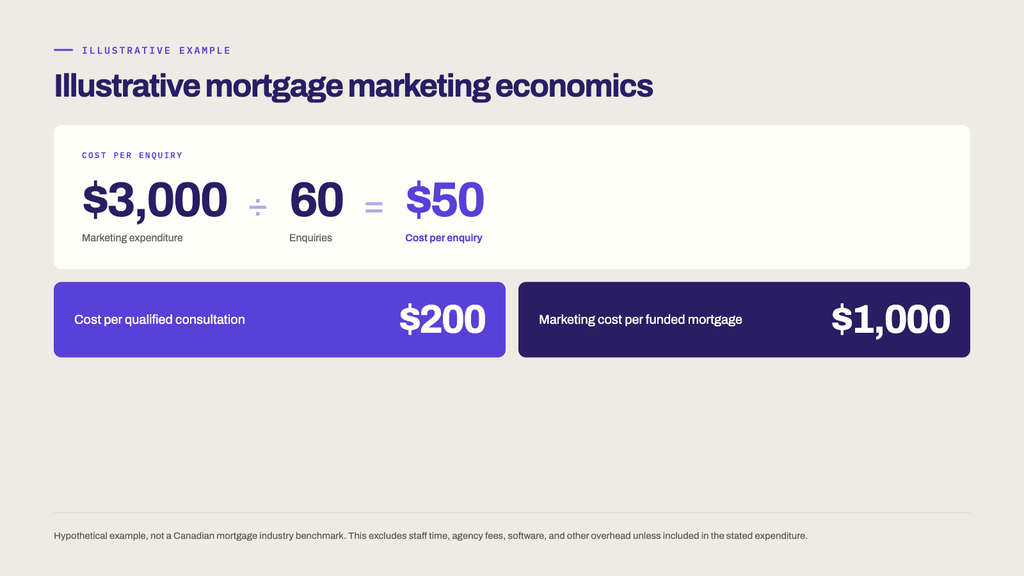
Whether that acquisition cost is acceptable depends on the brokerage’s actual economics.
A funded mortgage cannot be assumed to produce the same revenue in every case. Compensation arrangements, product types, lender relationships, operating costs, and other factors can differ.
This is why a low cost per lead should not automatically be celebrated.
A marketing campaign is commercially useful when it helps create suitable business opportunities at a sustainable cost.
Allocate Resources Based on the Brokerage’s Starting Position
A business with limited organic visibility may need to invest in its website and search foundations before scaling traffic.
An established brokerage with a well-performing website may benefit from improving conversion rates or expanding carefully targeted advertising.
A business that already receives sufficient enquiries but struggles with follow-up may need CRM improvements rather than additional acquisition expenditure.
Budget allocation should therefore follow an audit of existing performance, not a universal percentage presented as suitable for every brokerage.
Canadian Mortgage Advertising Compliance: What Brokerages Must Consider
Mortgage advertising operates within a regulated financial environment. A marketing message that appears persuasive can still create problems if it omits important qualifications or misrepresents available services.
In Ontario, the Financial Services Regulatory Authority of Ontario (FSRA) requires mortgage brokerages to clearly and prominently identify their authorized brokerage name and licence number in public-facing materials.
When an individual mortgage broker or agent is named, additional licensed-name and approved-title requirements apply. FSRA also prohibits false, misleading, and deceptive statements.
These obligations extend to websites, advertisements, email communications, and other promotional materials.
British Columbia’s BC Financial Services Authority (BCFSA) issued mortgage services advertising guidance on July 29, 2026. It addresses clear brokerage identification and truthful advertising, including social media communication.
Brokerages should review the requirements for every jurisdiction in which they operate.
Avoid Misleading Financial Claims
Advertising should not promise guaranteed mortgage approval, universally available rates, or automatic financial savings.
A claim about refinancing benefits should acknowledge that individual circumstances, lender requirements, and transaction costs influence the result.
The same principle applies to educational articles. A general explanation of mortgage qualification should not be presented as a personalized lending decision.
Protect Borrower Information
Mortgage enquiries can involve sensitive personal and financial details.
Initial marketing forms should collect only information reasonably necessary for the intended interaction. More detailed financial documents should be handled through approved, secure systems.
Customer information should not be indiscriminately shared across advertising platforms, CRM tools, and analytics services.
A good marketing system protects privacy while making it easy for prospective borrowers to obtain assistance.
A 90-Day Digital Marketing Plan for Canadian Mortgage Brokerages
Marketing improvements are easier to manage when they follow a structured implementation process.
The first 90 days should establish the necessary foundations, launch a focused set of acquisition activities, and identify measurable opportunities for improvement.
| Timeline | Main priority | Recommended actions |
| Days 1–30 | Research and infrastructure | Audit the website, define audiences, review licensing information, assess existing campaigns, establish tracking and CRM processes |
| Days 31–60 | Acquisition and visibility | Improve service pages, strengthen local SEO, publish useful content, test targeted advertising, and develop referral outreach |
| Days 61–90 | Conversion and optimization | Review lead quality, refine campaigns, improve landing pages, assess follow-up processes, and identify sustainable acquisition channels |
During the first month, determine which borrower categories matter most to the business.
A brokerage with substantial renewal expertise may choose to prioritize homeowners approaching maturity. Another business may focus on first-time buyers or refinancing clients.
The second month should connect these priorities to the appropriate channels.
For example, a renewal campaign could combine a detailed service page, educational blog content, relevant Google Ads, and permitted existing-client communication.
By the third month, performance data should begin showing which parts of the process require attention.
A campaign attracting relevant visitors but few enquiries may indicate problems with landing page clarity or form usability. A campaign producing many enquiries but few consultations may require better targeting or follow-up.
Ninety days provide an initial evaluation period, not a guarantee of rankings, conversions, or funded mortgages.
Common Mistakes When Marketing a Mortgage Brokerage
One common mistake is promoting every mortgage service to the same audience.
A homeowner approaching renewal doesn’t necessarily need information about first-time buyer incentives. A self-employed applicant may have different qualification questions from a salaried purchaser.
Marketing becomes more relevant when campaigns reflect these distinctions.
Another mistake is investing heavily in lead generation before establishing a reliable response process.
If enquiries remain unanswered, increasing the advertising budget may simply create more missed opportunities.
Brokerages should also avoid publishing repetitive content written only to target search keywords. Mortgage readers need accurate explanations that help them understand financing decisions.
Likewise, social media engagement should not be confused with business performance. Thousands of views may contribute little commercial value when the audience is irrelevant to the brokerage’s services.
Finally, brokerages should not make major budget decisions using cost per lead alone.
The most useful performance analysis connects marketing expenditure with qualified consultations, applications, and funded mortgages while accounting for operational costs.
Final Thoughts: Build a Mortgage Marketing System That Converts Interest Into Trust
Effective digital marketing for mortgage brokerages isn’t about being present on every platform or spending more than competitors.
It begins with understanding the borrowers a brokerage is equipped to serve, identifying the information those borrowers need, and creating an accessible path toward professional assistance.
In Canada, mortgage renewals, refinancing, and first-time homebuying each present different marketing opportunities. The most useful strategy connects those needs with relevant search visibility, educational content, targeted advertising, and consistent client communication.
At SuperKreatives, our perspective is that marketing should be evaluated as a complete acquisition and relationship-building process.
A website should help visitors understand services. Advertising should attract appropriate audiences. Content should answer meaningful questions. Automation should improve communication without replacing professional judgment. Reporting should reveal which activities contribute to qualified business opportunities.
Start by identifying the weakest part of the current process, whether that’s visibility, website conversions, lead quality, or follow-up. Improve it systematically, measure the outcome, and then decide where additional investment makes sense.
A successful mortgage marketing strategy doesn’t merely bring more people to a brokerage. It helps the right borrowers find knowledgeable professionals when they need them.
Frequently Asked Questions
What is digital marketing for mortgage brokerages?
It involves using online channels such as SEO, paid advertising, websites, educational content, social media, and email to attract relevant borrowers and maintain professional relationships. An effective strategy also includes enquiry tracking, conversion optimization, and appropriate compliance oversight.
How can I market a mortgage brokerage in Canada?
Begin by identifying the mortgage services and geographic markets you want to serve. Build a credible website, create relevant service pages, improve local SEO, develop educational content, and test targeted advertising where appropriate. Connect these activities with a reliable consultation and follow-up process.
Is SEO or Google Ads better for mortgage brokerages?
Both can be useful for different objectives. Google Ads can help reach borrowers actively searching for services, while SEO supports longer-term organic discovery. The best allocation depends on competition, budget, website condition, and the brokerage’s capacity to manage new enquiries.
How does mortgage broker digital marketing generate qualified leads?
It connects relevant borrower searches and interests with useful information and appropriate consultation opportunities. Lead quality depends on targeting, messaging, landing page relevance, and the brokerage’s actual service offering. Tracking consultations and funded mortgages provides more meaningful insight than enquiry volume alone.
What is the difference between mortgage agent marketing and brokerage marketing?
An individual agent may focus on professional recognition, educational content, and relationships within their authorized service area. Brokerage marketing generally supports wider business positioning, multiple professionals, lead distribution, and broader service categories. Both must comply with applicable licensing and advertising requirements.
Can mortgage digital marketing help generate renewal clients?
Yes. Search campaigns, renewal education, service pages, and appropriately authorized existing-client communication can help homeowners explore renewal options. Effective messaging should explain financial considerations without promising universally lower rates or guaranteed savings.
Which 2026 statistics are useful for mortgage marketing in Canada?
CMHC’s 2026 Mortgage Consumer Survey and Residential Mortgage Industry Report provide relevant information about borrower behaviour, renewals, refinancing, and mortgage activity. Bank of Canada data and Statistics Canada research can add economic and geographic context. Small-business lending statistics should be distinguished from residential mortgage data.
How much should a mortgage brokerage spend on digital marketing?
There is no fixed budget suitable for every brokerage. Spending should reflect service areas, competition, financial capacity, marketing objectives, and expected acquisition economics. Start with measurable campaigns and review the cost of qualified consultations and funded mortgages before expanding expenditure.