A real estate agent is preparing an offer for a homebuyer in Toronto. The buyer has spoken with a lender but isn’t entirely confident about their financing conditions. The agent needs a mortgage professional who can explain the situation, review the relevant information, and communicate clearly before the transaction progresses.
At that moment, the agent isn’t thinking about which mortgage broker has the most social media followers or the most attractive advertisements. They want someone knowledgeable, responsive, and reliable enough to recommend to their client.
This is what makes real estate referral relationships valuable. A mortgage broker who consistently helps agents understand financing considerations and provides a dependable client experience can become a trusted professional contact.
However, building these relationships requires more than introducing yourself to real estate offices, distributing business cards, or offering incentives.
Understanding the best ways mortgage brokers market to realtors means understanding what real estate professionals actually need, how to demonstrate value before requesting referrals, and how to develop relationships that benefit their clients.
For Canadian mortgage brokers and agents, an effective referral strategy should combine professional networking, practical education, relevant marketing materials, consistent communication, and appropriate regulatory safeguards.
This guide explores how to identify suitable real estate partners, approach them professionally, develop useful co-marketing initiatives, manage referrals, and measure the business value of these relationships.
Why Realtor Referral Relationships Matter in the Canadian Mortgage Market
Homebuying involves several interconnected services, and financing can influence the progress of a property transaction.
A real estate agent may need to understand whether a buyer has received pre-approval, whether financing conditions remain outstanding, or whether a particular property could create additional lending considerations.
Mortgage professionals contribute expertise in an area that directly affects these situations.
A dependable relationship between an agent and a broker can make it easier for clients to access relevant financial guidance while allowing each professional to remain focused on their responsibilities.
The value isn’t simply that an agent can introduce more borrowers.
A mortgage professional may be able to clarify the limitations of pre-approval, explain common documentation requirements, identify financing questions worth investigating, and communicate important process updates with the client’s authorization.
These actions can support clearer expectations during a transaction.
Referrals Depend on Professional Confidence
Consider two hypothetical mortgage brokers approaching the same real estate office.
The first asks agents to send mortgage enquiries and promises competitive rates.
The second introduces their services, explains the borrowing situations they work with, offers an educational session on financing conditions, and establishes a clear communication process for client introductions.
The second approach gives agents more information about how the professional works.
It doesn’t guarantee referrals, but it provides a stronger basis for evaluating whether a relationship would benefit clients.
At SuperKreatives, we recommend treating referral development as a professional relationship strategy rather than a simple lead exchange.
The objective is to become a credible resource that agents can consider when clients need mortgage assistance.
Understand the Difference Between Realtors and Real Estate Agents
In Canada, REALTOR is a registered trademark associated with membership in the Canadian Real Estate Association (CREA). It is not simply another term for every licensed real estate agent.
For general marketing, “real estate agents” or “real estate professionals” is often the more precise description when discussing the broader industry.
The underlying referral principles remain relevant to eligible professionals, regardless of association membership.
Best Ways Mortgage Brokers Market to Realtors: Start With Value, Not Referrals
Mortgage brokers often make the mistake of asking for introductions before establishing why a real estate professional should trust them.
Agents have professional reputations to protect. Recommending an unsuitable or unresponsive service provider can create frustration for their clients.
The first step is therefore demonstrating relevant expertise and a reliable process.
1. Identify Real Estate Agents Who Serve Your Ideal Borrowers
Not every real estate professional will be an equally suitable referral partner.
A mortgage broker who primarily assists first-time homebuyers may benefit from connecting with agents working extensively with entry-level residential properties.
Someone experienced with investment financing may find greater relevance among agents serving property investors.
A professional who regularly handles complex income documentation could develop useful relationships with agents who encounter self-employed purchasers.
The selection process should consider service alignment, geography, professional standards, and the actual needs of the agent’s clients.
For example, a broker serving the Greater Toronto Area might begin by researching agents working within specific communities where the brokerage already provides services.
The objective shouldn’t be to contact every real estate agent in Ontario. It should be to identify professionals whose clients could genuinely benefit from the brokerage’s expertise.
2. Lead With Financing Knowledge That Helps Agents
One of the strongest approaches to mortgage broker marketing to real estate agents is providing useful knowledge before requesting business.
Real estate agents encounter financing-related questions throughout the buying process, but their role is not to replace a licensed mortgage professional.
A broker can contribute by explaining subjects such as the differences between pre-approval and final approval, financing condition considerations, common lender documentation requirements, and the potential implications of property-related lending restrictions.
For instance, a short presentation explaining why mortgage pre-approval doesn’t automatically guarantee final financing could be valuable to agents working with first-time buyers.
The session should help agents recognize when clients need further mortgage guidance, not encourage them to make lending assessments themselves.
Educational value creates a more credible introduction than repeatedly promising exceptional service without demonstrating what that means.
3. Establish Clear Communication Expectations
Responsiveness matters in property transactions, but promising constant availability is not necessarily sustainable.
Instead, brokers should establish a realistic process for acknowledging referrals, booking consultations, and providing appropriate updates.
For example, a brokerage could explain who handles new introductions, how appointments are scheduled, and when the referring agent may expect authorized communication about relevant transaction milestones.
Avoid promising specific response times unless the business has the staffing and systems needed to meet them.
Also distinguish information that can be shared with the agent from confidential financial information that belongs to the borrower.
An organized communication process can reduce uncertainty without compromising privacy.
Mortgage Marketing to Real Estate Agents Through Educational Partnerships
Professional education is one of the most useful ways to introduce mortgage services without relying on aggressive sales techniques.
Agents may encounter unfamiliar financing situations, changes in lending requirements, or questions about products outside their normal experience.
A mortgage professional who explains these subjects clearly can become a valuable source of information.
Host Small Brokerage Education Sessions
A broker could organize an educational session for a real estate office, either in person or online.
Topics might include mortgage qualification considerations for self-employed purchasers, the limitations of pre-approval, or questions buyers should review before removing financing conditions.
The content should be practical and focused.
A session that spends most of its time promoting the mortgage brokerage is less useful than one that genuinely improves the audience’s understanding.
Provide agents with an opportunity to ask questions and direct them to credible resources where additional information is needed.
Create Financing Guides for Real Estate Professionals
A concise resource that agents can reference during relevant client discussions may provide lasting value.
For example, a first-time buyer financing guide could outline the general mortgage process, identify commonly requested documentation, and clarify that lenders assess applications according to their own requirements.
A guide to financing conditions could explain the distinction between preliminary borrowing discussions and a completed lender assessment.
These materials should not encourage agents to offer mortgage advice outside their permitted activities.
Instead, they should help agents identify when a qualified mortgage professional should become involved.
Share Relevant Updates Without Overwhelming Contacts
Canadian mortgage regulations, lending criteria, and financing products can change.
A broker may occasionally provide professional contacts with accurate information about developments that affect their clients.
However, sending generic promotional messages every few days can undermine the relationship.
Focus on updates with clear practical relevance, identify the source of important claims, and communicate only where appropriate consent or another valid legal basis exists.
Mortgage Marketing to Realtors: Building a Professional Outreach Process
Referral development should be deliberate enough to maintain consistency but personal enough to avoid becoming mass-produced outreach.
A good starting point is researching the real estate professional before making contact.
Review their public professional profile, location, property focus, and relevant business activities. Avoid making assumptions about their clients or transaction volume without evidence.
Introduce Yourself With a Relevant Reason
An introductory message should explain who you are, the mortgage services you provide, and why the connection might be useful.
A short message could say:
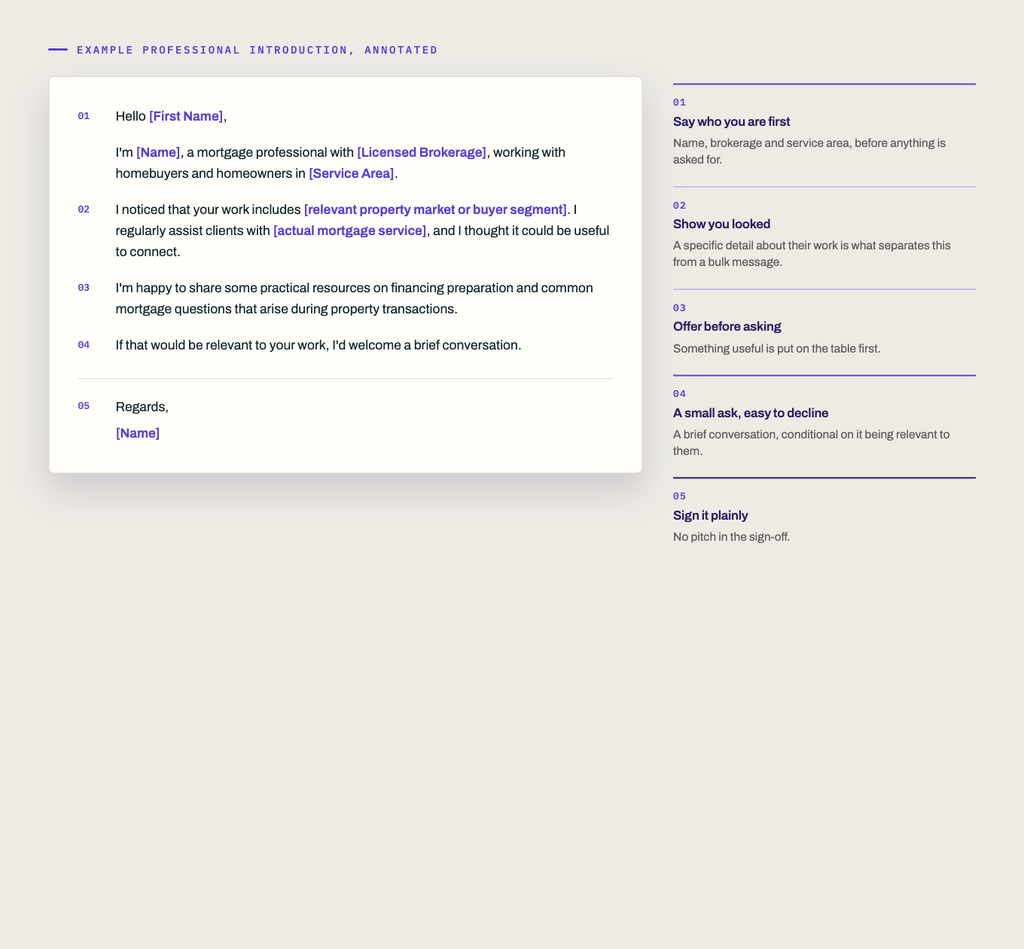
This example provides a reason for the introduction without asking for referrals immediately.
For commercial email outreach, confirm compliance with Canada’s Anti-Spam Legislation (CASL). A publicly available business email address is not automatically unrestricted permission for promotional messaging.
The Canadian Radio-television and Telecommunications Commission (CRTC) explains that commercial electronic messages generally require valid consent, sender identification, and an unsubscribe mechanism, subject to applicable exceptions.
Follow Up With Something Useful
If an agent expresses interest, the next interaction should provide value.
This might involve sharing an educational resource, arranging a short discussion, or answering a general financing question.
Avoid repeatedly contacting someone who has shown no interest or requested that communication stop.
It is also useful to record meaningful interactions in a CRM so the business can distinguish active professional relationships from contacts that have never engaged.
Develop Relationships Beyond a Single Contact
Real estate offices often include several professionals serving different client groups.
A broker who has established a useful relationship with one agent may eventually have opportunities to participate in broader educational sessions or approved office initiatives.
However, any collaboration should respect the policies of the real estate brokerage and the mortgage brokerage.
The aim is to earn professional confidence through consistent behaviour, not bypass supervisory or compliance processes.
Creative Mortgage Marketing Ideas to Realtors That Provide Real Value
Referral partnerships become more sustainable when both professionals contribute something useful to their shared audience.
The following initiatives can support relationship development without making payment for introductions the central proposition.
Co-Host First-Time Homebuyer Workshops
A mortgage professional and a real estate agent can collaborate on an educational event for prospective buyers.
The real estate professional could explain the property search and offer process, while the mortgage broker discusses pre-approval, financing conditions, and general borrowing considerations.
Each participant should communicate within their professional expertise.
The event can be promoted through approved social media posts, local community channels, and relevant website resources.
If attendee contact details will be collected or shared, the registration process should clearly explain how the information will be used and by whom.
Produce Co-Branded Educational Content
A short video series or downloadable guide can address questions that involve both the property purchase and financing process.
For example, a video titled “What Buyers Should Know Before Making an Offer” could explain the agent’s role in the purchase process and the broker’s role in helping clients understand financing.
The content should avoid suggesting that using one professional requires the client to hire the other.
Co-branded materials also require appropriate brokerage identification, approval, and privacy safeguards.
Support Appropriate Open House Education
Mortgage professionals sometimes participate in open houses or related buyer information events.
A small educational resource explaining pre-approval considerations or common closing expenses can be useful.
However, an open house shouldn’t become an environment where visitors are pressured to disclose personal financial details.
A mortgage broker can provide general information and offer a separate consultation for anyone seeking individual assistance.
Provide Practical Buyer Preparation Resources
A checklist can help agents encourage potential buyers to think about financing preparation without providing personalized lending advice.
It might outline general subjects such as budgeting for closing costs, understanding the difference between a financing discussion and final approval, and gathering information for an eventual mortgage consultation.
The resource should clearly distinguish education from a lender’s actual qualification decision.
This is more useful than a generic flyer claiming the broker can find the lowest rate for everyone.
How to Use a Realtor Mortgage Marketing Postcard
A postcard can be a practical introduction tool when it communicates a clear professional benefit.
However, a generic postcard featuring a headshot, brokerage logo, and “Send Me Your Buyers” is unlikely to distinguish a mortgage professional meaningfully.
The recipient needs a reason to keep or respond to the material.
Focus the Postcard on One Useful Message
A postcard intended for real estate agents could introduce an educational resource or invite professionals to a short financing workshop.
For example, the headline might read:
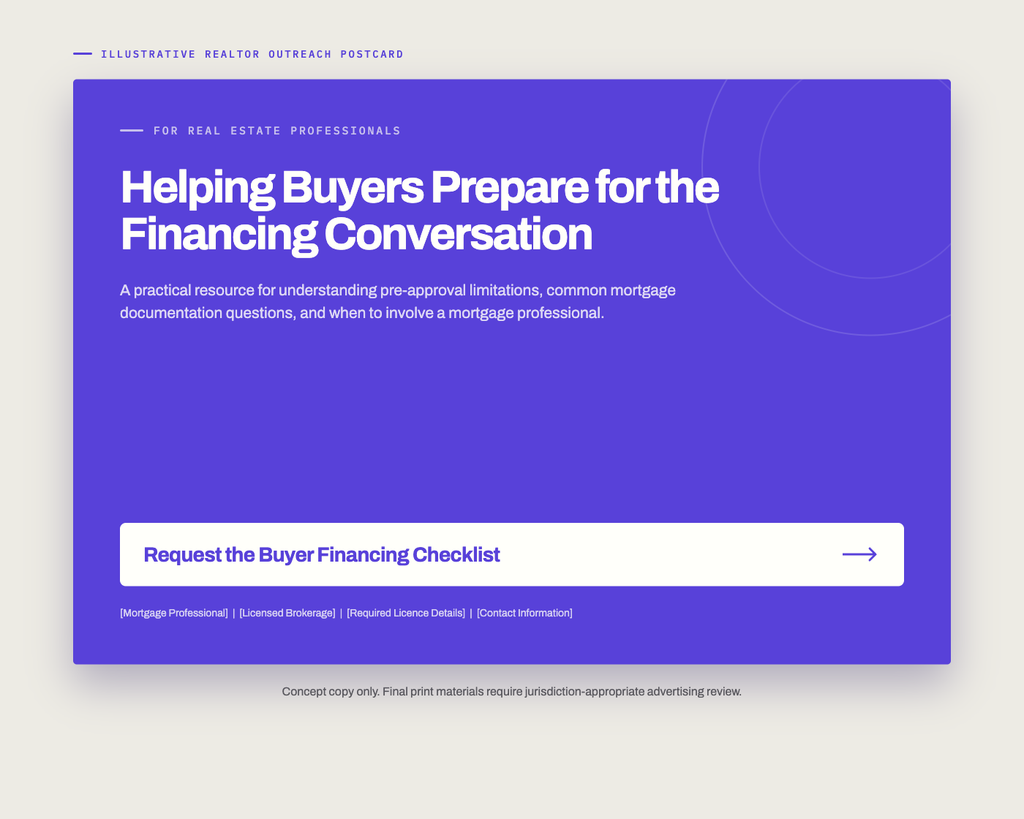
The postcard could direct interested professionals to a landing page containing the promised checklist.
The landing page should explain who created the resource, what information it covers, and whether requesting it also involves subscribing to future communication.
Keep the Design Professional and Uncluttered
Postcards have limited space, so the message should be concise.
Use readable typography, a relevant headline, recognizable contact information, and one clear next step.
A QR code can help connect the printed material to a digital resource, but it should be tested before distribution.
Avoid excessive financial claims or rates that may change before the postcard reaches recipients.
Where required, licensing information should be visible and compliant rather than hidden in unreadable fine print.
Track Responses Rather Than Distribution Alone
A postcard campaign should not be considered successful simply because hundreds of cards were delivered.
Use a dedicated landing page, identifiable QR code, or campaign-specific enquiry process to understand whether real estate professionals respond.
The more useful outcome is whether the campaign leads to meaningful professional conversations and appropriate future introductions.
Building a Realtor Referral System That Is Consistent and Measurable
Networking without a follow-up process can produce an extensive contact list but few meaningful relationships.
A referral system should track the development of professional partnerships while respecting the independence of each party.
At SuperKreatives, we recommend a five-stage framework.
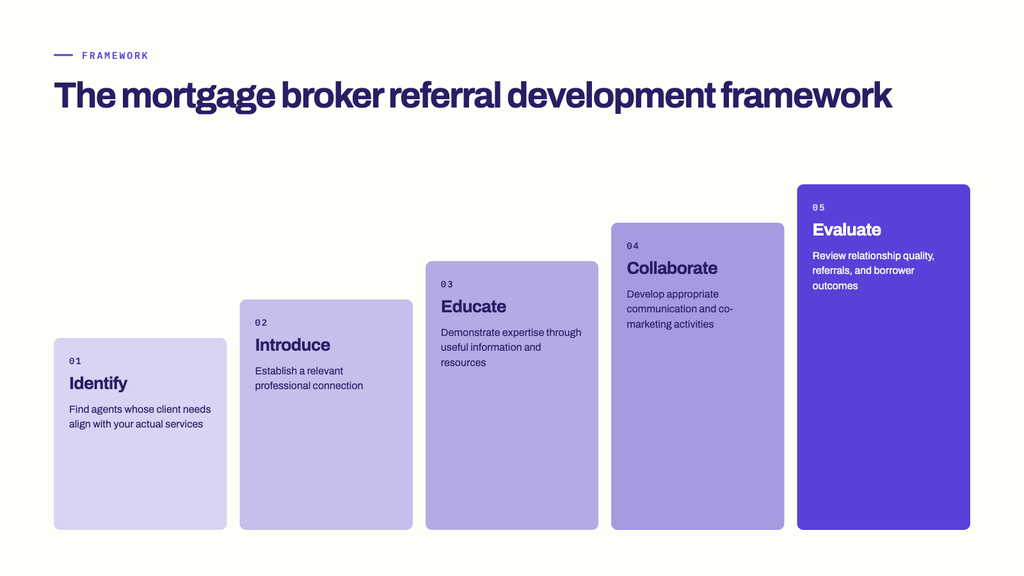
Track Relationship Progress in a CRM
A mortgage brokerage can use its CRM to record professional contacts, relevant business interests, meetings, educational sessions, and legitimate referral sources.
This helps maintain continuity when different team members participate in relationship management.
However, the CRM should not become a repository of client information shared without authorization.
Before transferring borrower contact details between professionals, confirm an appropriate legal basis and ensure relevant consent and privacy obligations are met.
Define a Responsible Referral Handoff
A referral process should clearly establish whether the client has agreed to be contacted by the mortgage professional.
Where practical, the real estate agent can introduce the broker and allow the borrower to decide whether to initiate communication.
A borrower who chooses to contact the broker directly retains greater control over the information initially shared.
Once the relationship begins, the mortgage professional should explain their own services, obligations, and next steps.
The real estate professional should not be given access to confidential mortgage application details merely because they made the introduction.
Evaluate the Quality of Relationships
Not every professional connection will become an active referral source.
A brokerage can evaluate the usefulness of its partnership efforts by reviewing legitimate introductions, consultations, and client outcomes.
It should also consider the quality of communication and whether the relationship supports a positive borrower experience.
A professional who sends occasional well-matched referrals may be more valuable than someone who shares numerous contacts without verifying that those people want mortgage assistance.
The emphasis should remain on suitability and client choice rather than raw referral volume.
Canadian Referral Fees, Disclosure Requirements, and Compliance
Referral fees and incentives require careful consideration because mortgage and real estate services are regulated across Canadian jurisdictions.
Mortgage brokers should not assume that offering cash, gifts, marketing support, or other benefits in exchange for referrals is automatically permissible.
The relevant rules depend on the province, the licence and role of each participant, the nature of the activity, and the arrangements between brokerages.
Ontario Referral Requirements
Ontario’s Financial Services Regulatory Authority of Ontario (FSRA) explains that mortgage brokerages may pay fees for certain simple referrals made by unlicensed individuals or businesses, where the activity falls within the applicable exemption.
However, more involved activities may require licensing, and disclosure obligations apply to remuneration and other benefits.
A simple referral is not permission for an unlicensed real estate professional to arrange a mortgage. FSRA also specifies that referral-related payments between licensed mortgage brokerages must be handled through the brokerages rather than paid directly to individual mortgage agents or brokers.
Ontario’s Real Estate Council of Ontario (RECO) also requires agents to disclose relevant direct or indirect financial benefits to clients. It states that real estate agents cannot receive payment directly from sources other than their employing brokerage.
This makes brokerage approval and the appropriate disclosures essential considerations before establishing any compensated referral arrangement.
British Columbia Referral Requirements
The BC Financial Services Authority (BCFSA) describes obligations under its mortgage services regulatory framework concerning referrals, client consent, payment through brokerages, and recordkeeping.
Its December 2025 guidance states that referrals involving mortgage service licensees require explicit client consent, and benefits related to referrals must be handled and disclosed according to the applicable requirements.
BCFSA‘s guidance for real estate professionals also recommends providing clients with a choice of qualified service providers rather than treating a single referral as the only available option.
Alberta and Other Canadian Provinces
Alberta’s Real Estate Council of Alberta (RECA) emphasizes that benefits associated with professional recommendations can include referral fees, marketing allowances, gifts, and other incentives.
Its guidance stresses that compensation arrangements should involve the brokerage and that consumers should be informed about relevant financial benefits.
Mortgage professionals operating elsewhere in Canada must review the requirements of their applicable provincial regulator.
The safest starting point is to build partnerships around professional value and client service, not referral payments. Any proposed compensation arrangement should be reviewed by the responsible brokerages and qualified compliance advisers before implementation.
A 90-Day Realtor Referral Marketing Plan for Mortgage Brokers
A structured plan can help mortgage professionals develop referral relationships without relying on occasional networking events or last-minute outreach.
The first three months should establish a focused contact list, demonstrate useful expertise, and build a consistent process for managing interested professional relationships.
| Timeline | Primary focus | Recommended activities |
| Days 1–30 | Research and introductions | Identify suitable agents, review professional alignment, prepare educational resources, and begin compliant outreach |
| Days 31–60 | Relationship development | Arrange meetings, deliver relevant educational sessions, share approved resources, and establish communication expectations |
| Days 61–90 | Collaboration and measurement | Test suitable co-marketing activities, review relationship engagement, and improve the referral handoff process |
During the first month, prioritize quality over volume. A targeted selection of professionals whose clients align with the brokerage’s services is more useful than an unfiltered database of real estate contacts.
In the second month, focus on substantive conversations.
Ask agents what financing-related questions frequently arise during their transactions and identify where the mortgage brokerage can provide legitimate assistance.
By the third month, assess whether the relationships have developed beyond introductions.
A partner who participates in an educational workshop or discusses a practical communication process may represent more meaningful progress than someone who simply accepts a business card.
Ninety days should be viewed as an initial relationship-building period, not a guarantee of referral volume.
Measuring Realtor Referral Marketing Performance
Professional referral development needs a different measurement approach from paid digital advertising.
An agent may take months to make a first introduction. Other relationships may become active sooner because the professionals already work with similar client groups.
Performance should therefore be assessed across relationship development and client outcomes.
| Metric | What it helps evaluate |
| Relevant professional contacts | Number of potentially suitable agent relationships identified |
| Meaningful conversations | Whether introductions progress beyond initial outreach |
| Educational engagements | Participation in workshops, meetings, or relevant resource discussions |
| Consented client referrals | Legitimate borrower introductions |
| Qualified consultations | Referrals that result in suitable mortgage conversations |
| Funded mortgage outcomes | Completed transactions attributable to eligible referral relationships |
| Repeat professional engagement | Whether the relationship continues to provide mutual professional value |
For example, suppose a broker establishes 20 relevant professional connections over three months. Six develop into ongoing conversations, three eventually make permitted client introductions, and two introductions result in qualified consultations.
These hypothetical figures do not establish an industry benchmark. They illustrate why the number of contacts alone cannot demonstrate referral programme effectiveness.
The brokerage should also consider the effort required to maintain relationships and whether the resulting enquiries align with the services it offers.
Common Mistakes Mortgage Brokers Make When Marketing to Realtors
One of the most common mistakes is asking for referrals before establishing professional value.
An agent needs a reason to feel comfortable introducing a client. Generic promises and frequent promotional messages rarely provide enough information.
Another mistake is approaching every real estate professional with the same pitch, regardless of market or client needs.
A broker specializing in complex self-employed applications should communicate that capability to relevant agents instead of distributing identical messages to an entire city.
Mortgage professionals should also avoid promising approvals, guaranteed rates, or financing outcomes that depend on lender decisions and individual circumstances.
Poor communication after a referral is another concern. If a client consents to an introduction but receives no response, the experience may affect both the mortgage professional and the real estate agent.
Finally, referral relationships should never override the borrower’s interests.
A mortgage recommendation must remain appropriate to the client’s needs and circumstances, regardless of any professional connection or compensation arrangement. Ontario’s FSRA specifically identifies suitability and conflicts of interest among the core obligations of mortgage brokerages.
Final Thoughts: Make Yourself a Valuable Professional Contact
The most sustainable approach to mortgage marketing to realtors is not convincing as many agents as possible to send leads.
It is earning the confidence of professionals whose clients may genuinely benefit from your mortgage expertise.
Canadian mortgage brokers can strengthen those relationships by explaining financing considerations clearly, participating in appropriate educational initiatives, responding consistently, and maintaining professional boundaries.
Postcards, newsletters, workshops, social media, and networking events can all support this process. However, none of these activities replaces the credibility established through actual professional conduct.
At SuperKreatives, our perspective is that effective referral marketing should be built as a long-term business development system, not an occasional lead-generation exercise.
Start with the real estate professionals whose audiences align with your services. Identify the questions their clients commonly face, demonstrate how your expertise can help, and establish a clear process for appropriate introductions.
When relationships are built around client needs, trustworthy communication, and consistent professional value, referrals can become a meaningful part of a mortgage brokerage’s acquisition strategy.
Frequently Asked Questions
What are the best ways mortgage brokers market to realtors in Canada?
Effective approaches include professional networking, educational workshops, financing guides, relevant co-marketing activities, and consistent communication. Mortgage professionals should focus on demonstrating expertise and reliability before requesting referrals. Any compensation or information-sharing arrangement must comply with applicable provincial requirements.
How can a new mortgage broker build relationships with real estate agents?
Begin by identifying agents whose clients align with the mortgage services you actually provide. Make a professional introduction, explain your expertise, and offer relevant educational resources. Focus on building familiarity through useful interactions instead of immediately asking agents to send business.
What are effective mortgage marketing ideas to realtors?
Practical ideas include first-time buyer seminars, pre-approval education, financing condition checklists, co-branded videos, and professional newsletters discussing relevant mortgage developments. Each initiative should benefit the audience and remain consistent with the participants’ licensing and advertising obligations.
Can mortgage brokers pay real estate agents for referrals in Canada?
Certain referral compensation arrangements may be permitted, but the rules vary by province and circumstances. Licensing exemptions, brokerage payment requirements, client disclosures, and consent obligations may apply. Mortgage professionals should have proposed arrangements reviewed by their brokerage and qualified compliance advisers before offering payment or incentives.
Does a realtor mortgage marketing postcard work?
A postcard can help introduce a mortgage professional or promote a useful educational resource. It is most effective when directed toward a relevant audience with a clear message and response mechanism. Results should be evaluated through meaningful professional conversations rather than the number of cards distributed.
How often should mortgage brokers contact real estate referral partners?
There is no universally appropriate frequency. Communication should reflect the relationship, mutual expectations, relevant developments, and applicable consent requirements. Providing occasional useful information is generally more constructive than repeatedly sending generic promotional requests.
Should mortgage brokers and real estate agents create content together?
Co-branded educational content can be useful when each professional contributes expertise within their permitted role. Possible subjects include homebuying preparation, financing conditions, and the difference between pre-approval and final approval. Content should be reviewed for accuracy, branding requirements, client privacy, and regulatory compliance.
How long does it take to build a reliable realtor referral network?
Referral relationships develop at different rates. Some professionals may begin collaborating after a few relevant conversations, while others need more time to evaluate the mortgage broker’s communication and service approach. Consistency, credibility, and appropriate client outcomes are more meaningful than a fixed timeline.